
When the Crowd Comes to the Library: How Community Institutions Navigate Protest and Civil Unrest
Disclaimer: No bias is intended in the writing of this article, this is purely informational and no reflection of LibLime or its affiliates.
Public libraries are built to be neutral ground — open to anyone, funded by everyone, and designed around the idea that information belongs to the public rather than to any faction of it. That neutrality is now being tested. Across the country, libraries have become default staging grounds for demonstrations, not because they seek the role, but because they are often the largest free civic space in town: a public building with meeting rooms, sidewalks, and, frequently, the city council chamber itself. The Henry Ford Centennial Library in Dearborn, Michigan — dedicated in 1969 as a memorial to Henry Ford, built with a $3 million grant from the Ford Foundation, and serving as the main branch of the Dearborn Public Library system [8] — offers a recent and vivid example of what that looks like when tensions boil over.
A Case Study: Dearborn, August 2026
On August 18, 2026, roughly 2,000 protesters and counter protesters converged on the Henry Ford Centennial Library, the main branch of the Dearborn Public Libraries and, that night, the relocated site of a city council meeting, after a Christian nationalist demonstration was led by Jan. 6 participant Jake Lang [1]. The demonstration, promoted online as a “Christian Crusader March,” was organized in part by Lang alongside Detroit pastor Lorenzo Sewell [6]. Organizers had floated the possibility of tens of thousands of attendees, though the crowd that actually assembled by mid-afternoon was considerably smaller [7].
Dearborn officials made a deliberate operational choice: rather than trying to keep the demonstration away from the library, they moved the council meeting itself there, anticipating the size of the crowd [7]. Michigan State Police coordinated directly with Dearborn police to help manage the event, and city leadership took the additional step of asking the state attorney general’s hate-crime unit to get involved, while publicly acknowledging that the First Amendment likely still protected the protesters’ speech [7].
Inside the building, officers restricted entry once capacity concerns arose, letting only a limited number of people into the meeting while demonstrators remained outside [6]. Security measures extended to the library’s roofline, with officers stationed above the crowd during the demonstration [2]. When barriers were breached and confrontations escalated, arrests followed both outside the building and during the meeting itself, after one speaker tore pages from a Quran during public comment and was removed by police [2]. By the next day, Dearborn police confirmed a total of 22 arrests, of people ranging in age from 18 to 64 and traveling from as far as New York and Tennessee [2].
Notably, city leaders tried to head off the confrontation before it happened. Dearborn’s mayor, its police chief, and regional Christian leaders held a joint appearance the day before the protest to call for calm and urge residents to reject hatred [7], and officials encouraged residents to stay away from the demonstration rather than confront it directly [7]. Mayor Abdullah Hammoud used his own remarks inside the meeting to push back on the protest’s framing of the majority-Muslim, Arab American city, arguing that portraying Dearborn as overtaken by Muslims amounted to an attack on its Muslim and Arab communities [4].
The Broader Policy Framework
Dearborn’s approach reflects a pattern that has developed across American public libraries over the past decade, formalized in written protest policies and professional guidance from organizations like the American Library Association (ALA). The starting legal principle is consistent: libraries are public institutions bound by the First Amendment, but that does not obligate them to host demonstrations inside their walls. The ALA advises that library administrators should make clear to organizers that indoor protest is not a guaranteed right, even as outdoor assembly on public sidewalks is constitutionally protected [11]. Model policies, such as the one adopted by Northland Public Library in Pennsylvania, direct staff to keep communication channels open with protest organizers, ask them to maintain a tone of civil discourse, and involve law

https://www.ala.org/advocacy/intfreedom/controversialprogramsqa
enforcement as soon as violence appears likely or multiple opposing groups plan to converge [10].
Operationally, that guidance translates into a fairly standard playbook: establishing occupancy limits and clear emergency-exit routes in advance, training staff to de-escalate rather than confront, documenting incidents for potential legal follow-up, and pre-negotiating criteria for when a temporary closure becomes necessary rather than deciding in the moment [9]. Some library systems have gone further. Advisories issued to public libraries in Ireland, prompted by aggressive far-right demonstrations, recommended designated staff “safe rooms,” panic buttons, lone-worker alert devices, and signage barring recording inside the building [14].
This is not an entirely new phenomenon for libraries, even if the frequency has increased. Researchers examining the library response to the 2014 Ferguson protests after the shooting of Michael Brown found that the Ferguson Municipal Public Library reoriented its services around the crisis rather than closing its doors — hosting displaced students when schools shut down, connecting local businesses to emergency aid, and providing mental health and civil rights resources, with then-director Scott Bonner describing the building as a refuge for the whole community during the unrest [13]. That episode has since become something of a reference point in library science for how an institution can absorb civil unrest without abandoning its core public function.
Why Libraries Keep Ending Up in the Middle
Part of the reason libraries increasingly find themselves at the center of these confrontations is structural. They are frequently the largest, most centrally located public buildings available for civic functions, which is precisely why Dearborn’s city council relocated its meeting to the Henry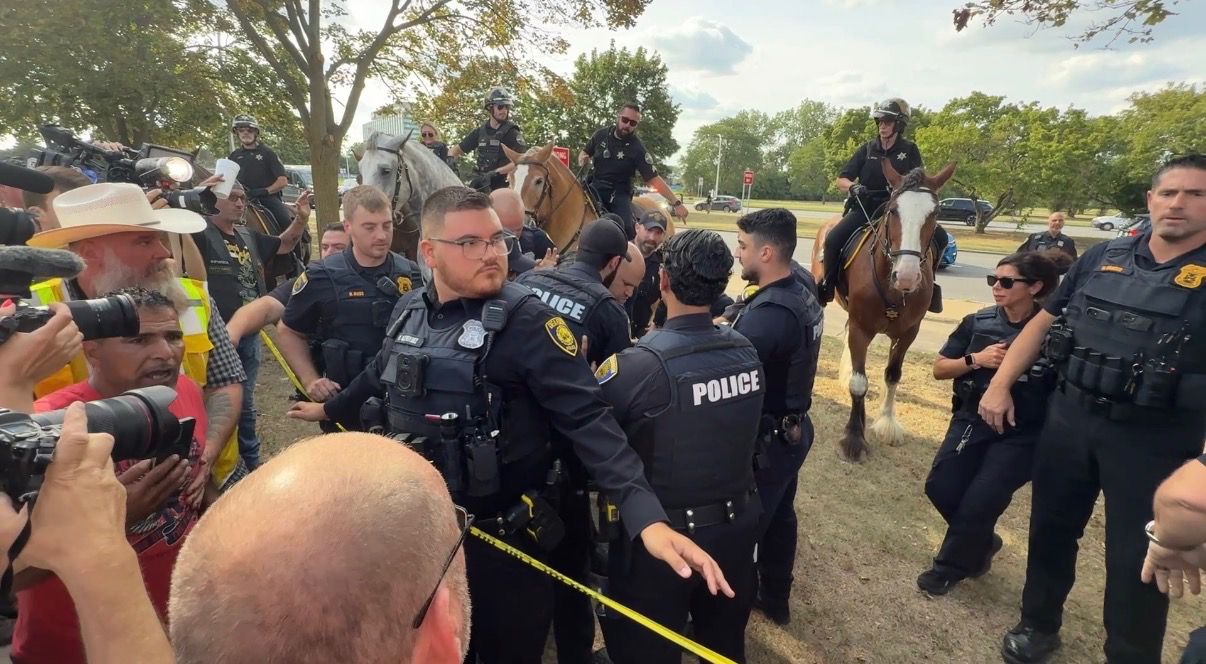
Taken together, these episodes suggest that community libraries occupy a genuinely difficult institutional position: legally obligated to remain viewpoint-neutral, physically exposed as open public buildings, and increasingly treated as symbolic battlegrounds by groups on multiple sides of the country’s political and cultural divides. The response from libraries like Dearborn’s — heavy coordination with police, advance communication with organizers, public calls for de-escalation from elected officials, and a refusal to simply shut the doors — reflects an attempt to hold that neutral, service-oriented identity together even when the crowd outside has no interest in neutrality at all.
Sources
- Michigan Advance, “Christian nationalist protest led by Jan. 6 rioter stokes tensions in Dearborn,” Aug. 19, 2026. https://michiganadvance.com/2026/08/19/christian-nationalist-protest-led-by-jan-6-rioter-stokes-tensions-in-dearborn/
- Spectrum News 1, “22 people were arrested during an anti-Islam demonstration in Dearborn,” Aug. 19, 2026. https://spectrumlocalnews.com/mi/michigan/news/2026/08/19/dearborn-protests-august-18
- ClickOnDetroit/WDIV Local 4, “Protest draws large crowd, riot police, several arrests outside Dearborn City Council meeting,” Aug. 19, 2026. https://www.clickondetroit.com/video/news/2026/08/19/protest-draws-large-crowd-swat-response-several-arrests-outside-dearborn-city-council-meeting/
- FOX 2/FOX 9, “Dearborn protest: Jake Lang’s anti-Islam message draws Nazi sympathizers, large demonstration,” Aug. 2026. https://www.fox9.com/news/dearborn-protest-jake-lang-council-meeting-henry-ford-centennial-library
- ClickOnDetroit/WDIV Local 4, “Several arrested during controversial Dearborn protest,” Aug. 19, 2026. https://www.clickondetroit.com/video/news/2026/08/19/several-arrested-during-controversial-dearborn-protest/
- ClickOnDetroit/WDIV Local 4, “Protest draws large crowd, riot police response, several arrests outside Dearborn City Council meeting,” Aug. 19, 2026. https://www.clickondetroit.com/news/local/2026/08/19/protest-draws-large-crowd-swat-response-several-arrests-outside-dearborn-city-council-meeting/
- ClickOnDetroit/WDIV Local 4, “Large police presence in Dearborn as crowds gather ahead of planned protest,” Aug. 18, 2026. https://www.clickondetroit.com/news/local/2026/08/18/large-police-presence-in-dearborn-as-crowds-gather-ahead-of-planned-protest/
- Dearborn Public Library, “History of the Dearborn Public Library.” https://dearbornlibrary.org/general-information/history-of-the-dearborn-public-library/
- Liblime, “Library Responsibilities During Protests and Civil Unrest,” June 14, 2025. https://liblime.com/2025/06/14/library-responsibilities-during-protests-and-civil-unrest/
- Northland Public Library, “Protest/Demonstration Policy.” https://www.northlandlibrary.org/about-northland/general-policies/protest-demonstration-policy/
- American Library Association, “Responding to and Preparing for Controversial Programs and Speakers Q&A.” https://www.ala.org/advocacy/intfreedom/controversialprogramsqa
- Berkeley Political Review, “Public Libraries Are Becoming Battlegrounds and the Damage Goes Far Beyond Books,” May 1, 2026. https://berkeleypoliticalreview.org/2026/05/01/public-libraries-are-becoming-battlegrounds-and-the-damage-goes-far-beyond-books/
- James Madison University Commons, “Libraries on the Frontlines: Neutrality and Social Justice.” https://commons.lib.jmu.edu/cgi/viewcontent.cgi?article=1110&context=letfspubs
- PressReader/Irish Daily Star, “Take cover… call for library ‘safe rooms’: Security fears over far-right [protests].” https://www.pressreader.com/ireland/irish-daily-star/20240215/282218015705919