
The Best Baby Books for Infants
The best baby books for infants are sturdy, simple, and made to be shared: high-contrast books for newborns, then bright board books with faces, textures, flaps, and rhythmic text as babies grow. The right book matters less than the habit of reading together every day, starting at birth.
That advice now comes straight from pediatricians. In 2024, the American Academy of Pediatrics (AAP) updated its literacy policy for the first time since 2014, urging parents to read aloud with newborns and asking pediatricians to hand out books and guidance at well-child visits [1]. The AAP frames shared reading as a positive parenting practice that builds the foundation for social-emotional, cognitive, language, and literacy development [1]. This guide covers what recent research says, what to look for in a first book, and a short list of titles worth owning.
What the Research Says
Babies who are read to more often tend to know more words, and the link shows up well before their first birthday. A pre-registered Norwegian study of 1,442 infants found that more frequent shared reading was associated with larger  vocabularies at both 12 and 24 months [2]. The association was strongest among 12-month-olds from lower-income families, which suggests books may help close early language gaps [2]. The same study linked more daily screen time to smaller vocabularies at 24 months [2].
Starting early appears to matter. A U.S. study of 286 mothers and fathers from diverse backgrounds found that reading with 9-month-olds, both how often and how interactively, was associated with stronger language skills at 18 months [3]. The authors concluded that programs should encourage both parents to read often during the first year [3]. A Greek study of 740 children aged 6 to 36 months reached a similar conclusion: both the quantity and the quality of shared reading had large effects on communication and language [4].
The type of book also shapes the conversation. A 2026 study filmed 52 children aged 6 months to 3 years across 557 home reading sessions with five kinds of books [5]. Narrative and concept books kept sessions going longer and drew more communication from children, while narrative picture books prompted more word combinations than concept or texture books [5]. More than half of children’s communication during reading involved pointing to share attention with the adult [5].
What Makes A Good Infant Book
A good first book matches what a baby can see and do at each stage. Choose by age rather than by the label on the box.
- Birth to 3 months: high contrast and faces. Newborns focus best on objects about 6 to 10 inches away and probably cannot see subtle color differences until 2 to 3 months [6]. Faces are their favorite thing to look at, and they also like bold patterns such as checkerboards and bull’s-eyes [6]. Black-and-white books, especially accordion

https://www.healthychildren.org/English/ages-stages/baby/Pages/Babys-Vision-Development.aspx
or tummy-time formats that stand up on their own, suit this stage.
- 3 to 6 months: color, mirrors and rhythm. As color vision develops, brighter books take over. Mirrors, simple photos of babies and sing-song text hold attention while babies begin grabbing and mouthing.
- 6 to 12 months: sturdy, interactive and talkable. Thick board pages survive chewing and give small hands practice turning pages. Simple stories and concept books with one clear object per page invite pointing and naming, the kind of back-and-forth the 2026 study observed [5].
A note on textures and flaps: they help babies engage, but they can also distract. In a lab study, infants of 14 to 20  months learned a new word less often from a touch-and-feel book than from a plain one [7]. Yet in a six-week home trial with 200 infants, a textured book did slightly better, likely because it kept babies interested over repeated readings [7]. The takeaway is to mix interactive books with plain ones, and to keep talking about the pictures either way.
Print still beats screens for this age. The AAP’s 2024 guidance supports limited screen use in early childhood, emphasizes print books, and recommends back-and-forth interaction if digital books are used [1].
The best baby books to start with
The list below mixes standout newer titles chosen by children’s librarian Betsy Bird for School Library Journal with long-loved classics [8, 9]. It is sorted from the youngest babies up.
| Book | Author | Best age | Why it works |
| Baby Faces | Steph Stilwell | 0–12 months | Accordion book with black, white and red faces on one side and baby photos plus a mirror on the other, so it grows with the baby [8] |
| Play! and Touch! | Pascale Estellon | 0–6 months | Black-and-white tummy-time accordion books with patterns that are also textured [8] |
| My Animal Sounds | Xavier Deneux | 0–6 months | High-contrast animals with a press-to-hear sound on each page [8] |
| Cuddly Sheep | Ingela P. Arrhenius | 0–9 months | Cloth book that combines high contrast, felt flaps and a mirror [8] |
| Whose Eyes? and Whose Nose? | Kristina Jones | 0–9 months | Black-and-white art with one accent color and detailed patterns [8] |
| Tummy Time: Park | Louise Lockhart | 4+ months | Fold-out book with animal faces and a mirror, in softer colors for older babies [8] |
| Together Time series | Ailie Busby | 3–12 months | Nursery rhymes with prompts for actions to do with your baby [8] |
| Where Is Baby’s Belly Button? | Karen Katz | 6–12 months | Lift-the-flap game that teaches body parts [9] |
| Brown Bear, Brown Bear, What Do You See? | Bill Martin Jr. | 6–12 months | Predictable rhythm that teaches animal and color words [9] |
| Goodnight Moon | Margaret Wise Brown | 6–12 months | Quiet, repetitive text that fits a bedtime routine [9] |
For more vetted titles, the Bank Street College of Education’s Children’s Book Committee publishes an annual annotated list of the best board books for ages 0 to 4 [10].
How to read with an infant
How you read matters as much as what you read. The research above found that interactive reading, not just frequent reading, predicted stronger language [3, 4].
- Start at birth and read every day. The AAP recommends shared reading from birth, including in the NICU when possible [1]. A few minutes a day is enough.
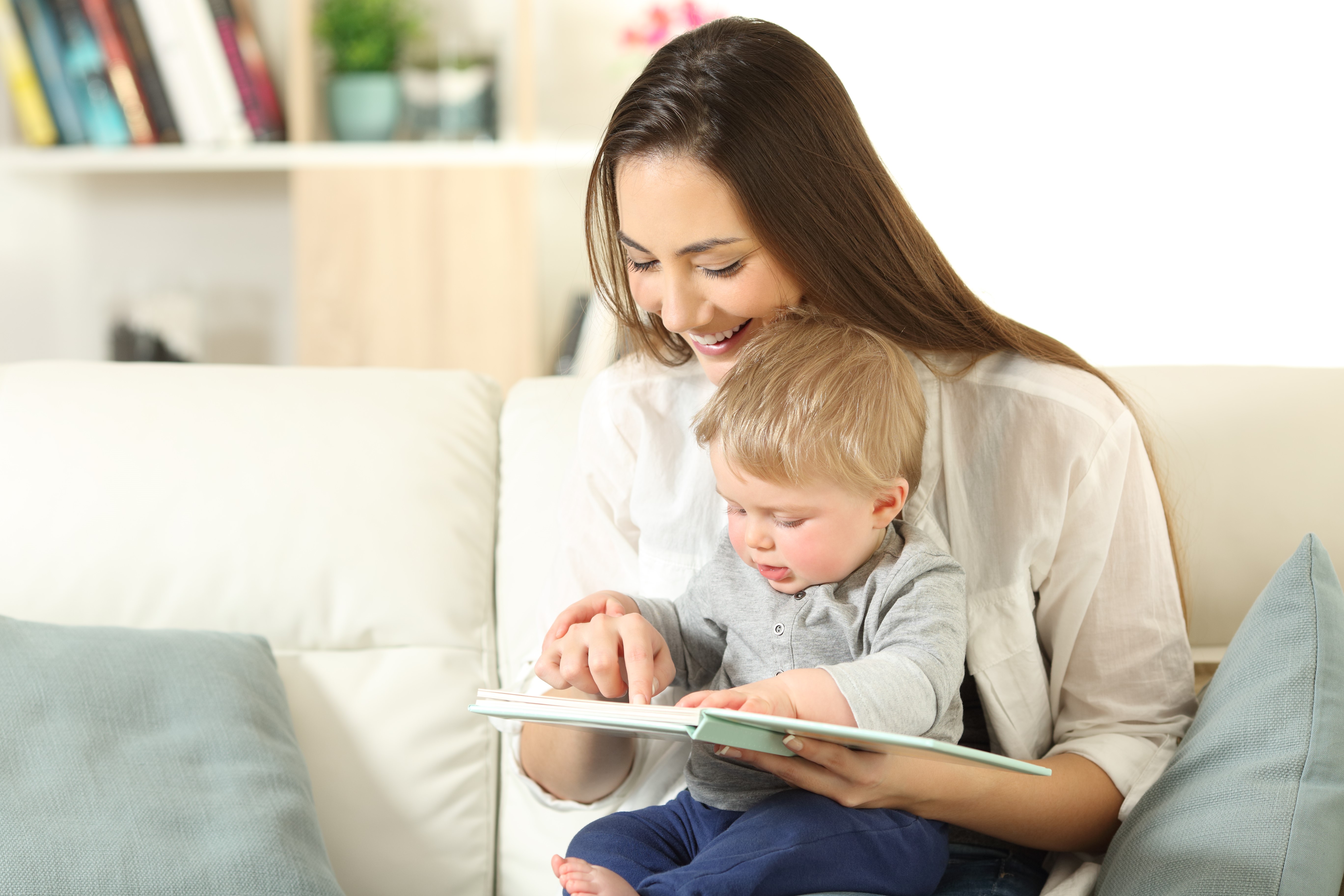
- Talk beyond the words. Name what your baby looks at, describe it, and ask simple questions, even before your baby can answer [3, 4].
- Follow the point. When your baby points at a picture, they are inviting you to share attention, so name it and respond [5].
- Repeat favorites. Repeated readings help babies stay engaged and learn, especially with interactive books [7].
- Share the job. Both mothers and fathers contribute to language growth, so let every caregiver take a turn [3].
- Keep it joyful. The AAP describes the goal as mutually joyful reading that fits the child’s stage [1]. Stop when your baby loses interest and try again later.
The best baby book is the one you will actually pick up together. Start with a high-contrast book in the newborn weeks, add bright board books and rhymes as your baby grows, and keep talking about every page.
References
- American Academy of Pediatrics. (2024). Beyond literacy: Shared reading starting at birth offers lifelong benefits. HealthyChildren.org. https://www.healthychildren.org/English/news/Pages/beyond-literacy-shared-reading-starting-in-infancy-offers-lifelong-benefits.aspx
- Rosslund, A., Kartushina, N., & Mayor, J. (2025). Associations between shared book reading, daily screen time and infants’ vocabulary size. Journal of Child Language, 52(4), 971–983. https://doi.org/10.1017/S0305000924000291
- Chen, Y., Cabrera, N., Sudduth, C., & Reich, S. M. (2024). Contributions of mothers’ and fathers’ shared book reading with infants at 9 months to language skills at 18 months in ethnically and socioeconomically diverse families. Infant and Child Development, 33(5), e2516. https://pmc.ncbi.nlm.nih.gov/articles/PMC12349905/
- Karousou, A., & Economacou, D. (2024). Quantity and quality of book reading to infants and toddlers: Their effect on early communication and language development. Psychology: The Journal of the Hellenic Psychological Society, 29(1), 1–27. https://ejournals.epublishing.ekt.gr/index.php/psychology/article/view/34486
- Frequency, form, and function of child communication during early shared book reading experiences. (2026). Journal of Speech, Language, and Hearing Research, 69(7), 3127–3148. https://doi.org/10.1044/2026_JSLHR-25-00614
- American Academy of Pediatrics. (n.d.). Your baby’s vision: 1 month. HealthyChildren.org. https://healthychildren.org/English/ages-stages/baby/Pages/Your-Baby’s-Vision-1-Month.aspx
- Royal Holloway, University of London. (2025, August 13). UK study reveals insights into how touch-and-feel books affect infants’ learning. https://venue.royalholloway.ac.uk/about-us/news/uk-study-reveals-insights-into-how-touch-and-feel-books-affect-infants-learning
- Bird, B. (2025, December 1). 31 days, 31 lists: The great board books of 2025. A Fuse #8 Production, School Library Journal. https://afuse8production.slj.com/2025/12/01/31-days-31-lists-the-great-board-books-of-2025/
- Taylor, M. (2023). Best board books for babies. Imagination Soup. https://imaginationsoup.net/best-board-books-babies-toddlers/
- Bank Street College of Education, Children’s Book Committee. (2025). The best board books of the year (2025 ed.). https://educate.bankstreet.edu/ccl/30