The Information Age Reimagined, Part 2: Who Governs the Machines?
https://www.un.org/global-dialogue-ai-governance/sites/default/files/2026-06/Updated%20MEDIA%20ADVISORY%20-%20AI%20Dialogue.pdf
When hundreds of millions of people use AI every day, the question is no longer whether to govern it but who does, and how well. Between mid-2025 and late 2026, the world’s major powers constructed three different answers: Europe wrote a binding rulebook and then slowed its rollout, the United States moved to centralize authority in Washington and push back on state laws, and China paired strict domestic controls with a bid to lead global rules. Meanwhile, the United Nations launched its first permanent forum for AI governance. Will it all work as intended, though, and be a boon to humanity?
| Date | Milestone |
| July 2026 | First UN Global Dialogue on AI Governance meets in Geneva [16] |
| July 2026 | EU Digital Omnibus enters into force, delaying high-risk AI rules [8] |
| Dec 2025 | U.S. executive order targets state AI laws [1] |
| Sept 2025 | California signs SB 53, the first U.S. frontier-AI safety law [5]; China’s AI content-labeling rules take effect [15] |
| Aug 2025 | EU obligations for general-purpose AI models begin [11]; UN creates Scientific Panel and Global Dialogue [16] |
| July 2025 | China releases its Global AI Governance Action Plan [13]; EU publishes General-Purpose AI Code of Practice [11] |
Europe: Rulebook Meets Reality
The EU AI Act, in force since August 2024, remains the world’s most comprehensive AI law. Its bans on prohibited practices apply from February 2025 and its obligations for general-purpose AI models from August 2025 [8]. To help developers comply, the European Commission published a voluntary General-Purpose AI Code of Practice in July 2025 covering transparency, copyright, and safety [11]. Most major developers signed, but Meta refused, arguing the Code went beyond the Act itself [12].
The bigger shift came with the Digital Omnibus. Proposed in November 2025 and approved by Parliament and Council in June 2026, it pushed back the Act’s high-risk obligations, covering AI used in education, hiring, credit and law enforcement, from August 2026 to December 2027, and to August 2028 for AI embedded in products such as medical devices [8][9]. The official reason was that technical standards were not ready.
The delay shows governance evolving under pressure. Analysts stress that the duties were postponed, not deleted, and that obligations for general-purpose AI models were left untouched [10]. Civil-society groups counter that AI already in use in schools and workplaces now goes unregulated for over a year longer than promised [17].
United States: Washington Versus The States
Without a federal AI law, U.S. states moved first. In September 2025, California enacted SB 53, the Transparency in Frontier Artificial Intelligence Act, the first U.S. law aimed specifically at the most powerful AI models [5]. It requires developers of frontier models, those trained with more than 10²⁶ operations, to publish safety frameworks, report major incidents to the state and protect whistleblowers [6][7]. Unusually, at least one major developer, Anthropic, publicly backed it as transparency without prescriptive technical mandates [6].
The federal government pushed the other way. On 11 December 2025, President Trump signed Ensuring a National Policy Framework for Artificial Intelligence, calling for a “minimally burdensome” national standard [1]. It created a Justice Department AI Litigation Task Force, operating from January 2026, whose sole job is to challenge state AI laws in court [1][2]. It also directed the Commerce Department to list “onerous” state laws and tied some federal broadband funding to states’ AI policies; Colorado’s AI Act was singled out [3].
The order faces legal doubts. An executive order cannot by itself override state law, a point raised even by Republican governors such as Florida’s Ron DeSantis [4]. The result is a governance model being decided as much in courtrooms as in legislatures.
China and the race to set global rules
China combines tight domestic control with an ambitious international agenda. At home, its rules on labeling AI-generated content took effect on 1 September 2025, requiring both visible labels and hidden metadata on AI text, images, audio and video, and making social media platforms responsible for detecting and  enforcing them [15]. It is among the most comprehensive labeling regimes anywhere.
Abroad, China released a 13-point Global AI Governance Action Plan at the World AI Conference in Shanghai in July 2025, days after the White House published America’s own AI Action Plan [13]. Premier Li Qiang proposed a World AI Cooperation Organization, which President Xi Jinping promoted again at APEC in November 2025, with Shanghai floated as its headquarters [14]. China pitches the body as a way to help the Global South close the “AI divide” [14].
The United Nations enters the picture.
The most inclusive new forum is at the UN. In August 2025, the General Assembly created two bodies: an Independent International Scientific Panel on AI and a Global Dialogue on AI Governance [16]. The panel’s 40 experts, chosen from more than 2,600 candidates and co-chaired by AI pioneer Yoshua Bengio and journalist Maria Ressa, issued their first report on 1 July 2026 [18]. At the first Dialogue in Geneva days later, Bengio told governments that science cannot currently guarantee AI will not cause catastrophic harm [19]. The UN model mirrors climate governance: shared evidence first, negotiation second.
Companies as co-regulators
A quieter evolution is the shift of governance into companies themselves. Much of the new law relies on firms to assess and disclose their own risks. The EU Code of Practice asks signatories to evaluate systemic risks such as chemical, biological, and nuclear misuse and loss of control, and to document their models [11]. California’s SB 53 likewise requires large developers to publish their own safety frameworks rather than meet fixed technical standards [6][7].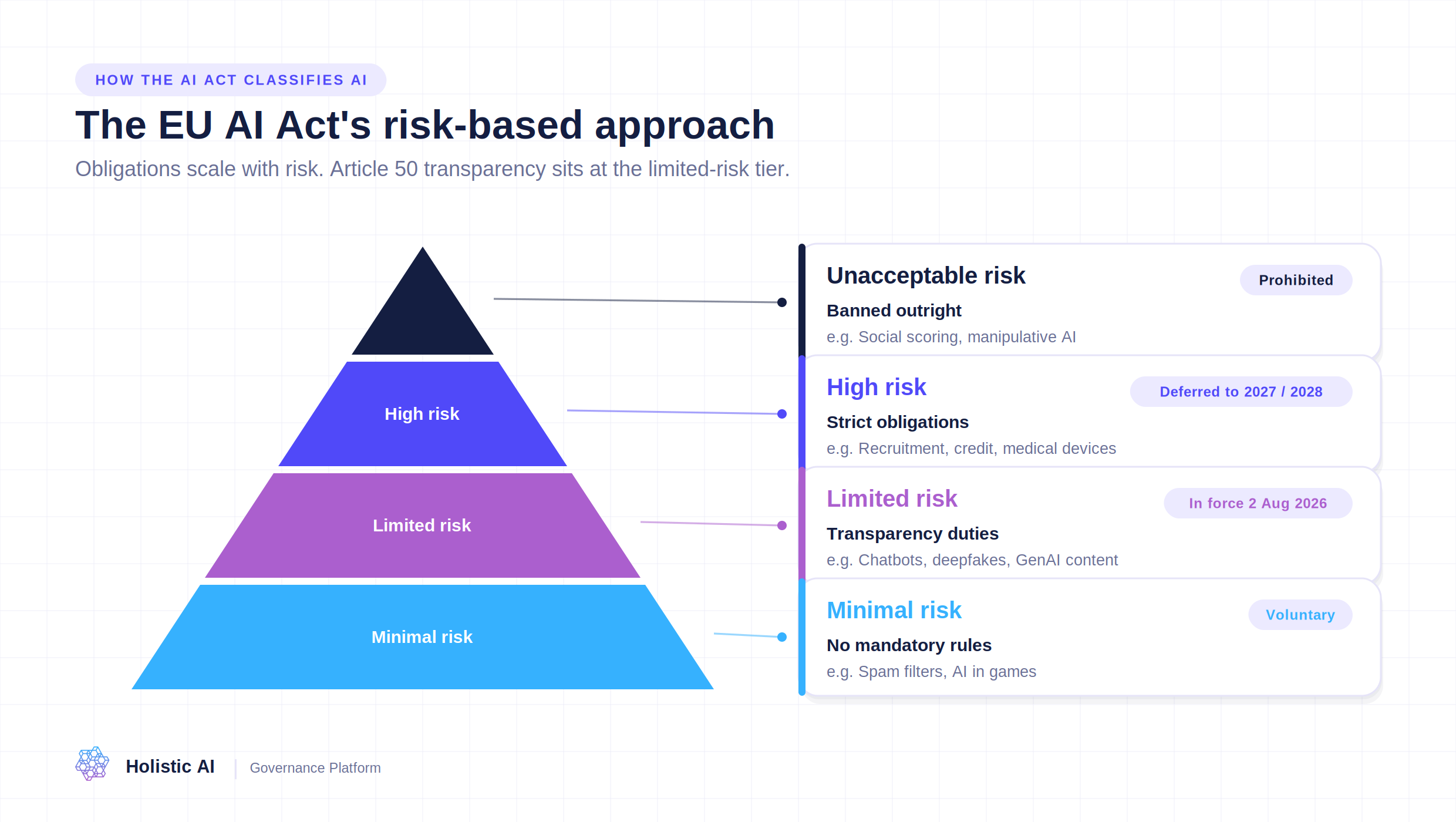
This “trust but verify” model, as California described it [5], gives regulators visibility without freezing a fast-moving technology into rigid rules. But it also means the people being regulated write much of the rulebook, and enforcement depends on regulators who can understand what they are shown.
The positive and negative impacts
Positive impacts
- Transparency is becoming the norm. From EU model documentation [11] to California’s safety-framework disclosures [7] and China’s labeling rules [15], the public is gaining more visibility into how AI is built and when content is synthetic.
- A shared evidence base. The UN Scientific Panel gives all 193 member states, not just AI superpowers, access to independent assessments of AI risk [16][18].
- Flexibility. Delays like the Digital Omnibus let rules wait for workable technical standards rather than imposing requirements no one can yet meet [9].
- Whistleblower protections. SB 53 gives employees inside AI labs legal cover to raise safety concerns [7].
Negative impacts
- Fragmentation. Companies face different regimes in Brussels, Washington, Sacramento, and Beijing, and in the U.S. the rules themselves are contested in court [3][4].
- Delay as a gap. Postponed high-risk rules leave AI in schools, hiring, and lending without its promised safeguards for longer [17].
- Geopolitical rivalry. Competing U.S. and Chinese action plans and institutions risk splitting governance into rival blocs rather than a common floor [13][14].
- Industry capture. Reliance on self-reported safety frameworks risks letting the most powerful firms set the terms of their own oversight [6][11].
- Labeling and surveillance. Traceability rules that fight misinformation can also enable tighter state monitoring of online speech [15].
The governance of technology is evolving from a single question, “should we regulate AI?”, into a layered system: binding law in some places, executive power

https://news.un.org/en/story/2026/07/1167862
and litigation in others, voluntary codes, corporate disclosure, and global scientific review. None of these layers is complete, and they often pull against each other.
The next phase will be decided by implementation: whether the EU’s delayed rules arrive on time, whether U.S. courts uphold or strike down state laws, and whether the UN process can produce shared standards in a world split between rival AI powers. As AI becomes part of everyday information use, governance will increasingly look less like a law passed once and more like infrastructure that must be maintained.
Part 3 turns to the public itself, and to a growing movement, shaped in part by decades of AI films, that is pushing back against the technology altogether.
References
- Seyfarth Shaw. (2025, December 12). President Trump signs executive order preempting state AI laws and centralizing federal oversight. https://www.seyfarth.com/news-insights/president-trump-signs-executive-order-preempting-state-ai-laws-and-centralizing-federal-oversight.html
- Ghavi, A. R., Glucksman, H., & Katsuki, K. (2025, December 16). President Trump signs executive order challenging state AI laws. Paul Hastings. https://www.paulhastings.com/insights/client-alerts/president-trump-signs-executive-order-challenging-state-ai-laws
- Latham & Watkins. (2025, December 17). AI executive order targets state laws and seeks uniform federal standards. https://www.lw.com/en/insights/ai-executive-order-targets-state-laws-and-seeks-uniform-federal-standards
- NPR, via Alaska Public Media. (2025, December 12). Trump is trying to preempt state AI laws via an executive order. It may not be legal. https://alaskapublic.org/news/economy/2025-12-12/trump-is-trying-to-preempt-state-ai-laws-via-an-executive-order-it-may-not-be-legal
- Office of Governor Gavin Newsom. (2025, September 29). Governor Newsom signs SB 53, advancing California’s world-leading artificial intelligence industry. https://www.gov.ca.gov/2025/09/29/governor-newsom-signs-sb-53-advancing-californias-world-leading-artificial-intelligence-industry/
- The Register. (2025, September 30). California lawmakers pretend to regulate AI, create a pile of paperwork. https://www.theregister.com/2025/09/30/california_governor_signs_ai_safety_law/
- StateScoop. (2025, September 29). California Gov. Gavin Newsom signs landmark AI bill. https://statescoop.com/newsom-california-sb-53/
- CASRAI. (2026). Digital Omnibus AI Act: New 2027 deadlines. https://casrai.org/news/digital-omnibus-ai-act
- Process Excellence Network. (2026). EU AI Act 2026: What actually changed and what deployers still must do. https://www.processexcellencenetwork.com/ai/articles/eu-ai-act-2026-what-actually-changed-and-what-deployers-still-must-do
- Holistic AI. (2026). The EU AI Act’s deadline moved to 2027. Yours didn’t. https://www.holisticai.com/blog/eu-ai-acts-deadline-moved-2027
- European Commission. (2025). The General-Purpose AI Code of Practice. Shaping Europe’s Digital Future. https://digital-strategy.ec.europa.eu/en/policies/gpai-code-practice
- CASRAI. (2026). EU AI Act GPAI Code of Practice signatories.https://digital-strategy.ec.europa.eu/en/policies/contents-code-gpai
- American National Standards Institute. (2025, August 1). China announces action plan for global AI governance. https://www.ansi.org/standards-news/all-news/8-1-25-china-announces-action-plan-for-global-ai-governance
- Fudan University Center for Global AI Governance. (2026, June 17). China steps up preparations for World Artificial Intelligence Cooperation Organization.https://cgaig.fudan.edu.cn/f4/db/c54665a783579/page.htm
- Covington & Burling. (2025). China releases new labeling requirements for AI-generated content. Inside Privacy. https://insideprivacy.com/international/china/china-releases-new-labeling-requirements-for-ai-generated-content
- United Nations Secretary-General. (2025, August 26). Statement on the establishment of the Independent International Scientific Panel on AI and the Global Dialogue on AI Governance. https://www.un.org/sg/en/node/271213
- CASRAI. (2026). EU AI Act Digital Omnibus deadline delay. https://www.casrai.org/news/eu-ai-act-digital-omnibus-deadline-delay
- United Nations. (2026, June 15). Global Dialogue on AI Governance: Media advisory.https://www.un.org/global-dialogue-ai-governance/sites/default/files/2026-06/Updated%20MEDIA%20ADVISORY%20-%20AI%20Dialogue.pdf
- AI Weekly. (2026, July). UN opens Geneva AI dialogue as Bengio warns of catastrophic risk [Reporting UN News]. https://aiweekly.co/alerts/un-opens-geneva-ai-dialogue-as-bengio-warns-of-catastrophic-risk