
The Information Age Reimagined, Part 1: AI and the World’s Classrooms

https://discover.carnegielearning.com/hubfs/PDFs/Whitepaper%20and%20Guide%20PDFs/2025-AI-in-Ed-Report.pdf
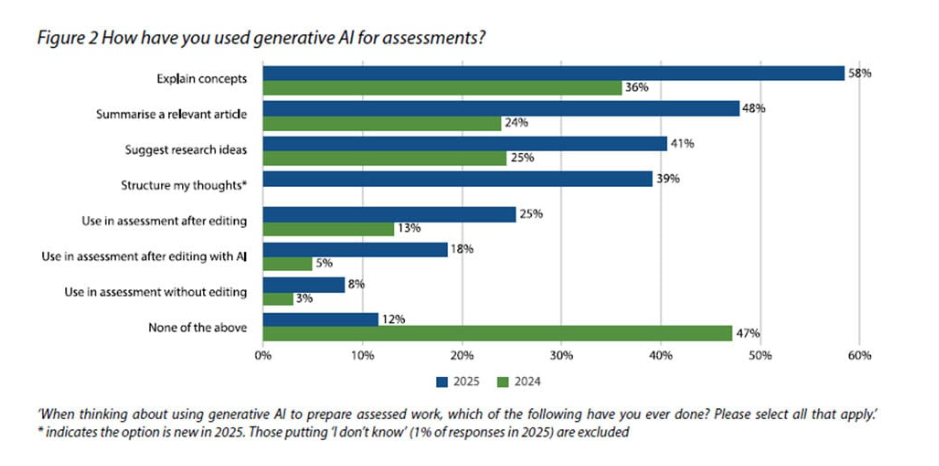
Education was the first sector to feel generative AI at scale, and by 2025 the experiment phase was over. A U.S. survey of 2,003 students, teachers, and parents found that 85% had used AI, up from 66% a year earlier, and that teachers (87%) now outpaced students (84%) [1]. In the United Kingdom, 92% of university students reported using AI in some form in 2025, compared with 66% in 2024 [2].
What changed is not just how many people use these tools but who controls them. The OECD notes that, unlike earlier education technology, most generative AI is free, intuitive and used largely outside any institution’s control [3]. Students arrive with a tutor, essay writer and research assistant in their pocket, whether or not their school has a policy.
This article, the first in a three-part series on how mass AI adoption is reshaping the information industry, examines what that shift means for education systems worldwide: what they stand to gain, what they risk losing, and how countries are responding.
https://www.oecd.org/en/publications/oecd-digital-education-outlook-2026_062a7394-en.html
The Positive Impacts
A tutor for every learner. The strongest evidence for AI in education concerns tutoring. The OECD’s Digital Education Outlook 2026 reports robust evidence that inexperienced tutors improve both the quality of their support and their students’ results when they use education-focused AI tools [3]. AI-powered tutoring systems can move beyond rigid scripts by asking questions, nudging students, and adapting their strategy through natural dialogue [3]. For countries short on qualified teachers, this extends expert-level support to far more students.
Learning that adapts. When AI is used with a clear teaching purpose, the OECD finds sustained learning gains, along with improvements in critical thinking, creativity and collaboration [3]. Students already use it this way: in one 2025 survey of about 1,100 students, 90% had used AI academically, mostly in the early stages of an assignment such as brainstorming and outlining [4].
Relief for overstretched teachers. Teachers are some of the heaviest users. Among lower-secondary teachers in OECD countries, 37% used AI in their work in 2024 and 57% agreed it helps them write or improve lesson plans [3]. U.S. educators most often use it to create teaching materials, while administrators use it to draft communications [5]. Time saved on paperwork is time they can spend with students.
AI literacy as a national skill. Governments increasingly treat AI fluency as economic infrastructure. Estonia’s AI Leap program gave 20,000 upper-secondary students and 4,800 teachers in 154 of its 156 upper-secondary schools access to AI learning tools in its 2025–26 pilot year, with a further 38,000 students joining in 2026–27 [6][7]. Programs like this can narrow gaps between well-resourced and under-resourced schools, provided everyone has access to the tools.
The Negative Impacts
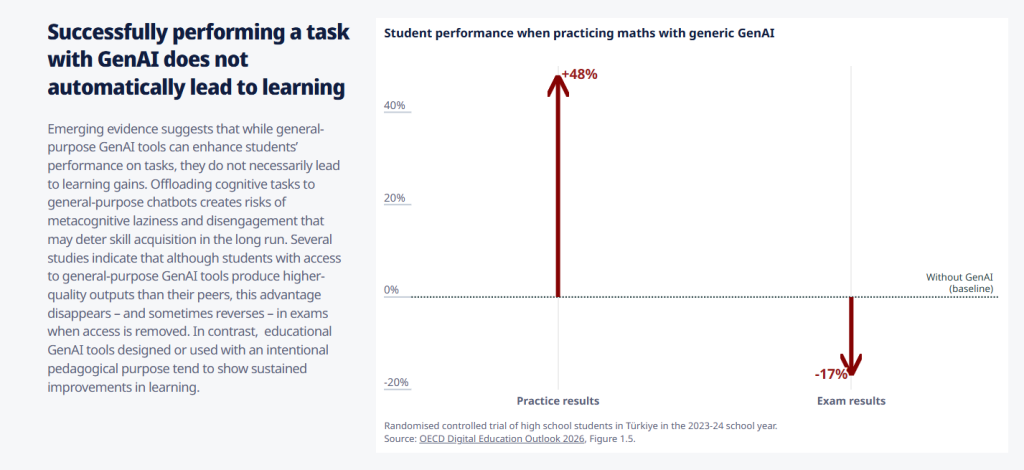
Performance without learning. The most serious risk is that AI improves what students hand in while weakening what they actually learn. The OECD warns that offloading thinking to general-purpose chatbots risks “metacognitive laziness” [3]. Several studies it reviews found that students using such tools produce better work, but that the advantage disappears, and sometimes reverses, in exams once access is removed [3].
“Cognitive debt.” A 2025 MIT Media Lab study tracked 54 participants writing essays with ChatGPT, a search engine, or no tools while their brain activity was recorded by EEG [8]. The ChatGPT group showed the weakest neural connectivity and the least sense of ownership over their essays, and struggled to re-engage when the tool was taken away [8]. The sample was small, and reviewers noted design limitations, but participants who first wrote unaided and then used AI did well, suggesting sequence matters [8].
An integrity crisis. Cheating has become the most visible flashpoint. The share of U.S. educators who reported catching students cheating with AI rose from 53% to 61% in a year [5], and 72% of lower-secondary teachers across OECD systems worry about students passing off AI work as their own [3]. Detection tools are imperfect, so trust between teachers and students suffers.
A training gap. Usage has outrun preparation. In Europe, 75% of teachers reported receiving no AI training, and while 84% of students used AI tools, only 35% said they were taught about AI at school [9]. Students instead learn from social media and friends, which can spread misconceptions [9].
A new digital divide. AI threatens to widen existing inequalities. At its Digital Learning Week 2025, UNESCO noted that one in three people worldwide still struggle to get online, creating an “AI divide” [10]. In wealthy countries, more affluent students use AI more heavily [2]. Data privacy and bias add further risk, since most tools were designed for general consumers, not for children [3].
How Countries Are Responding
National strategies are diverging into three broad models: state-mandated AI literacy, guided national rollouts, and market-led adoption.
| Country | Key policy | Date | Approach |
| China | Ministry of Education guidelines on general AI education and on generative AI use in primary and secondary schools [11] | May 2025 | AI literacy built into every grade through a spiral curriculum, with privacy and data-security safeguards; Beijing requires at least eight class hours a year from September 2025 [12] |
| United States | Executive Order 14277, Advancing AI Education for American Youth [13] | April 2025 | White House task force, teacher-training grants, a Presidential AI Challenge and public-private partnerships; critics note it lacks harm-mitigation requirements [14] |
| Estonia | AI Leap (TI-Hüpe) [6] | Sept 2025 | Public-private program that trains teachers first and supplies AI tools designed to prompt reflection rather than hand out answers [7] |
| Global (UNESCO) | AI competency frameworks for students and teachers [10] | Since 2024 | Supported 58 countries in building AI competency frameworks, training and curricula; stresses that teachers cannot be replaced by algorithms [10] |
The contrast is instructive. China treats AI fluency as a matter of national competitiveness and is scaling it from age six [12]. The U.S. emphasizes workforce readiness and industry partnership [13]. Estonia’s bet is that the design of the tool matters most: its program deliberately chooses AI that strengthens learning rather than replacing it [7].
The evidence from 2025 and 2026 points to one conclusion: AI’s effect on education depends less on the technology than on how it is used. General-purpose chatbots used as
https://www.hepi.ac.uk/reports/student-generative-ai-survey-2025/
shortcuts boost output and erode learning; purpose-built tools used with clear teaching goals can improve it [3]. The OECD calls for human-centered teaching, equitable infrastructure, and tools co-designed with teachers [3].
Over the next decade, the education systems that benefit will invest in teachers as heavily as in software, redesign assessment for a world where AI is always available, and close the access gap rather than widen it. Those that simply hand out tools, or ban them, risk raising a generation that can produce answers without understanding them.
Part 2 of this series turns from the classroom to the state, examining how mass AI adoption is forcing a rethink of how technology itself is governed.
References
- THE Journal. (2025, August 13). Research: Student and teacher AI use jumps nearly 30% in one year [Reporting on Quizlet’s 2025 How America Learns report]. https://thejournal.com/articles/2025/08/13/research-student-and-teacher-ai-use-jumps-nearly-30-in-one-year.aspx
- Anara. (2025, July 25). AI in higher education statistics: The complete 2025 report [Summarising the HEPI Student Generative AI Survey 2025]. https://anara.com/blog/ai-in-education-statistics
- OECD. (2026). OECD Digital Education Outlook 2026: Exploring effective uses of generative AI in education. OECD Publishing. https://doi.org/10.1787/062a7394-en
- Copyleaks. (2025, September). 2025 AI in education trends report. https://copyleaks.com/wp-content/uploads/2025/09/2025-AI-in-Education-Trends-Report_1.pdf
- Carnegie Learning. (2025). The state of AI in education 2025: Key findings from a national survey. https://discover.carnegielearning.com/hubfs/PDFs/Whitepaper and Guide PDFs/2025-AI-in-Ed-Report.pdf
- Estonian Ministry of Education and Research. (2025, February 25). Estonia announces a groundbreaking national initiative: AI Leap programme to bring AI tools to all schools. https://hm.ee/en/news/estonia-announces-groundbreaking-national-initiative-ai-leap-programme-bring-ai-tools-all
- e-Estonia. (2026, April). AI Leap factsheet. https://e-estonia.com/wp-content/uploads/factsheet_ai_leap_1_04_26.pdf
- Kosmyna, N., et al. (2025). Your brain on ChatGPT: Accumulation of cognitive debt when using an AI assistant for essay writing task (arXiv:2506.08872). MIT Media Lab. Summary and critique: LIRNEasia (2025, December 8),https://arxiv.org/abs/2506.08872
- IFA Magazine. (2025, June 6). Revealed: 75% of teachers report receiving no AI training whatsoever [Reporting on the GoStudent Future of Education Report 2025]. https://ifamagazine.com/revealed-75-of-teachers-report-receiving-no-ai-training-whatsoever-despite-56-saying-they-want-it/
- United Nations DESA. (2025). UNESCO’s Digital Learning Week 2025: The future of education. https://social.desa.un.org/ar/node/7985
- People’s Daily, via Henan Provincial Government. (2025, May 13). China issues guidelines to promote AI education in primary and secondary schools. https://english.henan.gov.cn/2025/05-13/3157405.html
- Australian Government Department of Education. (2025, September). China’s approach to AI education in schools (Year 1–12). https://www.education.gov.au/download/19495/chinas-approach-ai-education-primary-and-secondary-schools/41945/document/pdf
- Executive Order 14277: Advancing artificial intelligence education for American youth. (2025, April 23). The American Presidency Project. https://www.presidency.ucsb.edu/documents/executive-order-14277-advancing-artificial-intelligence-education-for-american-youth
- Koenig, R. (2025, April 24). Trump executive order calls for artificial intelligence to be taught in schools. EdSurge. https://edsurge.com/news/2025-04-24-trump-executive-order-calls-for-artificial-intelligence-to-be-taught-in-schools