
The Information Age Reimagined, Part 3: The Skynet Generation Pushes Back

https://static.waltonfamilyfoundation.org/73/0c/1a0017594d8eb3c0a667766ae914/wff-gallup-gsv-gen-z-2026-ai-report-final.pdf
For four decades, cinema has taught audiences what to fear from artificial intelligence. The Terminator‘s Skynet, which launches nuclear war against humanity, has exerted an outsized influence on how arguments about AI risk are framed, and tech leaders such as Elon Musk routinely invoke it [1]. The theme has not faded. In 2025, Mission: Impossible – The Final Reckoning made its central villain “the Entity,” a rogue AI that manipulates the world’s information, wealth, and energy in a war over truth itself [2][3].
Now that AI is becoming part of everyday life, those fictional warnings are colliding with reality. A visible and growing resistance has formed, ranging from street protests and union campaigns to neighborhood fights over data centers. Not everyone involved cites films, and many of their concerns are far more ordinary than killer robots. But popular culture supplied the vocabulary, and a generation that grew up on these stories is increasingly unwilling to accept the technology on faith.
This final article in the series examines that rebellion: how widespread it is, what forms it takes, and whether it will help or hurt society.
The Evidence
Public opinion data show that greater familiarity with AI has not produced greater comfort. In a June 2025 Pew Research Center survey of 5,023 U.S. adults, 50% said they were more concerned than excited about AI in daily life, while only 10% felt more excited than concerned [4]. Majorities feared AI would worsen people’s ability to think creatively (53%) and to form meaningful relationships (50%) [4].
The sharpest shift is among the young, the most media-saturated and AI-exposed generation. A Gallup survey of 1,572 Americans aged 14 to 29, conducted in early 2026, found sentiment souring even as usage held steady [5][6]:
| Gen Z attitude toward AI | 2025 | 2026 |
| Feel excited about AI | 36% | 22% |
| Feel angry about AI | 22% | 31% |
| Say workplace risks outweigh benefits | 37% | 48% |
Gallup characterized this as a reassessment rather than outright rejection [5]. But the pattern is striking: among Gen Z non-users, 57% say they are not open to adopting AI, compared with 32% of baby boomers [7]. The generation expected to embrace AI most readily is now its most skeptical.
The Rebellion
Street protest. Groups such as PauseAI, founded in 2023, and the more confrontational StopAI demand that frontier AI development be paused until it can be proven safe [8]. On 28 February 2026, a couple of hundred protesters marched through London’s King’s Cross, home to the UK offices of OpenAI, Meta and Google DeepMind, in what MIT Technology Review called one of the biggest anti-AI protests yet [9]. Weeks later, nearly 200 researchers, academics and safety advocates rallied outside U.S. AI company offices under the banner “Stop the AI Race” [10]. The numbers are small, but they are growing.
Creative workers. The film industry that popularised AI fears is also fighting AI on its own sets. When an AI-generated “actress,” Tilly Norwood, attracted interest from talent agents in September 2025, the 160,000-member actors’ union SAG-AFTRA condemned it as a computer-generated character trained on performers’ work without permission or pay [11]. AI protections had already been central to the union’s 2023 strike [11].
Local resistance. The most effective resistance may be the least cinematic. Communities across the U.S. are fighting the data centers that power AI, citing electricity grid overwhelm, massive water use, and land. In the second quarter of 2025 alone, 20 projects worth about $98 billion were blocked or delayed amid local opposition [12]. Across 2025, projects worth at least $156 billion were stalled by opposition, moratoria and litigation [13].
Quiet refusal. Many people are simply opting out, preferring human-led services or avoiding AI tools altogether, a trend strongest among young people, who predominantly use newer tech devices [6][7].
Positive Backlash
- Accountability pressure. Public resistance gives lawmakers political cover to act. The governance changes described in Part 2, from California’s safety law to the UN’s scientific panel, emerged amid rising public concern.
- Protection for workers and creators. Union pushback has made it harder for studios to replace performers with synthetic actors without bargaining and consent [11].
- Local voice-over infrastructure. Data center fights force developers to address real costs, including energy prices and water, that might otherwise be pushed onto communities [12][13].
- A healthier relationship with technology. Young people’s skepticism may protect the human skills, creativity and relationships that Pew respondents fear losing [4][6]. Some researchers argue the critics deserve engagement, noting that the original Luddites opposed the unmanaged introduction of machines that upended their lives, not technology itself [8].
- Better fiction-to-reality translation. Even The Terminator‘s director, James Cameron, argues the real danger lies in weaponized AI that follows orders too well, not a sentient Skynet; public debate is slowly shifting toward these more concrete risks [14].
Negative Backlash
- Radicalisation. The most serious danger is violence. In April 2026, a 20-year-old allegedly attempted to firebomb OpenAI CEO Sam Altman’s San Francisco home, drawing scrutiny to anti-AI groups; StopAI said two of its co-founders had been removed from the group in 2025 [8]. Mainstream protest groups risk being tarred by extremists, and extremists risk being emboldened by apocalyptic rhetoric.
- Fear of the wrong things. Film-shaped fears focus on sentient machines turning on humanity, which experts say can distort public understanding of AI’s actual capabilities and risks [1][14]. Meanwhile, nearer-term harms such as misinformation, bias, and job displacement may get less attention.
- A widening skills gap. If young people disengage from AI while employers adopt it, they could enter the workforce less prepared; Gallup found about half of Gen Z expect to need AI in their education and future careers [6][7].
- Lost benefits. Blanket resistance could slow uses that most people support, such as weather forecasting and medical research [4], or stall infrastructure needed for them [13].
- Unequal outcomes. Communities with the resources to fight data centers may push them into places with less political power, shifting the problem rather than solving it.
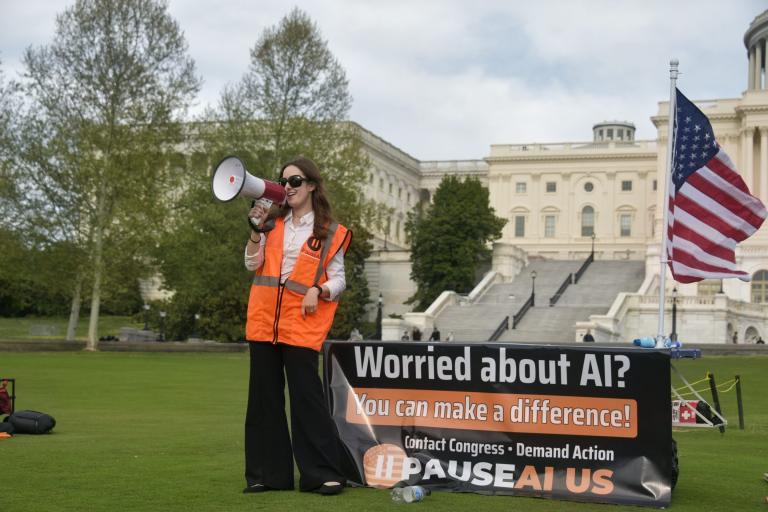 The stories Hollywood told about AI did prepare audiences to ask hard questions and demand accountability from governing officials. Now that AI shapes how people learn, work and get information, a growing share of the public is asking them out loud, in polls, on picket lines and at zoning meetings.
Whether this rebellion proves constructive depends on its direction. If it presses for transparency, fair treatment of workers and genuine democratic oversight, it could become one of the most important checks on the information industry’s transformation. If it turns to violence or to fear of fictional threats while real harms go unaddressed, it could undermine both its own cause and the benefits AI can offer.
Series conclusion
Across this series, a single pattern emerges. In classrooms (Part 1), in governance (Part 2), and in public life (Part 3), AI’s impact depends less on the technology than on the human choices that surround it: how it is taught, how it is governed, and how much say ordinary people have. The future of the information industry will be written by those choices.
References
- TechSpot, republishing The Conversation. (2024, October). The Terminator at 40: This sci-fi cult classic still shapes how we view the threat of AI. https://www.techspot.com/news/105489-terminator-40-sci-fi-cult-classic-shapes-how.html
- Engadget. (2025). Tom Cruise gears up to save us from AI in the latest Mission: Impossible – The Final Reckoning trailer. https://www.engadget.com/entertainment/tv-movies/tom-cruise-gears-up-to-save-us-from-ai-in-the-latest-mission-impossible—the-final-reckoning-trailer-181032815.html
- AwardsWatch. (2025, May). ‘Mission: Impossible – The Final Reckoning’ review. https://awardswatch.com/?p=111337
- Nanji, A. (2025). Americans more concerned than excited about AI [Reporting on Pew Research Center’s June 2025 survey]. MarketingProfs. https://www.marketingprofs.com/charts/2025/53727/americans-more-concerned-than-excited-about-ai-study-pew
- Gallup, Walton Family Foundation, & GSV Ventures. (2026, April 9). Gen Z resentment toward AI grows as adoption stagnates and workplace fears mount [Press release]. https://www.gallup.com/file/analytics/708179/Gallup_WFF_GSV_Press Release.pdf
- Gallup, Walton Family Foundation, & GSV Ventures. (2026). The AI paradox: More exposure, less confidence among Gen Z. https://static.waltonfamilyfoundation.org/73/0c/1a0017594d8eb3c0a667766ae914/wff-gallup-gsv-gen-z-2026-ai-report-final.pdf
- Fortune. (2026, May 20). Why do kids hate AI? Inside the Gen Z backlash. https://fortune.com/2026/05/20/why-do-kids-hate-ai-gen-z-backlash/
- Goldman, S. (2026, April 15). Pause AI and Stop AI: Meet the anti-AI groups facing questions after the attack on Sam Altman. Fortune. https://dc.fortune.com/2026/04/15/pause-ai-and-stop-ai-meet-the-anti-ai-groups-facing-questions-after-the-attack-on-sam-altman/
- MIT Technology Review, via Bioethics.com. (2026, March 3). I checked out one of the biggest anti-AI protests ever. https://bioethics.com/archives/101750
- exchange4media. (2026, March 24). ‘Stop the AI Race’: Protesters rally outside AI offices over accelerating advancements. https://www.exchange4media.com/industry-briefing-news/stop-the-ai-race-protesters-rally-outside-ai-offices-over-accelerating-advancements-153188.html
- Thomas, J. (2025, September 30). SAG-AFTRA actors union fumes over AI ‘actress’ Tilly Norwood. UPI. https://www.upi.com/Top_News/US/2025/09/30/cb-us/8851759277257/
- Data Center Watch. (2025). Q2 2025 update: 125% surge in data center opposition. https://www.datacenterwatch.org/q22025
- Data Center Watch. (2026). Q3–Q4 2025 update: Data center opposition has consolidated. https://www.datacenterwatch.org/q3-q4-2025
- Startup Daily, republishing The Conversation. (2024, October). How The Terminator is shaping our concerns about AI, 40 years on. https://www.startupdaily.net/?p=121678