What LibLime Can Do for Every Type of Library
 Since 2005, LibLime has built its reputation on a single premise: library technology should be shaped by librarians, not imposed on them [1]. Through its flagship platform, Bibliovation, the company offers an open-development Library Services Platform (LSP) that is fully web-based, cloud-hosted on FedRAMP-compliant Amazon EC2 infrastructure, and modular enough to serve public, academic, special, and school libraries with very different needs [1][2].
Public Libraries
For public libraries, LibLime’s core pitch is affordability without sacrificing functionality. Because Bibliovation is delivered as SaaS with no local servers or desktop installs required, small and mid-sized public systems can avoid the licensing and IT overhead of traditional commercial vendors [2]. The platform supports union and consortium catalogs, patron record ownership across agencies, and multiple circulation policies for shared systems — features that have made it a fit for networks such as the South Central Library System and the Pioneer Consortium [1][2]. Self-checkout, self-renewal, suspend/reactivate holds, and SIP2 integration with vendors like OverDrive and 3M round out the patron-facing side [3]. LibLime has also positioned public libraries as partners to schools, citing programs like the Cincinnati and Hamilton County Public Library’s rotating book-delivery service for local classrooms as a model for community engagement [4].
Academic Libraries
Academic institutions get a system built around discovery and research support. Bibliovation’s Discovery Layer offers relevancy-ranked keyword searching, faceted browsing, full-text searching of digital objects, and course reserves — all designed to unify a campus’s physical collection with its electronic resources into one search experience [2]. LibLime has also written extensively about pairing its platform with virtual library services such as LIRN, which gives students federated access to millions of full-text articles, e-books, and databases from providers like EBSCO and ProQuest [5]. Authority control for multiple thesauri, batch record editing, and Z39.50 searching from the cataloging editor support the more complex metadata work typical of academic and consortial cataloging, as seen historically in projects like the Westchester Academic Library Directors Organization’s migration to Koha [6].
Special Libraries
Special libraries — including research, nonprofit, medical, government, and music libraries — depend on tailored collections rather than broad general-interest holdings [7]. LibLime supports this niche work through the same modular architecture: libraries can deploy only the 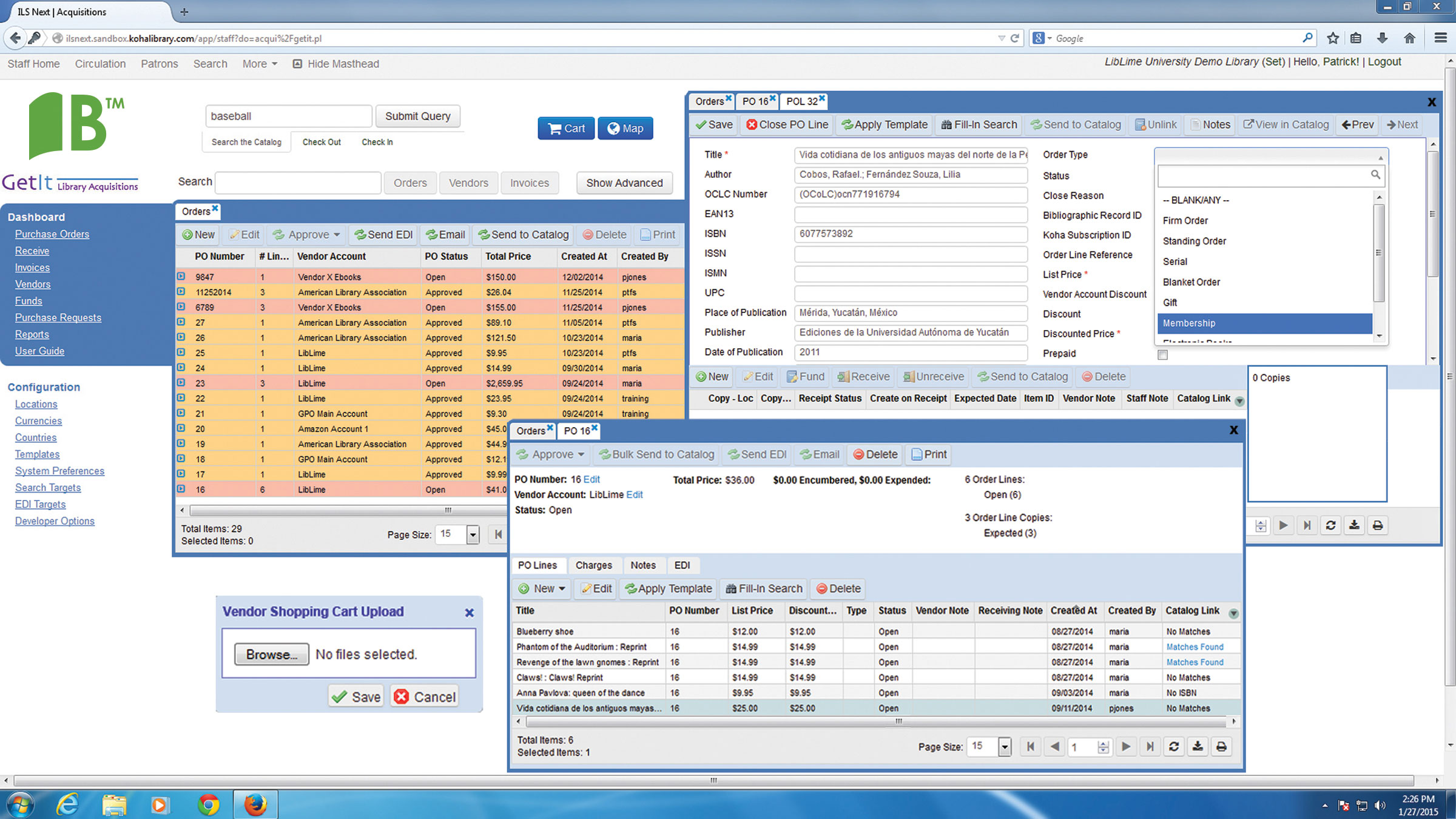 components they need, such as Acquisitions or the Discovery Layer, layered on top of an existing system [2]. The platform’s digital content management module, which ingests both scanned and “born digital” documents, is particularly relevant to special libraries managing archives, technical reports, or industry-specific repositories [2]. LibLime counts federal and government libraries among its customers, several of which have migrated multi-branch collections onto hosted Bibliovation deployments [8].
School Libraries
For K-12 environments, LibLime’s more recent content has focused less on new modules and more on the operational realities school librarians face each fall — auditing sublocations as classroom assignments shift, preparing displays and lessons, and testing catalog software before students return [9]. The company has also tracked a sharp rise in book-challenge activity, noting that the American Library Association recorded 821 censorship attempts targeting 2,452 titles in 2024, with the number rising further in 2025 [9]. LibLime frames its hosted support model as relieving school districts — often the most resource-constrained library type — of the need for dedicated technical staff [1].
Sources
- LibLime. “About Us.” Liblime.com, 2026. https://liblime.com/about-us/
- LibLime. “Bibliovation.” Liblime.com, 2026. https://liblime.com/bibliovation/
- GetApp. “Koha ILS 2026 Pricing, Features, Reviews & Alternatives.” GetApp, 2026. https://www.getapp.com/industries-software/a/liblime-koha/
- LibLime. “How School Libraries Are Getting Ready for Kids to Come Back.” Liblime.com, Aug. 17, 2026. https://liblime.com/2026/08/17/how-school-libraries-are-getting-ready-for-kids-to-come-back/
- LibLime. “Top 5 Virtual Library Services for Academic Research.” Liblime.com, June 9, 2025. https://liblime.com/2025/06/09/top-5-virtual-library-services-for-academic-research/
- Breeding, Marshall. “Chapter 2. Koha.” Library Technology Reports, ALA, 2017. https://journals.ala.org/index.php/ltr/article/view/6405/8452
- LibLime. “Special Libraries: Niche Collections and Impact.” Liblime.com, Nov. 24, 2023. https://liblime.com/2023/11/24/special-libraries-niche-collections-and-impact/
- LibLime. “Public Libraries Archives.” Liblime.com, 2026. https://liblime.com/tag/public-libraries/
- LibLime. “How School Libraries Are Getting Ready for Kids to Come Back.” Liblime.com, Aug. 17, 2026. https://liblime.com/2026/08/17/how-school-libraries-are-getting-ready-for-kids-to-come-back/