
The Ethical Storm Over AI in Libraries
Libraries have survived every information revolution, from microfilm to the open web, but artificial intelligence is testing the profession like few previous technologies. The question is no longer if AI will arrive in libraries. It is whether libraries can adopt it without sacrificing the values that make them trusted.
The challenge is real. Clarivate’s Pulse of the Library 2026 report found that 58% of respondents name staff productivity as a 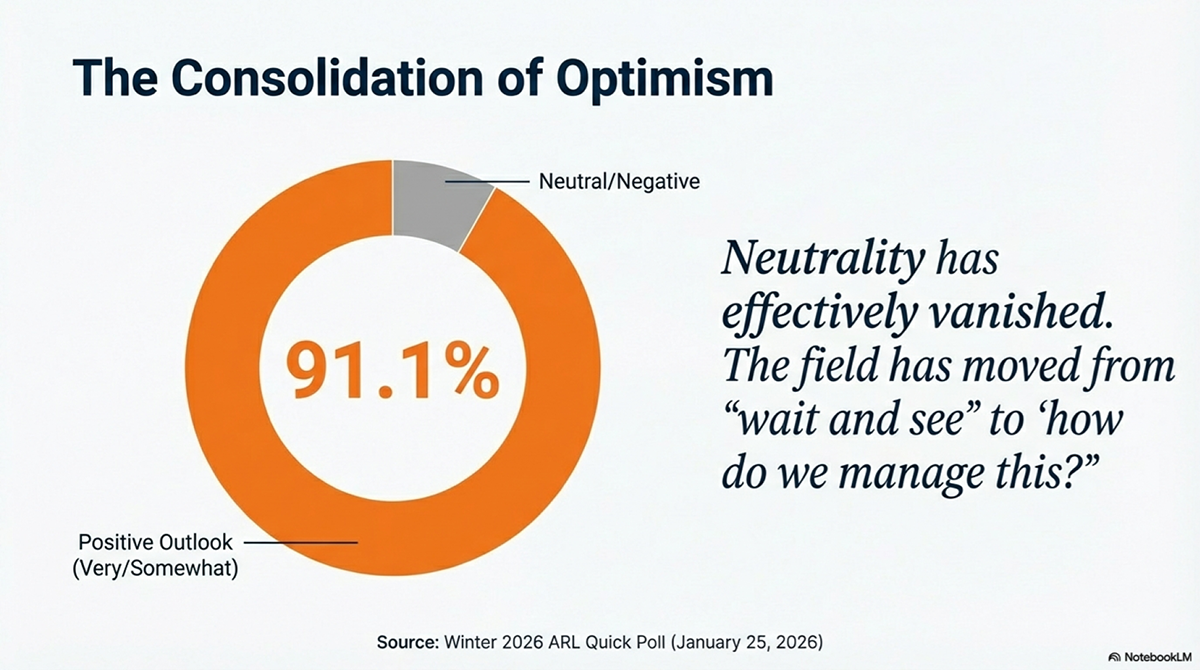 primary goal for AI initiatives [2]. In a January 2026 quick poll of Association of Research Libraries members, more than one-third of responding libraries reported active implementation, and most of the rest were exploring practical uses [4]. Among academic librarians, nearly 90% say AI is now treated as a legitimate tool at their institution [3].
Yet the same surveys reveal a governance gap. Only 47% of academic librarians report that their organization has formal AI guidelines [3]. A Book Industry Study Group survey went further: about a third of library respondents do not use AI and have no plans to; roughly 34% describe themselves as ethically opposed; and the most common answer about institutional AI policy was that none existed [1]. Library scholar R. David Lankes argues this resistance is not ignorance; it comes disproportionately from librarians who understand the technology well and judge it unreliable [1].
Their objections cluster around three fault lines. The first is privacy. Clarivate reports that privacy and security, misinformation, and bias are now librarians’ leading concerns, and that libraries further along in implementation often report more worries than non-adopters [2]. The second is collection integrity. Librarians describe catalogs filling with low-quality machine-generated titles and staff hours lost to weeding them out [1]. At the University of California, Irvine, a faculty member and the library’s head of collection strategies found that Springer Nature has published book-length, partly machine-generated literature reviews since 2021, works sitting in a curated, costly collection while most faculty remained unaware [5].
The third fault line is labor. Critics fear that “efficiency” becomes a polite word for replacing reference librarians, catalogers, and instructors. That worry shaped the American Library Association’s response. In July 2026, the ALA Council adopted Guidance on the Use of Artificial Intelligence in Libraries, written by a 30-member working group and framed as a living document [6]. The guidance says AI should complement, not replace, human judgment; warns against replacing reference, readers’ advisory, and instructional services; and calls for defined human review before AI output reaches the public [7]. It also asks libraries to weigh vendors’ labor ethics and to require AI-free equivalents of services [7].
Not everyone sees refusal as the ethical high ground. At ALA’s 2026 Annual Conference, Michael Hanegan of the Center for the Future of Learning and Work warned that patrons will be harmed if librarians disengage, and panelists urged every library to adopt guidelines whether or not it uses AI [8]. Lankes points to a University of Texas project that used AI to create confidence-scored stub records for an uncataloged music collection, flagging uncertain entries for human review [1]. There, the real choice was AI or nothing.
The storm will not pass quickly. What libraries can control is how they adopt: transparently, with human oversight, and with patron trust treated as the asset it is. As Lankes suggests, librarians may increasingly serve as the “trusted humans” in an information system flooded with machine-made text [1].
Sources
- Friedman, J. (2026, April 20). AI and libraries: Why librarians may become arbiters of reality. Jane Friedman. https://janefriedman.com/ai-and-libraries-why-theyre-like-canaries-in-the-coal-mine/
- Library Journal infoDOCKET. (2026, September 9). Now available: Clarivate releases Pulse of the Library 2026 survey report. https://www.infodocket.com/2026/09/09/just-released-clarivate-releases-pulse-of-the-library-2026/
- De Roo, D. (2026, June 11). What 311 academic librarians from 31 countries told us about AI. De Gruyter Conversations. https://blog.degruyter.com/what-311-academic-librarians-from-31-countries-told-us-about-ai/
- Association of Research Libraries. (2026). Tracking the AI evolution in research libraries: Findings from ARL’s 2026 AI quick poll. https://www.arl.org/blog/tracking-the-ai-evolution-in-research-libraries-findings-from-arls-2026-ai-quick-poll/
- Inside Higher Ed. (2026, September 29). AI slop coming to a library near you [Opinion]. https://www.insidehighered.com/opinion/views/2026/09/29/ai-slop-coming-university-library-near-you-opinion
- American Library Association. (2026, July 16). ALA Council adopts Guidance on the Use of Artificial Intelligence in Libraries [Press release]. https://www.ala.org/news/2026/07/ala-council-adopts-guidance-use-artificial-intelligence-libraries
- American Library Association. (2026, June). Guidance on the use of artificial intelligence in libraries. https://www.ala.org/sites/default/files/2026-07/Guidance-on-the-Use-of-Artificial-Intelligence-in-Libraries_June-2026.pdf
- Library Journal. (2026). Ethical use of AI in libraries | ALA Annual 2026. https://www.libraryjournal.com/story/ethical-use-of-ai-in-libraries-ala-annual-2026