
When the Cloud Comes to Town: How the AI Data Center Boom Is Reshaping America’s Libraries
In 2026, libraries are being squeezed from two directions at once: the physical infrastructure of the AI boom and the economic and cultural fallout of the software it powers. Data centers are rising in rural counties and suburban business parks, publishers are rewriting contracts to account for AI training, and
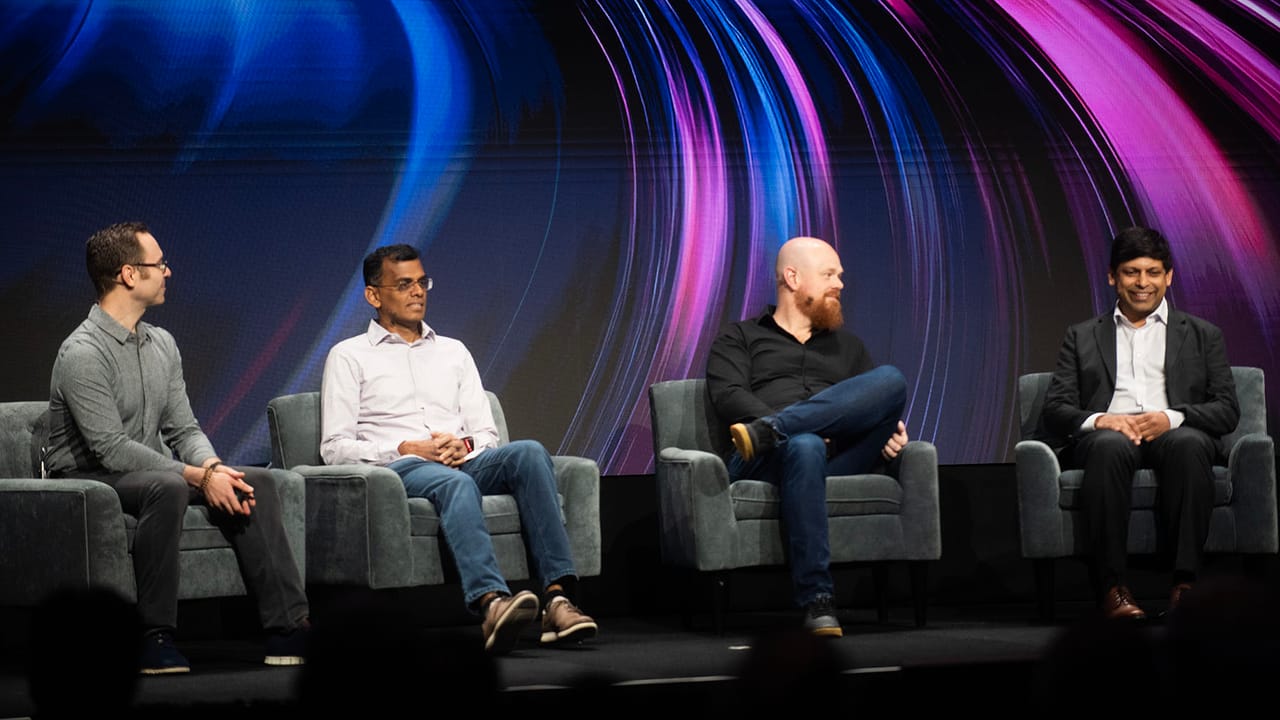
At Data Center World, leaders from Oracle Cloud Infrastructure, Nvidia, and Google agree AI’s unique demands are straining the traditional data center model. Photo by Shane Snider
library budgets are being tested by federal cuts even as the tools librarians use — and the misinformation they must filter — are transformed by generative AI. The result is a continuous industry navigating opportunity and disruption, often in the same building.
The Infrastructure In Backyards
The scale of AI-driven data center construction is difficult to overstate. In 2026, major tech companies are estimated to spend roughly $650 billion on AI data centers, with racks that once drew 30–40 kilowatts now approaching the megawatt range [1]. Microsoft, Google, Amazon, and Meta alone are expected to spend over $700 billion on capital expenses in 2026, a 60% jump from the prior year, much of it funneled into rural land acquisition and new facilities the size of university campuses [2]. Global data center electricity demand hit roughly 485 terawatt-hours in 2025, and the “Big Five” hyperscalers are projected to spend about $725 billion on AI infrastructure in 2026 alone [3].
That buildout has begun to intersect directly with library funding and civic life. Microsoft’s newly published “Community-First Infrastructure” framework, for example, commits the company to paying full local property taxes on its data center developments, with the resulting revenue explicitly earmarked to support schools, hospitals, parks, and libraries, and it includes new AI-literacy investment aimed at K-12 schools, community colleges, and libraries [4]. In Quincy, Washington, Microsoft says its data centers already generate more than $200 million in annual regional economic activity [4]. For some

As AI data centers scale, investigating their impact becomes its own beat
communities, this represents a genuine funding lifeline; librarians in growing data-center corridors may see new tax revenue even as neighboring counties watch water tables and electricity rates strain under the demands of industrial-scale compute [1][3].
But the backlash is real. By mid-2026, local community resistance had blocked construction of AI data centers worth an estimated $130 billion, driven by concerns over water consumption, noise, heat, and rising electricity costs passed on to residential ratepayers [2]. Investigative reporters have increasingly treated data centers as their own beat, documenting facilities that can require up to five million gallons of water a day for cooling and citing research linking nearby construction to air and noise pollution with minimal long-term local job creation [2]. For public libraries — themselves reliant on local tax bases and often serving as the de facto internet-access point in underserved communities — the arrival of a massive facility can mean either a windfall or a strain on the same civic infrastructure libraries depend on.
The Content Pipeline Is Being Renegotiated
While the physical footprint of AI expands, its appetite for content is reshaping the economics of what libraries can offer patrons. Ebook and audiobook licensing — already a sore point for a decade — has become acute. ReadersFirst’s 2026 Publisher Price Watch report found that HarperCollins has raised library ebook license prices at an annualized rate of 17.3% since 2022, while Hachette’s library audiobook license prices surged 36% year-over-year [5]. In May 2026, five major library associations issued a joint statement demanding that publishers overhaul their licensing models, an unusual show of unified pressure after years of separate advocacy efforts [6]. Library administrators report that in some high-circulation systems, ebook and audiobook licensing now consumes as much as 50% of the collections budget, with a single new ebook license running $55 or more and requiring repurchase after two years or a set number of checkouts [7].
Generative AI has added a second, more complex layer to that licensing conflict. Publishers, including Penguin Random House and Elsevier, have begun inserting language into copyright statements explicitly barring the use of their content for AI training, even though such notices can’t override statutory fair use rights [8]. The Library Copyright Alliance — representing the Association of Research Libraries and the American Library Association — has held that existing U.S. copyright law is sufficient to handle AI training questions without new legislation, but the fight is playing out in court as much as in policy. In May 2026, publishers including Elsevier, Hachette, Macmillan, and McGraw-Hill sued Meta, alleging the company trained its Llama models on more than 267 terabytes of copyrighted material torrented from pirate sites — a case that could reshape how courts weigh fair use against evidence of market harm for AI training data [9]. For research libraries, higher costs of securing “AI rights” on top of existing subscriptions threaten to push licensing further out of reach, potentially reducing the scope of academic work that depends on access to text-and-data-mining [8].
AI is Reshaping Collection Development
Generative AI isn’t just a licensing abstraction; it is showing up on library shelves. Librarians have reported discovering AI-generated ebooks with fabricated or dangerous content — including Holocaust  denial — being distributed through digital lending platforms and passed off as legitimate titles, a phenomenon first widely reported in 2025 investigations and one that continues to strain collection-development staff in 2026 [10]. Vendors like Hoopla have responded to community pressure by removing flagged AI-generated titles, but librarians say the burden of catching “AI slop” before it reaches patrons largely falls on already-stretched staff [11].
At the same time, AI is quietly becoming a workflow tool inside library operations. Recent research cited by industry publishers suggests AI tools are helping libraries reduce manual workflow time by 30% to 60% across cataloging, administration, and user services [12] — a rare bright spot suggesting AI’s disruptive and productive effects are arriving in the same institutions simultaneously.
Budgets Being Tested from Washington
All of this is unfolding against a backdrop of federal funding uncertainty that predates the AI boom but compounds its pressures. The Institute of Museum and Library Services, the only federal agency dedicated to library and museum funding, faced an executive order attempting to dismantle it in 2025; a court settlement in April 2026 preserved the agency through fiscal year 2026, but the administration’s FY2027 budget proposal calls for slashing its roughly $290 million budget to just $6 million [13][14].
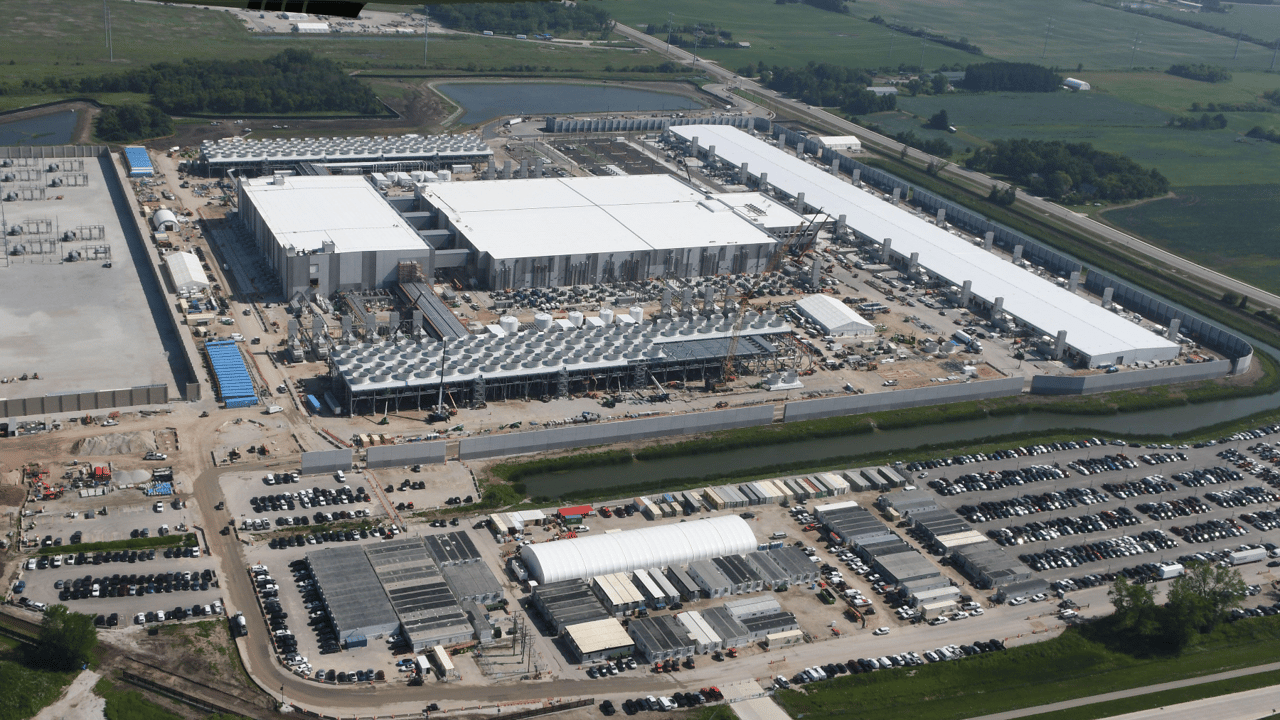
A Microsoft data center in Quincy, Washington. (Credit: Microsoft)
Library advocates note that IMLS grants fund everything from interlibrary loan networks to rural broadband upgrades and Braille production — the same basic infrastructure libraries need to expand AI literacy and digital access programming for their communities [14].
Caught in the Middle
Libraries in 2026 sit at an unusual junction: physically bordering some of the largest capital projects in American history, financially pinched by the content industries reacting to AI, and experimenting with AI as an operational tool. Whether the net effect is disruptive or additive will likely depend on decisions made far outside library walls — in publisher boardrooms, congressional appropriations committees, and the utility commissions now approving multi-gigawatt data center interconnections. For now, librarians are left managing all three fronts on tighter budgets than before the AI boom began.
Sources
- Snider, Shane. “Data Center World 2026: AI Pushes Infrastructure to New Limits.” Data Center Knowledge, 2026. https://www.datacenterknowledge.com/build-design/data-center-world-2026-ai-pushes-infrastructure-to-new-limits
- AI data center locations: Map of the world’s supercomputers. (n.d.). The Information. https://www.theinformation.com/projects/ai-data-center-database
- Deck, Andrew. “As AI data centers scale, investigating their impact becomes its own beat.” Nieman Journalism Lab, March 10, 2026. https://www.niemanlab.org/2026/03/as-ai-data-centers-scale-investigating-their-impact-becomes-its-own-beat/
- “Microsoft Unveils a New Social Contract for AI Data Centers.” Data Center Knowledge, April 16, 2026. https://www.datacenterknowledge.com/ai-data-centers/microsoft-shifts-to-community-first-model-for-scaling-ai-infrastructure
- “Checked Out: Why Public Libraries Are Fighting Back Against Ebook Pricing.” LibLime, June 8, 2026. https://liblime.com/2026/06/08/checked-out-why-public-libraries-are-fighting-back-against-ebook-pricing/
- “Leading Public Library Groups Call for E-book Action.” Public Libraries Online, May 27, 2026. https://publiclibrariesonline.org/2026/05/leading-public-library-groups-call-for-e-book-action/
- Friedman, Jane. “Library associations express concern about pricing for ebooks and audiobooks.” Jane Friedman (newsletter), June 3, 2026. https://janefriedman.com/library-associations-express-concern-about-pricing-for-ebooks-and-audiobooks/
- Klosek, Jonathan; Teremi. “AI Is Reigniting Decades-Old Questions Over Digital Rights, but Fair Use Prevails.” Association of Research Libraries, 2025–2026. https://www.arl.org/blog/ai-is-reigniting-decades-old-questions-over-digital-rights-but-fair-use-prevails/
- “Major Publishers Challenge AI Training Practices in Landmark Copyright Suit Against Meta.” Holland & Knight, May 20, 2026. https://www.hklaw.com/en/insights/publications/2026/05/major-publishers-challenge-ai-training-practices
- “The Challenges Facing Libraries in 2026 (And Why There’s Hope).” Pop Heist, December 31, 2025. https://popheist.com/the-challenges-facing-libraries-in-2026-and-why-theres-hope
- “Addressing AI-Generated Materials in the Library Collection.” The Digital Librarian, August 7, 2025. https://the-digital-librarian.com/2025/08/05/addressing-ai-generated-materials-in-the-library-collection/
- “Study Finds Academic AI Reduces Library Workflow Time.” Cited in Anthem Press publishing industry digest, 2026. https://blog.anthempress.com/2026/05/29/talk-of-the-town-monthly-publishing-industry-news-digest-8/
- “Federal Budget Cuts: How Library Jobs & MLIS Careers Are Affected in 2026.” Masters in Library Science, June 26, 2026. https://www.mastersinlibraryscience.org/articles/library-budget-cuts-mlis-2026-06-26/
- “White House FY27 budget proposal repeats threats to eliminate IMLS.” American Library Association, April 2026. https://www.ala.org/news/2026/04/white-house-fy27-budget-proposal-repeats-threats-eliminate-imls