Checked Out: Why Public Libraries Are Fighting Back Against Ebook Pricing
When a reader places a hold on an ebook at their local library, they rarely think about the financial machinery behind that simple transaction. But for library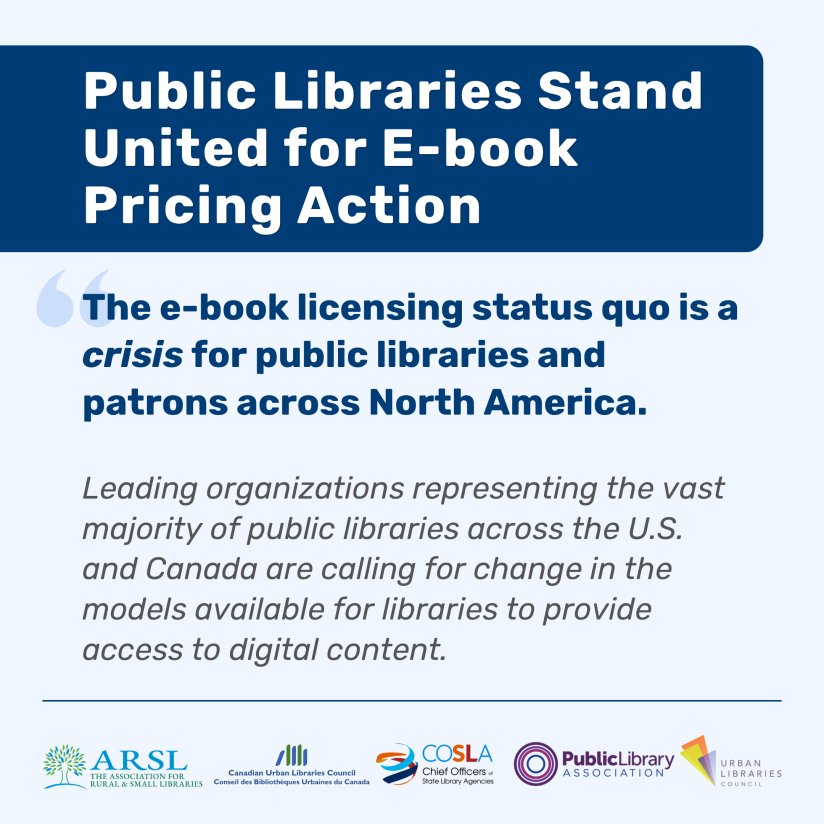 administrators across North America, the economics of digital lending have become an increasingly urgent crisis — one that a coalition of the continent’s most powerful library organizations is now taking directly to the publishing industry.
On May 26, 2026, five major library associations released a landmark joint statement demanding that large publishers overhaul the licensing models that govern how libraries access digital content. The organizations — the Urban Libraries Council (ULC), the Public Library Association (PLA), the Canadian Urban Libraries Council (CULC/CBUC), the Chief Officers of State Library Agencies (COSLA), and the Association for Rural & Small Libraries (ARSL) — represent the vast majority of public libraries in the United States and Canada [1]. Their unified message was blunt: the current system is broken, and readers are paying the price.
The Cost Gap
At the heart of the conflict lies a fundamental asymmetry between what consumers pay for ebooks and what libraries are charged for the privilege of lending them. While a typical consumer might purchase a popular ebook for around $13, libraries routinely pay $55 or more for a two-year license to lend the same title — not ownership, just temporary access [1]. When that license expires, the library must pay again to keep the book available.
A concrete example from Colorado illustrates the disparity with alarming clarity. When the fantasy novel Onyx Storm by Rebecca Yarros was released in January 2025, Jefferson County Public Libraries spent $3,300 on 166 print copies. For the digital version, however, the library spent $22,000 on roughly 360 ebooks — more than three times the cost per copy [1]. Print books, once purchased, can be lent indefinitely. Ebooks disappear from a library’s collection the moment a license lapses.
 The financial toll of this model is reflected in per-capita spending data collected over time. According to the Urban Libraries Council’s 2025 Library Insights Report, libraries spent an average of $1.54 per capita on ebooks in 2019; by 2024, that figure had nearly doubled to $2.72 — while spending on print books remained nearly flat at $2.77 per capita [2]. In other words, libraries are now spending almost as much on digital content alone as they do on their entire print collection, despite serving far fewer simultaneous readers per copy.
A Licensing Model That Wasn’t Built for Libraries
Unlike physical books, which fall under the “first sale” doctrine allowing libraries to lend purchased copies freely, ebooks exist entirely within licensing agreements dictated by publishers. Libraries do not own ebooks; they rent them — under terms that have grown increasingly restrictive and expensive.
The ReadersFirst working group, a library advocacy organization that has monitored publisher pricing for years, tracks these trends through its Publisher Price Watch report. Its 2026 summary paints a troubling picture: HarperCollins has increased its library ebook license prices at an annualized rate of 17.3% since 2022, while Hachette’s library audio license prices surged 36% year over year — the highest annualized rate of increase at 13.1% over four years [3]. These are not isolated jumps; they represent a sustained, compounding escalation that has quietly drained library budgets over nearly half a decade.
Meanwhile, retail prices have not followed the same trajectory. Print prices for popular books fell 3.2% year over year and have declined at an annualized rate of 1.2% since 2022 [3]. The widening gap between what publishers charge libraries and what they charge consumers has become a defining fault line in the debate.
The impact on patrons is tangible. Because libraries can only afford a finite number of ebook licenses, and because each license typically permits only one patron at a time to borrow a title, wait times for popular ebooks can stretch to two to six months [4]. By the time a handful of readers have accessed a title through the library’s checkout system, the license may already be approaching expiration — forcing the library to pay again or drop the title from its collection.
A Coalition Goes on the Record
What makes the May 2026 joint statement notable is not just its content but its authors. For years, library organizations have often addressed the ebook pricing issue in isolation, publishing separate statements or advocacy materials without the coordinated weight of a unified front. That approach changed this spring.
“Joining together obviously amplifies the concerns for all libraries,” wrote ReadersFirst in a response to the joint statement, noting that it had been “bruiting” these same concerns for nearly a decade [5]. The organization welcomed the coalition approach as a meaningful escalation.
The statement’s signatories spoke with rare directness. Brooks Rainwater, President and CEO of the Urban Libraries Council, called on large publishers to “meet with  libraries across North America, to hear our concerns, and address them, so we can continue building a mutually beneficial future for literacy and reading” [1]. Dr. Brandy McNeil, President of the Public Library Association, declared that libraries would “pay a fair price for fair services” but insisted they “must be able to lend and preserve content in all its forms to advance literacy and learning” [1].
The statement also gave particular voice to the rural and small-library experience. Kate Laughlin, Executive Director of the Association for Rural & Small Libraries, described ebooks as “a lifeline” for many small and rural communities — but warned that “with limited budgets, offering e-books at these prices has become unsustainable, and for many small libraries, impossible” [1].
Legislative Attempts and Legal Dead Ends
Library advocates have not confined their efforts to public statements. Over the past several years, more than fourteen states have introduced legislation designed to compel publishers to offer ebooks to libraries on reasonable terms [6]. The results have been mixed at best.
Maryland was the first state to pass such a law in 2022 — and it was subsequently struck down by a federal judge, who ruled that it conflicted with copyright law [7]. Connecticut became the first state to successfully pass library ebook legislation since Maryland’s failed effort [7]. New Jersey has also introduced a bill of its own. But these legislative initiatives remain fragile, heavily opposed by the publishing industry, and constrained by the limits of what state law can accomplish in a domain governed by federal copyright statutes [6].
The persistent failure of legislative remedies has reinforced the importance of direct negotiation with publishers — which is precisely what the May 2026 coalition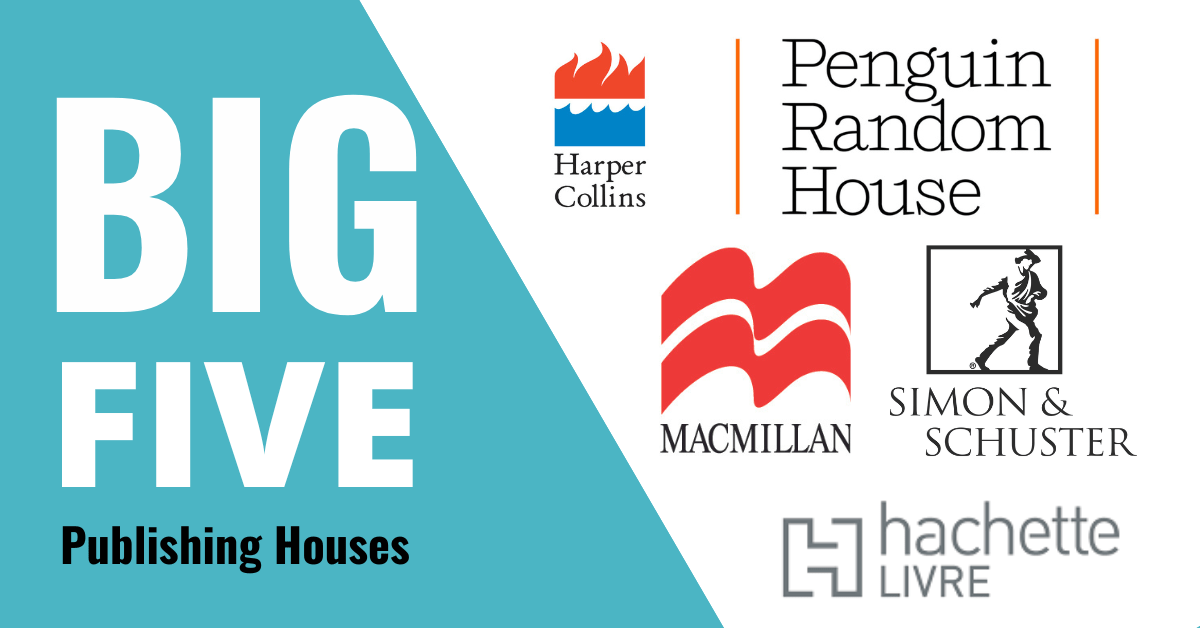 statement is designed to jumpstart. Rather than waiting for courts or legislatures to act, the organizations are calling on the Big Five publishing houses to come to the table voluntarily.
The Advocacy Ecosystem
Beyond the five signatories of the joint statement, a broader ecosystem of organizations has spent years pressing publishers for reform. ReadersFirst, which has been monitoring and publishing data on library ebook pricing since 2022, has helped build an evidence base that advocacy efforts depend on [3]. Library Futures, another nonprofit, has focused on research and policy, including a major follow-up study on ebook availability, licensing, and pricing in Canada and the U.S. conducted by the ReadersFirst Working Group [7]. The eBook Study Group, based at Harvard, has similarly pushed for structural reform in how ebook contracts are written [4].
Groups like the American Library Association and the Urban Libraries Council continue conducting advocacy on behalf of public libraries [6]. The San José Public Library, in its own published guidance for patrons, pointed to all of these organizations as part of the broader movement working toward “more fair and favorable prices and licensing of digital materials” [6].
Research from this ecosystem has produced one notable finding that advocates invoke frequently: medium-sized independent publishers tend to offer libraries considerably fairer terms than the Big Five. A 2025 ReaderFirst Working Group study concluded that “medium-sized independent publishers are often giving us much  fairer terms than the Big Five,” suggesting that the most restrictive pricing practices are concentrated at the top of the industry [7].
What Reform Could Look Like
The joint statement stops short of demanding specific pricing formulas, instead calling on publishers and platform providers to “come to the table to work with public libraries to identify and implement sustainable solutions” [1]. But advocates have generally coalesced around several principles: licenses that allow more borrowers to be active simultaneously, perpetual access options, pricing that more closely reflects the consumer retail price, and greater transparency in contract terms.
Whether the Big Five publishers — Penguin Random House, HarperCollins, Hachette, Macmillan, and Simon & Schuster — will respond remains to be seen. The industry has historically resisted legislative mandates and shown limited appetite for voluntary concessions. But the formation of a cross-organizational coalition, with clear public accountability and the attention of the broader library and publishing press, marks a new level of pressure that advocates hope will prove harder to ignore.
For the millions of Americans who rely on public libraries for affordable access to books — including the growing share who prefer to read digitally — the outcome of these negotiations is anything but abstract.
Sources
- American Library Association. “Leading Public Library Groups Call for E-book Action.” ALA News, May 26, 2026. https://www.ala.org/news/2026/05/leading-public-library-groups-call-e-book-action
- Urban Libraries Council. 2025 Library Insights Report. Cited in: “ULC Releases 2025 Library Insights Report.” Publishers Weekly. https://www.publishersweekly.com/pw/newsbrief/index.html?record=5645
- ReadersFirst. “Publisher Price Watch.” ReadersFirst.org, May 2026. https://www.readersfirst.org/publisher-price-watch
- Bose, Adrija. “E-Book Contracts Are a Big Cost for Public Libraries. One Harvard Librarian Is Fighting to Change That.” The Harvard Crimson, September 24, 2025. https://www.thecrimson.com/article/2025/9/24/Library-eBook-Contracts/
- ReadersFirst. “The Joint Statement to the Big 5 on Library Ebooks.” ReadersFirst News, May 27, 2026. https://www.readersfirst.org/news/2026/5/27/the-joint-statement-to-the-big-5-on-library-ebooks
- San José Public Library. “The Rising Cost of eBooks.” SJPL Blog, February 13, 2025. https://www.sjpl.org/blogs/post/the-rising-cost-of-ebooks/
- Carreiro, Erin. “New Report Looks at the State of the Library Ebook Market.” Words and Money, July 31, 2025. https://www.wordsandmoney.com/new-report-looks-at-the-state-state-of-the-library-ebook-market/