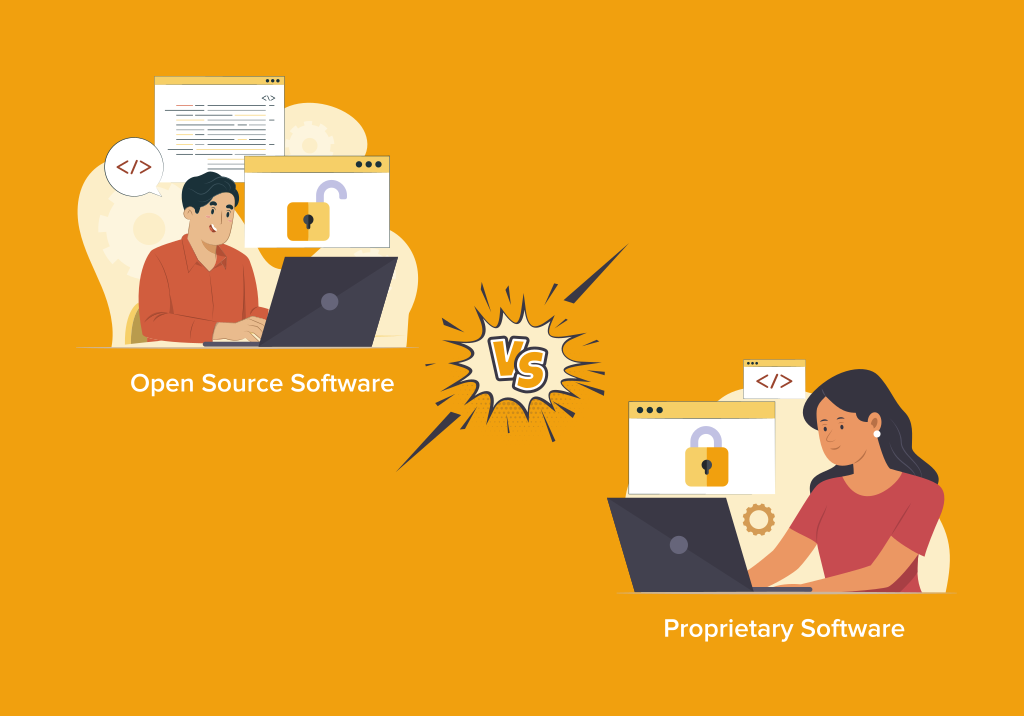
The Case for Proprietary Software: Why Companies Choose Vendor-Built Solutions
Open source dominates headlines and developer conversations, but proprietary software hasn’t gone anywhere — and in 2026, it remains the clear backbone of enterprise IT. Employers still expect expertise in both worlds, and for much of computing’s history, proprietary companies built their businesses precisely because they could protect intellectual property, invest in polished interfaces, and fund dedicated support organizations [1]. A fair look at the evidence shows proprietary software offers real, distinct advantages.
Predictable & Accountable Support
Perhaps the single biggest reason organizations pay for proprietary software is accountability. Proprietary vendors provide dedicated support SLAs, which matters enormously for regulated industries and enterprise deployments, whereas open-source projects typically rely on community forums or third-party specialists for equivalent help [2]. This isn’t a minor convenience — it’s structural. One key benefit of proprietary software is dedicated customer support through official channels like SLAs and help desks, which matters for businesses that need fast, reliable assistance and minimal downtime [3]. When a mission-critical system goes down at 2 a.m., a support contract with guaranteed response times is a fundamentally different proposition than posting in a community forum and waiting for a volunteer maintainer to notice.
This distinction becomes especially important for organizations without deep in-house technical benches. Proprietary software delivers strong returns through faster deployment and comprehensive support, providing businesses with quicker time-to-value, automatic updates, and guaranteed vendor assistance [4]. Small and medium businesses, in particular, benefit most when internal technical resources are limited, since higher licensing costs are often offset by lower opportunity costs — the team can focus on core business operations rather than software maintenance [4].
Stability, Testing, and Controlled Releases
Proprietary systems also offer something open-source projects often can’t guarantee by default: predictable, tested release cycles. Proprietary systems provide planned updates and long-term support versions, which helps ensure consistent performance for businesses that prioritize stability and accountability over open customization [5]. This structure appeals directly to companies running business-critical applications, where an unplanned breaking change can be far costlier than a slightly slower feature cadence.
 That reliability is backed by investment. Companies spend significant resources on user experience to ensure their software meets customer needs efficiently, and proprietary vendors typically invest heavily in rigorous testing and maintenance because their reputation and revenue depend directly on the product working as promised [6][7]. This commercial incentive structure — where a single company’s brand and bottom line are at stake — creates a different kind of quality assurance than volunteer-driven development, where contributions may be reviewed on a more variable timeline.
For large enterprise systems specifically, this matters even more. For business-critical applications — including ERP solutions, AI platforms, and digital transformation initiatives — proprietary software provides the stability and support infrastructure necessary for these systems, and business technologists and citizen developers particularly benefit from the structured environments and simplified interfaces proprietary solutions often provide [8]. In other words, proprietary tools frequently lower the skill floor required to operate them safely, which matters for organizations without specialized engineering teams.
Security Through Concentrated Investment
The security comparison between open and proprietary software is genuinely contested, and a fair-minded article shouldn’t overstate either side’s case. Open-source advocates rightly point out that thousands of security researchers reviewing code can quickly catch and patch vulnerabilities, whereas proprietary software often relies on “security through obscurity,” which can be devastating when a vulnerability is eventually discovered [2]. That’s a legitimate concern. But it cuts both ways: because proprietary software is closed-source, the code is only accessible to the software’s own developers, which limits the pool of people who can find and exploit vulnerabilities, and companies that build proprietary products usually invest heavily in security specifically to protect their reputation and customer base [7]. Ultimately, both models have trade-offs, and what matters most in practice is patch cadence and an organization’s own security discipline [2] — but proprietary vendors offer something open source structurally cannot: a single, contractually accountable party responsible for that discipline.
Compliance and Legal Protection
For regulated industries — finance, healthcare, government contracting — proprietary software offers a compliance advantage that’s easy to underrate. Because proprietary software is controlled by a single accountable entity, it is more likely to provide the legal protections, certifications, and guarantees needed to meet strict regulatory requirements, and its use often directly supports compliance with industry standards [9]. When an auditor asks “who is responsible if this breaks,” a vendor contract gives a clear answer in a way that a loosely governed open-source dependency chain often cannot.
Return on Investment and Focus
There’s also a strategic argument beyond pure technical merit: proprietary software can free organizations to focus on their actual business rather than software management. Open-source delivers better returns for organizations with strong technical teams who need deep customization, while proprietary software offers superior returns for businesses prioritizing speed and guaranteed vendor support — and the right choice depends on a team’s capacity, not just theoretical cost savings [4]. For a company whose core competency isn’t systems administration, paying a vendor to own that complexity — including updates, security patching, and roadmap decisions — can be the more economically rational choice, even at a higher sticker price.
The Honest Trade-offs
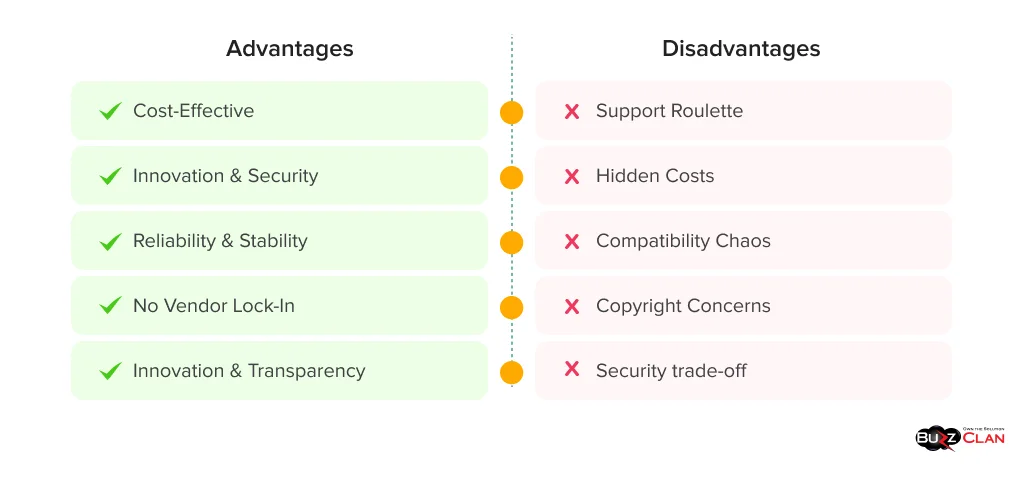
Advantages and Disadvantages of Open Source Software
None of this means proprietary software is without real downsides, and a fair treatment has to acknowledge them. Vendor lock-in is a genuine and common consequence: organizations become dependent on a single provider for updates and compatibility, and switching to another platform can become difficult, particularly once data is stored in proprietary formats [9][10]. Costs can also rise over time, and proprietary vendors don’t always innovate or respond to bug reports as quickly as open-source communities do, since they operate on their own internal development schedules rather than in response to real-time community pressure [9].
A Both/And Conclusion
The most balanced reading of the current landscape isn’t “proprietary versus open source” but “proprietary and open source, deployed deliberately.” Most successful enterprises now use open source for flexible infrastructure and proprietary software for mission-critical applications, choosing the model that fits a given system’s risk profile rather than adopting one philosophy across the board [4]. For core business operations where accountability, predictable support, and regulatory compliance matter most, proprietary software’s central promise — a company standing behind its product with contracts, SLAs, and dedicated support — remains a compelling, evidence-backed reason to pay for what open source gives away for free.
Sources
- Capitol Technology University. “Open-Source vs Proprietary Software: Key Differences, Benefits, and the Future of Software Development.” May 18, 2026. https://www.captechu.edu/blog/open-source-vs-proprietary-software-key-differences-benefits-and-future-of-software
- O8 Agency. “Open-Source vs Proprietary Software: The Clear Winner in 2026.” May 8, 2026. https://www.o8.agency/blog/open-source-software-vs-proprietary-software
- TechTimes. “Open-Source vs Proprietary Software: Key Differences, Pros, Cons, and Which One to Choose.” April 27, 2026. https://www.techtimes.com/articles/316162/20260427/open-source-vs-proprietary-software-key-differences-pros-cons-which-one-choose.htm
- BuzzClan. “Open Source vs Proprietary Software: Which is Better? (2026).” April 15, 2026. https://buzzclan.com/digital-transformation/open-source-vs-proprietary-software/
- TechTimes. “Open-Source vs Proprietary Software: Key Differences, Pros, Cons, and Which One to Choose.” April 27, 2026. https://www.techtimes.com/articles/316162/20260427/open-source-vs-proprietary-software-key-differences-pros-cons-which-one-choose.htm
- EC Group. “Pros and Cons of Proprietary Software | Benefits and Drawbacks Explained.” December 2, 2024. https://www.ecgrouptucson.com/blog/the-pros-and-cons-of-proprietary-software-is-it-right-for-your-business
- CNLTD Business IT Services. “What Is a Proprietary System? Benefits, Drawbacks & Examples Explained.” August 21, 2025. https://cnltd.co.uk/docs/digital-workplace/proprietary-system/
- Planet Crust. “Proprietary License Software in Enterprise Systems.” April 29, 2025. https://www.planetcrust.com/proprietary-license-software-enterprise-systems
- EC Group. “Pros and Cons of Proprietary Software | Benefits and Drawbacks Explained.” December 2, 2024. https://www.ecgrouptucson.com/blog/the-pros-and-cons-of-proprietary-software-is-it-right-for-your-business
- TOD Technologies. “Open Source vs Proprietary Software: Pros & Cons 2025.” October 2, 2025. https://todtechnologies.in/blog/the-pros-and-cons-of-open-source-vs-proprietary-software/