Dolly Parton’s Imagination Library: A Quiet Revolution in Childhood Literacy
 What began in 1995 as a small program mailing free books to children in Sevier County, Tennessee, has become, three decades later, the world’s largest early-childhood book-gifting initiative, reaching children across five countries every single month [1][3]. As the program moves through 2026, it finds itself simultaneously celebrating a landmark research validation of its impact and navigating real-world funding challenges that show just how dependent its mission is on the partnerships that sustain it.
A Mission Born From Personal Loss
The Imagination Library’s mission is rooted in Parton’s own family history. She created the program in honor of her father, Robert Lee Parton, who never learned to read or write [3][13]. That personal connection gives the organization’s mission a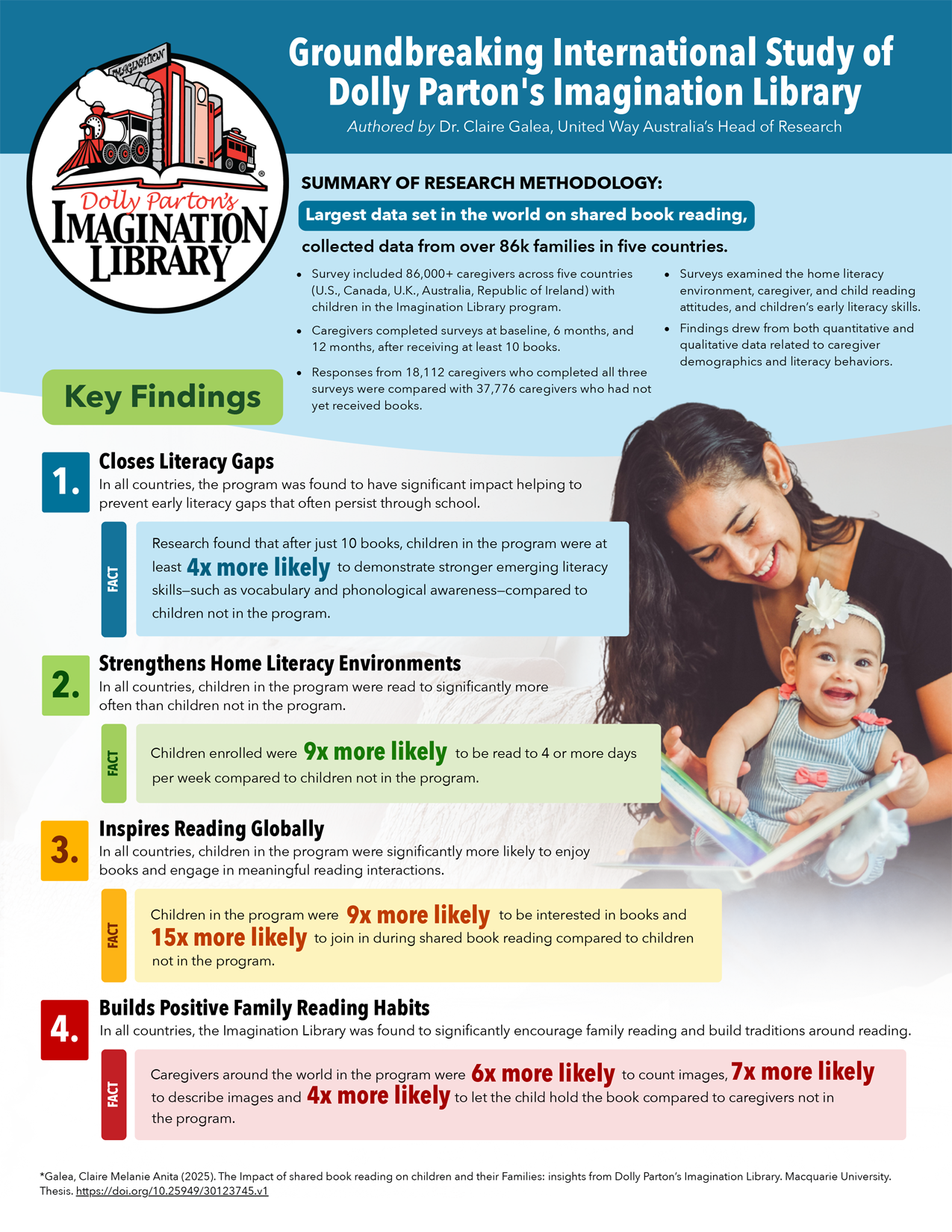 clarity that’s easy to state and hard to argue with: every child, regardless of their family’s income, should have books in their home from the moment they’re born until they start kindergarten. Enrolled children receive one free, age-appropriate book every month from birth to age five, mailed directly to their house with their name on it [5][13].
The model works because it isn’t run by Parton alone. The program is the flagship initiative of The Dollywood Foundation, a 501(c)(3) nonprofit, and it operates through cost-sharing partnerships with hundreds of local community organizations, libraries, United Ways, school districts, and state agencies [13]. Parton’s organization typically covers a portion of the per-book cost, while local partners — sometimes funded by state legislatures, sometimes by nonprofits or county governments — cover the rest and handle outreach and enrollment in their communities. This decentralized funding structure is precisely why the program has been able to scale into a global phenomenon. It’s also the program’s largest vulnerability.
The Scale of Impact
The numbers involved are difficult to overstate. As of March 2026, the Imagination Library has gifted more than 314 million books to children across the United States, Canada, the United Kingdom, Australia, and the Republic of Ireland, and it now mails over 3.4 million books every single month [11]. In the UK alone, where the program launched in 2007, more than 7 million free books have been distributed to children since its debut [16].
But raw volume has never been the most interesting part of the Imagination Library’s story — the question that’s mattered most to researchers and policymakers is whether the books actually change outcomes for kids. That question got its most 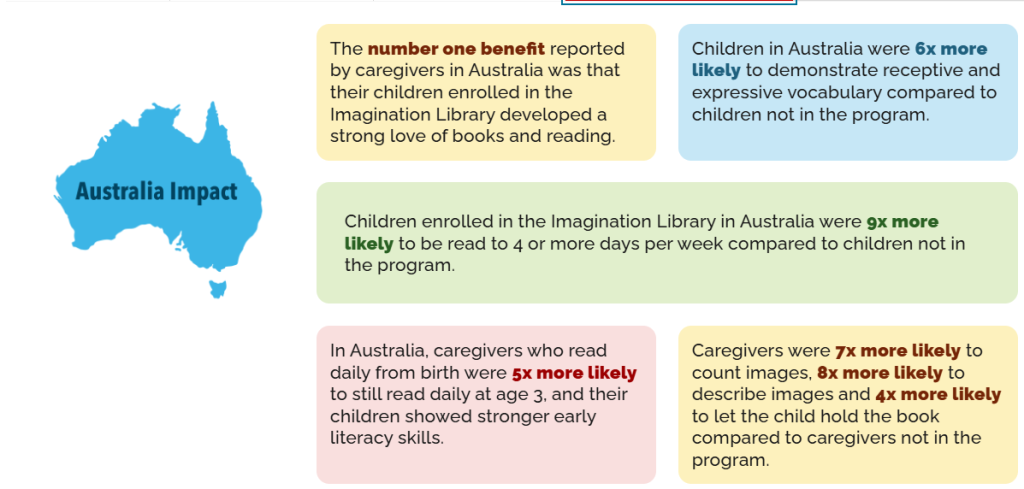
 authoritative answer yet in early 2026.
A Landmark Research Milestone
In February 2026, the Imagination Library announced results from what organizers describe as the largest dataset ever collected on shared book reading [12][13]. Conducted by Dr. Claire Galea, Head of Research at United Way Australia, the study followed more than 86,000 caregivers across the United States, Canada, the United Kingdom, Australia, and the Republic of Ireland over twelve months, with surveys administered at baseline, six months, and twelve months [13][17]. Researchers
compared those families against a control group of more than 37,000 caregivers whose children had not yet received Imagination Library books [12].
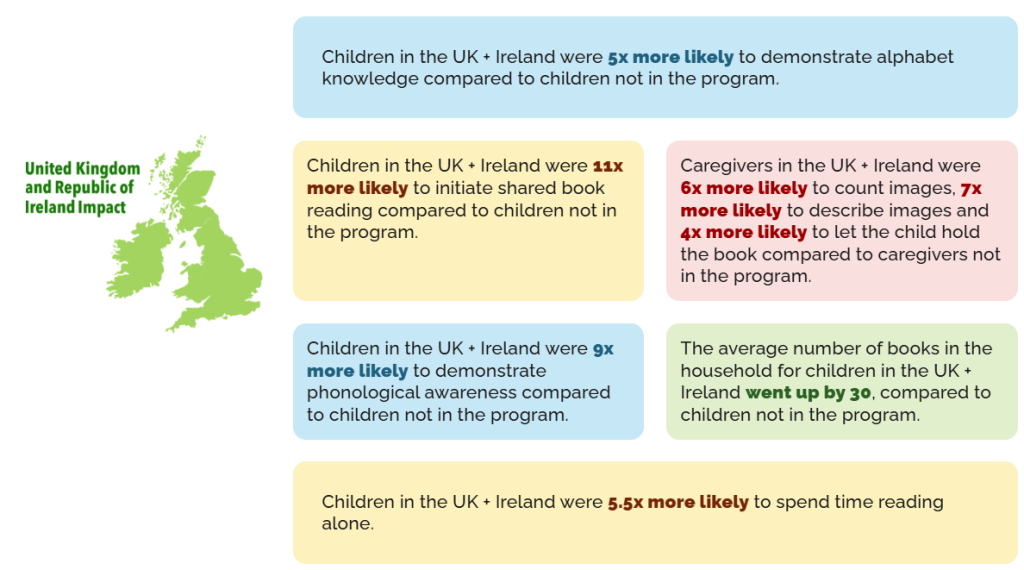
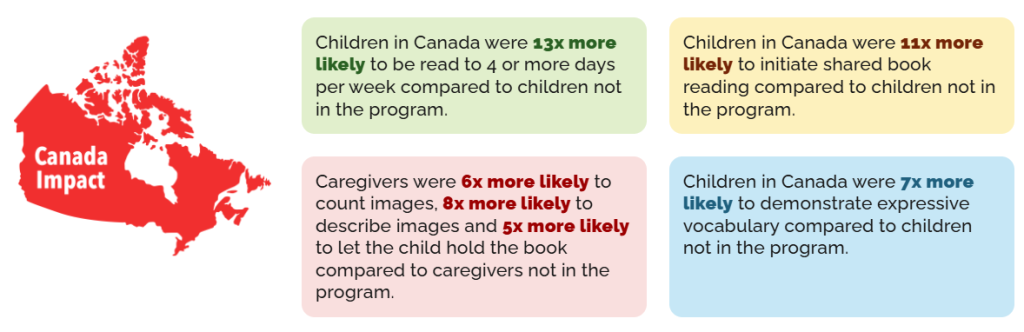
The findings were striking in part because of how little it took to produce them. After receiving just ten books — roughly the program’s first ten months of mailings — children enrolled in the program showed measurably stronger early literacy skills, including vocabulary development and phonological awareness, compared to children who weren’t yet enrolled [11]. The effect extended well beyond the books themselves: enrolled children were nine
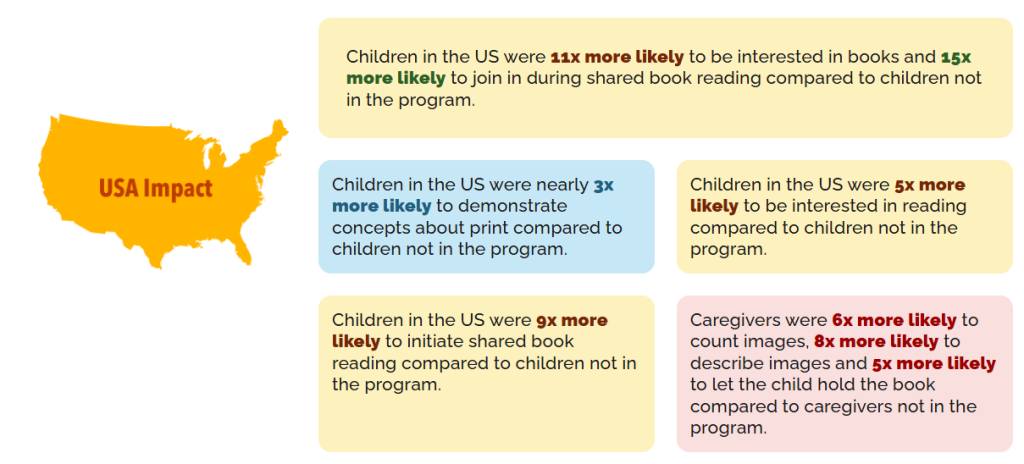
times more likely to initiate shared reading on their own and nearly three times more likely to understand basic print concepts, such as how a book is structured and read [18]. In the UK arm of the study, researchers found that while children in the program had received ten books through the Imagination Library itself, the total number of books in those households rose by an average of 30 over the same period — evidence that the program was sparking broader family reading habits rather than simply supplying isolated titles [17].
Perhaps the most policy-relevant finding was that the benefits were not evenly distributed: the research found the largest gains in literacy and family reading routines occurred in communities facing the greatest economic and educational barriers [13]. That detail matters enormously for state and local governments deciding whether the program is worth public investment, since it suggests the Imagination Library functions less as a universal nicety and more as a targeted tool for closing early opportunity gaps before children ever reach a classroom.
Growth on the Ground
While the research made headlines, the day-to-day story of the Imagination Library in 2026 has mostly been one of expansion. New local chapters have launched or grown in communities across the country this year: Monterey County, California, held a launch event in mid-June featuring local officials reading to children at a press conference [8]; the Imperial Valley in California is preparing to bring the program to an estimated 13,000 eligible children ahead of the new school year [5]; Ector County, Texas, expanded its reach through a grant from the Texas State Library and Archives Commission [9]; and Columbus County, North Carolina, recently reopened registrations after a temporary pause [7]. In Pittsburgh, Reading Ready Pittsburgh has been working with the program for eight years and is now pushing to move enrollment of children under five from roughly 30 percent toward full coverage [2].
These local stories illustrate how the Imagination Library actually functions in practice — not as a single national program, but as a patchwork of community partnerships, each requiring its own local champions, funding stream, and outreach effort to find and enroll eligible families.
The Missouri Funding Fight
That patchwork model is also why a single state budget decision can put thousands of children’s enrollment at risk. In 2025, Missouri became one of eleven states to provide full statewide government investment in the Imagination Library, guaranteeing coverage for every eligible child [6]. But the state’s fiscal year 2027 budget cut funding for the program from nearly $6 million to roughly $2 million, a reduction serious enough that the program announced it would stop accepting new  enrollments as of July 1, 2026, while continuing to mail books to children already signed up for as long as funding allows [3][6]. The Missouri Department of Elementary and Secondary Education confirmed that existing enrollees would continue to receive books. Still, the freeze on new sign-ups effectively shuts the door on any child born in the state after that date until funding is restored [6]. As of early June, the foundation overseeing the program was reportedly working with the Missouri legislature to restore full funding [3].
The Missouri situation is a useful reminder that the Imagination Library’s mission — get books to every child, no exceptions — is only as durable as the public and private commitments that fund it. Unlike a federal entitlement program, eligibility for the Imagination Library can effectively change at a county line or a legislative session.
Looking Ahead
Thirty years after Dolly Parton mailed her first books to children in rural Tennessee in memory of a father who never learned to read, the Imagination Library has become something closer to global infrastructure for early literacy — one validated by what researchers call the largest study of its kind, yet still dependent on a patchwork of local funding decisions that can expand or freeze enrollment overnight. The research released this year provides the program with its strongest evidence yet that a few free books, mailed consistently during a child’s earliest years, can meaningfully shift a child’s trajectory before they ever set foot in a classroom. Whether that evidence translates into more durable funding commitments — in Missouri and elsewhere — will likely shape the next chapter of the program’s growth.
Sources
- Dolly Parton’s Imagination Library. (2026, March 25). Dolly Parton’s Imagination Library Celebrates Spring Impact and Global Research Milestone. dollyparton.com. https://dollyparton.com/imagination_library
- CBS Pittsburgh. (2026, June 18). Pittsburgh expands efforts to get free books to kids through Dolly Parton’s Imagination Library. CBS News. https://www.cbsnews.com/pittsburgh/news/pittsburgh-expands-dolly-parton-imagination-library/
- Spectrum News 1. (2026, June 3). Missouri cuts budget to Imagination Library, enrollment frozen. https://spectrumlocalnews.com/mo/st-louis/news/2026/06/03/imagination-library-funding-cut-in-missouri
- Dolly Parton’s Imagination Library of Ohio. (2026, January 15). 2026 Book Lists. https://www.ohioimaginationlibrary.org/news/2vp4b7lm8eoky4t3ir8iwq2xugk27n
- KYMA. (2026, June 10). Dolly Parton’s Imagination Library set to launch in Imperial Valley. https://kyma.com/news/top-stories/2026/06/10/dolly-partons-imagination-library-set-to-launch-in-imperial-valley/
- Kaplan, Z. (2026, June 2). Dolly Parton’s free book program, Imagination Library, is set to lose funding in Missouri, reports say. NewsNation. https://www.newsnationnow.com/us-news/education/dolly-partons-free-book-program-loses-funding-missouri/
- The News Reporter. (2026). Dolly Parton’s Imagination Library registrations reopen in Columbus County. nrcolumbus.com. https://www.nrcolumbus.com/news/dolly-parton-s-imagination-library-registrations-reopen-in-columbus-county/article_ca017151-8fb8-4e2e-907d-b725aabcf58c.html
- Hernandez, R. (2026, June 18). Dolly Parton’s Imagination Library that delivers free books to young children launches in Monterey County. Monterey County Now. https://www.montereycountynow.com/svnow/news/dolly-parton-s-imagination-library-that-delivers-free-books-to-young-children-launches-in-monterey/article_eef9487d-e557-4b10-b298-07c97eca0dfd.html
- KOSA News. (2026, April 7). Dolly Parton’s Imagination Library expands to Ector County. https://www.firstalert7.com/2026/04/07/dolly-partons-imagination-library-expands-ector-county/
- CBS News Chicago. Dolly Parton launches her Imagination Library in Illinois. https://cbsnews.com/chicago/news/dolly-parton-imagination-library-illinois
- Dolly Parton’s Imagination Library. (2026, March 26). Dolly Parton’s Imagination Library Celebrates Spring Impact and Global Research Milestone. https://dollyparton.com/imagination_library/dolly-partons-imagination-library-celebrates-spring-impact-and-global-research-milestone
- Largest-Ever Shared book reading study finds Dolly Parton’s Imagination Library dramatically improves early literacy for children. (n.d.). Imagination Library of Washington. https://www.imaginationlibrarywashington.org/largest_ever_shared_book_reading_study_finds_dolly_parton_s_imagination_library_dramatically_improves_early_literacy_for_children
- Dolly Parton’s Imagination Library. International Research. imaginationlibrary.com. https://imaginationlibrary.com/international-research/
- Largest-Ever Shared-Book Reading Study Finds Dolly Parton’s Imagination Library Dramatically Improves Early Literacy for Children. (n.d.). Imagination Library of Washington. https://www.imaginationlibrarywashington.org/largest_ever_shared_book_reading_study_finds_dolly_parton_s_imagination_library_dramatically_improves_early_literacy_for_children
- Dolly Parton’s Imagination Library. Imagination Library news archive. dollyparton.com. https://dollyparton.com/imagination_library
- PRNewswire UK. (2026, February 3). Largest-Ever Shared Book Reading Study Shows Dolly Parton’s Imagination Library Dramatically Strengthens Early Literacy in the UK. https://www.prnewswire.co.uk/news-releases/largest-ever-shared-book-reading-study-shows-dolly-partons-imagination-library-dramatically-strengthens-early-literacy-in-the-uk-302676792.html
- International Research – Dolly Parton’s Imagination Library. (2026, February 3). Dolly Parton’S Imagination Library. https://imaginationlibrary.com/international-research/
- Times News. (2026, February 9). Study finds Imagination Library improves literacy. times-news.com. https://www.times-news.com/community/study-finds-imagination-library-improves-literacy/article_ce833bb6-3e09-49c6-83ac-631dde7c4046.html