
Shh… We’re Talking About You: A Jovial Look at Librarian Stereotypes
Picture the scene: a hushed room lined wall to wall with towering shelves, the faint smell of aging paper hanging in the air like a pleasant ghost, and somewhere in the middle of it all — a librarian. Perhaps she has a cardigan. Perhaps there is a cat asleep on the reference desk. Perhaps a mug of tea is steaming beside a teetering stack of novels. If any of this sounds familiar, congratulations: you have successfully activated the full librarian stereotype package.
But here’s the twist. Many of these beloved clichés are not entirely wrong — and some of them are gloriously, verifiably true. Let’s take a fond, cheerful, and thoroughly footnoted tour through the most enduring myths and realities of the library world.
1. The Book Obsession (Obviously)
Let’s start with the obvious one. Librarians love books. This is a bit like saying fish enjoy water, or that accountants have opinions about spreadsheets. Of course they do. That’s rather the point.
And while the rest of the population struggles to keep up, Americans as a whole are not exactly setting records. A December 2025 YouGov survey of over 2,200 adults found that 40% of Americans did not read a single book during the year, and among those who did, the median was a modest two books [1]. A separate 2025 peer-reviewed study found that only 16% of Americans read for pleasure on any given day [2].
Librarians, meanwhile, are surrounded by books for a living. They catalog them, shelve them, recommend them, and — one can safely assume — sneak reads of them during quiet afternoons. The book lover stereotype isn’t so much a cliché as it is a job requirement.
2. The Cat Situation
Here is where things get genuinely delightful. The librarian-cat connection is not merely a cultural joke. It is an institution with ancient roots and a surprisingly robust present.
The relationship between libraries and cats stretches back to antiquity — monastic records from the Middle Ages document the use of cats in monasteries to deter rats from chewing through precious manuscripts [3]. The practice continued right up to the modern era. There are currently more than 800 cataloged library cats worldwide, according to documentarian Gary Roma, who actually drove 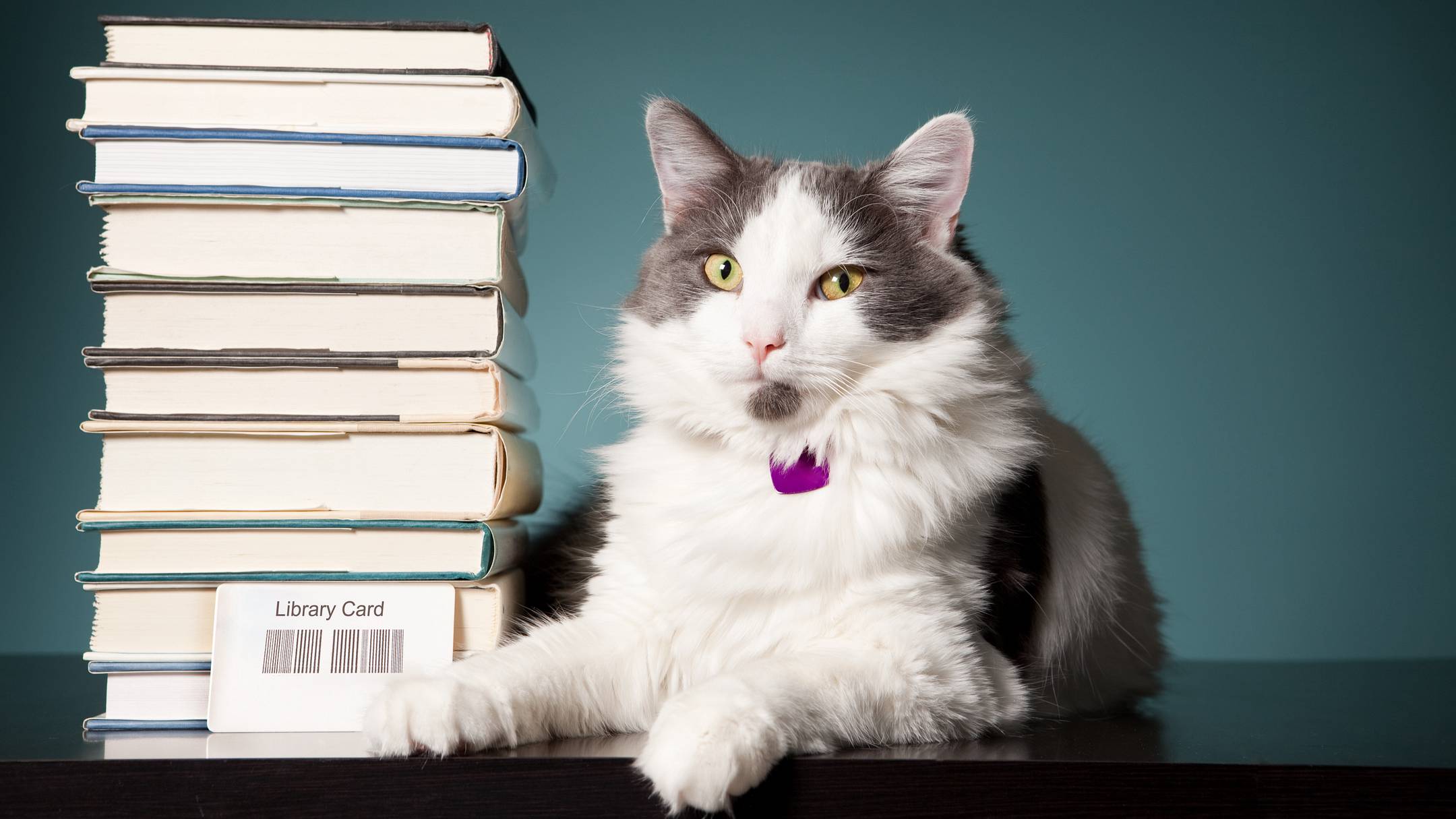 across the country to film them [4].
The most famous of these feline bibliophiles was Dewey Readmore Books, an orange tabby who was discovered as an abandoned kitten in the book drop of Spencer, Iowa’s public library in 1988. He stayed for nineteen years, became an international celebrity, and eventually inspired a bestselling book [5]. Then there was Browser, a grey cat at the White Settlement Public Library in Texas, who survived a city council vote to evict him in 2016 — a petition to keep him gathered over 12,000 signatures from as far away as Australia and Malaysia — before passing away peacefully of natural causes in September 2025 [6].
As one librarian cheerfully admitted in a widely shared online post: “There are lots of stereotypes about librarians that are not true, but the librarian and cat stereotype is absolutely true. Books and cats are just a cozy combo.” [7]
Library cats have been shown to boost staff morale, befriend nervous patrons, and generate no small amount of valuable social media publicity for their institutions [4]. They are, in other words, the perfect colleagues: warm, low-maintenance, and unlikely to complain about the break room coffee.
3. Tea (and the Serene Demeanor That Comes With It)
A warm beverage is practically a professional accessory in the library world, and tea — with its associations of calm, focus, and civilized reflection — fits the atmosphere rather perfectly.
There is science to back this up. Tea contains theanine, an amino acid that promotes relaxation without drowsiness, enhances cognitive focus, and reduces stress [8]. For someone whose job involves helping frantic students, locating obscure reference materials, and politely but firmly enforcing silence, a calming cup of something warm is not a luxury — it is a survival strategy.
Tea drinkers in the workplace have been described as bringing a “methodical and serene demeanor” to their professional environments [9], which frankly describes an excellent librarian to a T (pun very much intended).
4. The Cardigan and the Bun
Ah, the sartorial stereotype: the sensible cardigan, the hair in a bun, perhaps a pair of reading glasses perched on the nose. One librarian blogger described the classic image with affectionate exasperation as “a withdrawn, socially awkward woman with ill-fitting clothing and horn-rimmed glasses. Her hair is in a frazzled bun with a knitting needle holding it together.” [10]
Real librarians, needless to say, dress like real people — which is to say in every possible way. But one can see how the cardigan legend took hold. Libraries can be chilly. Cardigans are practical. And there is something deeply satisfying about a profession that prioritizes comfort and functionality over fashion-forward statement pieces. Let the investment bankers have their tailored suits. The librarian has pockets.
5. The “Shush” — Fact or Fiction?
The image of the stern, finger-to-lips librarian enforcing silence with the force of a disapproving deity is perhaps the most well-known cliché of them all. Modern librarians have largely moved away from this reputation — today’s library spaces often buzz with community events, children’s reading groups, and lively public programming. Yet, as the Book Riot librarian Anna Gooding-Call conceded with a  laugh: “cell phone use is still occasionally appropriate for a good shush.” [11]
Progress, then. But not complete surrender.
6. Mostly Women, and Proud of It
One stereotype that does hold up statistically: the profession skews heavily female. Women made up 82.5% of librarians in the United States as of 2023, according to the U.S. Bureau of Labor Statistics [12]. This has historical roots — the great library reformer Melvil Dewey (yes, of Dewey Decimal fame) actively recruited women into the profession in the late 19th century, partly because they would work for lower wages [11]. Librarianship, to put it mildly, has come a long way since then.
In Defense of Stereotypes (The Nice Ones, Anyway)
Stereotypes, when gentle and affectionate, can sometimes capture something true. The librarian who loves books, keeps a cat, sips tea, and cares deeply about connecting people with knowledge is not a fiction — she (or he, or they) is a reality, multiplied across tens of thousands of libraries worldwide.
These are people who fought for intellectual freedom, built programs for underserved communities, and kept the lights on for curious minds when everywhere else charged admission. If they occasionally do it in a cardigan while a cat sleeps on a nearby chair and a mug of tea cools beside the keyboard — well, honestly, that sounds like the best possible way to spend a working day.
The next time you walk into a library and spot all the clichés in glorious, cozy alignment, don’t smirk. Sit down, grab something off the shelf, and appreciate that some stereotypes exist simply because the reality behind them is worth celebrating.
Sources
[1] YouGov / Book Riot. (January 2026). American Reading Habits Survey 2025. Retrieved from https://bookriot.com/american-reading-habits-2025/
[2] Dataopedia. (January 2026). Reading Statistics: 2026 Outlook. Retrieved from https://dataopedia.com/reading-statistics/
[3] Mental Floss. (2023). A Brief History of Library Cats. Retrieved from https://www.mentalfloss.com/animals/cats/library-cat-history
[4] Wikipedia. (2024). Library cat. Retrieved from https://en.wikipedia.org/wiki/Library_cat
[5] Priceonomics. (2022). The World’s Most Famous Library Cat. Retrieved from https://priceonomics.com/the-worlds-most-famous-library-cat-dewey-readmore/
[6] Wikipedia. (2025). Browser (cat). Retrieved from https://en.wikipedia.org/wiki/Browser_(cat)
[7] Fark.com. Librarian’s quote on cats and books. Retrieved from https://www.fark.com/comments/13423562/
[8] Ideal Pure Water. (2021). Should Employers Provide Tea and Coffee? Retrieved from https://www.idealpurewater.com/should-employers-provide-tea-and-coffee
[9] ThoughtLab. Percolating Culture: Coffee and Tea in the Workplace. Retrieved from https://www.thoughtlab.com/blog/percolating-culture-coffee-and-tea-in-the-workplac/
[10] Words on the Shelf / TC Library Blog. (2016, updated 2025). The Librarian’s Image Problem. Retrieved from https://tclibraryblog.wordpress.com/2016/03/15/the-librarians-image-problem/
[11] Book Riot. (2020). The History and Debunking of Librarian Stereotypes. Retrieved from https://bookriot.com/librarian-stereotypes/
[12] Hiring Librarians. (July 2025). The Current State of Female Representation in Library Leadership in the U.S. Retrieved from https://hiringlibrarians.com/2025/07/11/researchers-corner-the-current-state-of-female-representation-in-library-leadership-in-the-u-s/