
Library Cybersecurity in 2026: Why It Matters, and How Libraries Can Fight Back
In 2026, the long-held trust that libraries protect information is under sustained digital assault. From small rural branches to national institutions, cybercriminals treat libraries as soft, high-value targets—repositories of patron data, financial systems, and public-facing infrastructure that often run on constrained budgets and thin IT staffs. Understanding why libraries have become targets, considering whether to bring in a commercial cybersecurity vendor, and knowing the practical defenses available are now core parts of running a library, not a side concern for the IT department.
Why Library Cybersecurity Matters Now
The scale of the ransomware problem in 2026 is not abstract. Black Kite’s 2026 Ransomware Report found that 61 new ransomware groups entered the market between April 2025 and March 2026 — more than one new group per week — bringing the total number of active threat groups to 146
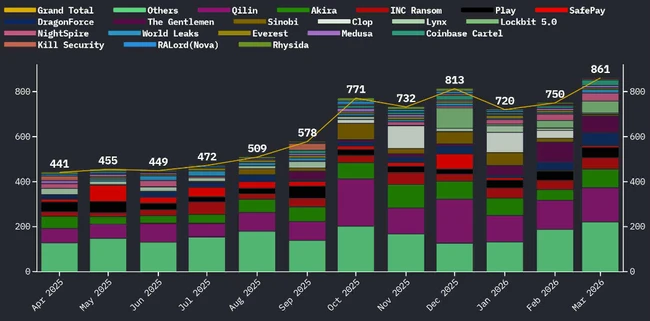
Monthly victim count by threat actor (Source: Black Kite)
by June 2026, with the five largest groups responsible for 43.6% of all victims [1]. Education and public-sector institutions, the category libraries fall into, have been hit especially hard. Comparitech’s Education Ransomware Roundup found that attacks against higher education rose 8% in the first half of 2026 compared to the previous six months, driven largely by a new ransomware operation called “The Gentlemen,” whose attacks on the education sector grew 275% during the period [2]. The financial stakes have also risen sharply: the median ransom demand against education-sector victims hit $420,620 in the first half of 2026, up 53% from the prior half-year period [2].
Libraries are not bystanders to this trend — they are named targets. The Digital Librarian’s 2026 trend report points directly to a pattern of ransomware strikes against public libraries, citing Seattle Public Library, Toronto Public Library, and Michigan’s Orion Township Public Library as high-profile examples, and warns that generative AI is now letting non-experts build malware and craft convincing deepfake or voice-cloned social engineering attacks, further raising the sophistication of threats aimed at libraries and their patrons [3]. The British Library’s late-2023 ransomware attack remains a cautionary case study still being cited in library literature: attackers stole and leaked internal HR data and knocked out the library’s website, phone lines, on-site Wi-Fi, and payment systems for weeks, with recovery dragging on for months afterward [4][5]. Writing in College & Research Libraries, Fiscus notes that educational and cultural institutions are attractive targets precisely because they hold large volumes of sensitive personal data—student, staff, and patron records—while operating with comparatively limited security budgets, a mismatch cybercriminals have learned to exploit [4].
Why does this matter beyond the IT department? Libraries are civic infrastructure. A successful attack does not just lock a server room — it can take down public catalogs, self-checkout systems, meeting-room bookings, public Wi-Fi, and the payment systems patrons rely on for printing and fines, while also exposing patron reading histories and personal data that libraries have a professional and ethical obligation to protect. Recovery is neither quick nor cheap; industry-wide, average ransomware recovery costs across sectors reached $2.73 million in 2026, and even when libraries pay far less, operational disruption and reputational damage can be severe and long-lasting [6].
The Case for (and Against) a Cybersecurity Vendor
Given the scale of the threat, many libraries are asking whether they need to bring in a dedicated cybersecurity vendor rather than relying solely on in-house IT staff or a parent government/university IT department. This is not a simple yes-or-no question, and it comes with  real tradeoffs.
The case for investing in a vendor:
- Specialized expertise at a fraction of in-house cost. Most libraries, especially public libraries, cannot afford to hire a dedicated security operations team. Vendors offer access to threat intelligence, 24/7 monitoring, and incident response expertise that would otherwise be out of reach. Government procurement data from 2026 shows agencies and library-adjacent institutions signing meaningful but manageable contracts — for example, endpoint protection retainers in the tens of thousands of dollars annually — that would be far more expensive to replicate with in-house hires [7].
- Funding is increasingly available to offset the cost. The FCC voted to launch a $200 million cybersecurity pilot program specifically to help libraries and schools purchase advanced cybersecurity tools, and the American Library Association has continued to push for this to become a permanent E-rate funding stream [8]. Separately, E-rate already reimburses libraries and schools for 20–90% of eligible technology costs, and vendors like Fortinet have built pricing and bundling specifically around E-rate eligibility, making vendor-provided firewalls and network security appliances substantially more affordable [7].
- Faster response to a fast-moving threat landscape. With AI-driven attacks, deepfake social engineering, and near-weekly emergence of new ransomware groups, few library IT departments can keep pace with threat intelligence updates on their own [1][6]. Vendors whose entire business is tracking these shifts can push out defenses faster than a general-purpose IT team.
- Modern library systems increasingly assume vendor involvement. The 2026 Library Systems Report notes that “legacy ILS products will increasingly be seen as liabilities” and that libraries deferring system replacements will eventually be forced to modernize to meet cybersecurity requirements — a modernization path that, in practice, usually runs through vendor relationships [9].
The case for caution:
- Cost and budget competition. Even with E-rate offsets, vendor contracts are a recurring line item that competes with collections, programming, and staffing budgets — an acute tension given that library systems reporting in 2026 describes an environment of “austerity” across the sector, with staff reductions a persistent, multi-year trend [9].
- Vendor relationships expand the attack surface. Bringing in a third party means trusting another organization with access to library systems and, potentially, patron data. Supply-chain compromises were a recurring theme in 2026 incident reports — including a supply-chain attack on AI development tools used by Hugging Face and disruptions tied to third-party and identity-related weaknesses at multiple organizations — a reminder that vendors themselves can become the point of failure [10].
- No vendor is a substitute for institutional practices. A firewall or endpoint protection subscription does not fix weak password policies, unpatched systems, or untrained staff. The British Library case and similar incidents make clear that the initial point of compromise is often human or procedural, not something a vendor’s software alone can prevent [4][5].
- Vendor lock-in and integration complexity. Library systems reporting in 2026 notes a growing trend toward bundling — for example, Koha installations paired with Aspen Discovery, or Polaris paired with the Vega LX suite — which can simplify security management but also reduces a library’s flexibility to switch vendors or mix best-of-breed tools later [9].
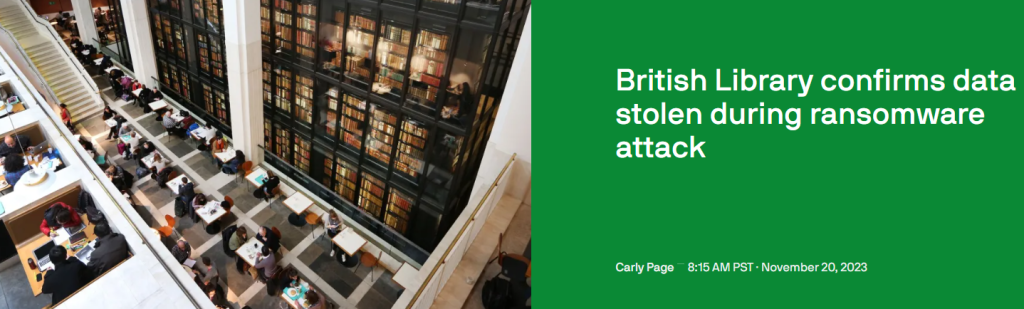
https://techcrunch.com/2023/11/20/british-library-employee-data-stolen-ransomware-attack/
The reasonable middle path most library technology observers point toward is not “vendor versus no vendor” but matching vendor investment to actual risk and budget, while treating vendor tools as one layer of a broader security posture rather than a complete solution.
Practical Ways Libraries Can Defend Themselves
Whether or not a library brings in a vendor, several concrete steps are consistently recommended across 2026 library-sector guidance:
- Staff training remains the first line of defense. The Fiscus case study on the British Library attack specifically credits staff cybersecurity training with preventing further compromise, noting that colleagues who had been through annual training recognized and reported a suspicious phishing email rather than opening it [4]. Regular, low-cost training — including on AI-generated phishing and deepfake voice scams — is one of the highest-return investments a library can make [3].
- Patron-facing digital literacy programs. The Public Library Association has built out cybersecurity-focused templates on DigitalLearn.org so libraries can run their own community classes covering safe browsing, antivirus basics, and password hygiene, extending the library’s protective role beyond its own network to the community it serves [11].
- Pursue available public funding rather than treating cybersecurity as a fully self-funded cost. Between E-rate reimbursements and the FCC’s cybersecurity pilot, libraries have real avenues to offset the cost of firewalls, endpoint protection, and monitoring tools — funding that the ALA continues to advocate for making permanent [7][8].
- Modernize legacy systems on a real timeline. Deferred ILS and infrastructure upgrades are increasingly flagged as security liabilities, not just efficiency problems; the 2026 Library Systems Report is explicit that libraries putting off system replacement will eventually be forced into it by cybersecurity requirements, so planning the transition proactively is cheaper than reacting to a breach [9].
- Harden infrastructure and plan for incident response before an attack, not during one. The Digital Librarian’s 2026 guidance frames the priorities plainly: harden systems to reduce the chance of a successful intrusion, limit the blast radius when one occurs, and have a tested recovery plan ready, since some level of attempted compromise is now treated as a near-certainty rather than a remote risk [3].
- Scrutinize vendor and supply-chain relationships. Given how often 2026 breaches trace back to third-party or identity weaknesses, libraries evaluating any vendor — cybersecurity or otherwise — should ask about that vendor’s own security practices, data handling, and incident history before signing a contract [10].
Libraries in 2026 are operating in a threat environment that has genuinely shifted: more ransomware groups, higher ransom demands, AI-assisted social engineering, and repeated real-world incidents at public and academic libraries alike. A cybersecurity vendor can offer expertise and monitoring capacity that  most library IT teams cannot build alone, and public funding mechanisms are making that investment more attainable. But vendors are a layer of defense, not a substitute for trained staff, hardened infrastructure, and a tested incident-response plan. The libraries best positioned heading into the rest of 2026 are the ones treating cybersecurity as an ongoing institutional practice — combining smart, funded vendor partnerships with the staff training and infrastructure planning that no vendor contract can replace.
Sources
- Pogorelec, A. (2026, July 24). Ransomware in 2026: More groups, more victims, no slowdown. Help Net Security. https://www.helpnetsecurity.com/2026/07/24/ransomware-attack-trends-2026-report/
- Ransomware Attacks Targeting Universities on the Rise. (2026, August). Infosecurity Magazine. https://www.infosecurity-magazine.com/news/university-ransomware-attacks-rise/
- Library Tech Trends for 2026. (2026, February 3). The Digital Librarian. https://the-digital-librarian.com/2026/02/03/library-tech-trends-for-2026/
- Fiscus, J. Knowledge Held Hostage: What the British Library Ransomware Attack Can Teach Us. College & Research Libraries. https://crl.acrl.org/index.php/crl/article/view/26408/34343
- British Library confirms ransomware attack led to data theft. TechCrunch. https://techcrunch.com/?p=2631487
- Cybersecurity Threats 2026: Ransomware, AI Attacks & Defense. (2026, April 21). JazzCyberShield. https://blog.jazzcybershield.com/cybersecurity-threats-2026/
- Government Cybersecurity Spending in 2026: Vendors & Cost. (2026, July). Civic IQ. https://civiciq.com/blog/government-cybersecurity-spending-2026
- American Library Association welcomes FCC cybersecurity funding pilot for libraries, calls for long-term funding. (2024, June 6). ALA. https://www.ala.org/news/2024/06/american-library-association-welcomes-fcc-cybersecurity-funding-pilot-libraries-calls
- Breeding, M. (2026, May 5). Library Systems Report 2026: Innovation under constraint: how libraries and vendors navigate austerity and AI disruption. Library Technology Guides. https://librarytechnology.org/LibrarySystemsReport/2026
- Major Cyber Attacks, Data Breaches, Ransomware Attacks in July 2026. CM-Alliance. https://www.cm-alliance.com/cybersecurity-blog/major-cyber-attacks-data-breaches-ransomware-attacks-in-july-2026
- Public libraries highlight cyber security awareness in October. ALA. https://www.ala.org/news/2017/10/public-libraries-highlight-cyber-security-awareness-october