The Modern University Librarian: Skills and Characteristics for Success
The university librarian of the twenty-first century bears little resemblance to the quiet guardian of card catalogs that popular culture once imagined. Today’s academic library professional is a digital navigator, research educator, data specialist, and community advocate—often all before lunch. As the International Federation of Library Associations (IFLA) made clear in its 2024 Trend Report, library professionals must actively embrace a skills agenda aligned with emerging trends in knowledge creation, technological  transformation, and evolving community needs [1]. For those considering or building a career in university librarianship, understanding which skills and characteristics drive success is both practically important and professionally urgent.
Digital and Technological Proficiency
Perhaps no skill has grown more essential more quickly than technological fluency. Digital literacy—the ability to find, evaluate, and create content using information technologies and the internet—sits at the core of the modern librarian’s toolkit [1]. University librarians must be proficient with databases, institutional repositories, e-resources platforms, metadata systems, and an ever-expanding suite of multimedia tools. They are increasingly expected not just to use these technologies themselves, but to teach them to others: students, faculty, and fellow staff.
This requirement extends meaningfully into artificial intelligence. A 2024 survey of academic libraries found that more than 60% were planning or actively integrating AI into their services [2]. The  Association of College and Research Libraries (ACRL) has responded by publishing a dedicated framework of AI competencies for academic library workers, calling for dispositions such as curiosity, skepticism, judgment, and responsibility when engaging with AI tools [3]. A 2025 scoping review in Library & Information Science Research further confirmed that library professionals now play a central role in promoting AI literacy through workshops, LibGuides, and instructional programs—while simultaneously needing to develop their own AI fluency [4]. The implication is clear: a university librarian who cannot engage critically and practically with AI tools will find themselves increasingly sidelined.
Information and Data Literacy Instruction
Academic librarians have long been educators, but the scope of that role has widened considerably. University librarians are now regularly tasked with embedding information literacy instruction across disciplines, collaborating with faculty to design curricula, and guiding students through the complex, often murky landscape of scholarly sources, open access repositories, and generative AI outputs.
Research published in 2025 in the Journal of Academic Librarianship described a tiered AI literacy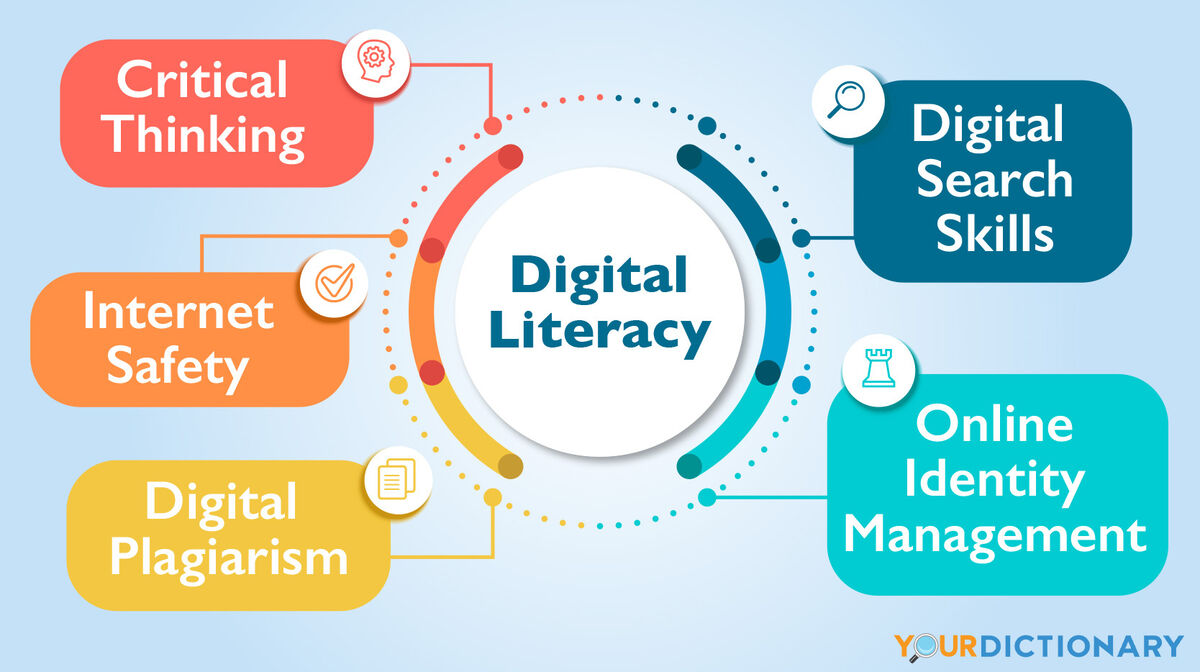 curriculum model grounded in both the ACRL Framework for Information Literacy and an updated AI literacy framework, emphasizing that librarians must integrate technical proficiency, ethical understanding, and critical evaluation into their instruction [5]. This represents a significant broadening of the instructional librarian’s mandate: the job is not merely to teach students where to find information, but also how to think about the information—and about the tools that generate it.
Data literacy is an equally important dimension of this instructional role. University librarians who understand how to collect, interpret, and communicate data are better positioned to support research partnerships, advise on data management plans, and help patrons develop analytical skills that are increasingly demanded by employers [1].
Research Support and Subject Expertise
Successful university librarians combine broad institutional knowledge with deep subject expertise. Many academic libraries employ specialist liaison librarians aligned to particular schools or departments—sciences, humanities, law, medicine—who develop familiarity with discipline-specific databases, citation practices, and research methodologies. This subject knowledge enables meaningful collaboration with faculty and graduate researchers, rather than superficial transactional assistance.
Research support increasingly means engagement with the full research lifecycle: from initial literature searches through grant support, data management, open access publishing, and research impact tracking. A 2024 study from Ithaka S+R found that library leaders ranked student success as their highest recruitment focus, signaling that librarians’ contributions to research and learning outcomes are  being taken seriously at the institutional level [6].
Communication and Interpersonal Skills
Technical expertise means little if a librarian cannot communicate effectively. University librarians routinely interact with students from diverse backgrounds, faculty with varying expectations, administrators who control budgets, and external partners. Strong written and verbal communication skills—including the ability to present complex information clearly—are fundamental.
Beyond formal communication, interpersonal warmth and empathy are distinguishing characteristics of excellent librarians. The reference desk interaction, whether in person or virtual, requires the ability to listen carefully, ask clarifying questions, and respond to users who are often frustrated or unsure about what they need. A librarian who can make a first-year student feel confident, or help a doctoral candidate reframe an unfocused research question, provides a service that no database can replicate.
The importance of active listening and user-centered service is reflected across the professional literature. Core competencies identified by library science programs consistently include the capacity for respectful, non-judgmental engagement with a wide range of patrons [7].
Leadership, Project Management, and Adaptability
University librarians rarely work in isolation. They manage teams, plan and deliver programs, oversee complex budget negotiations, and coordinate with IT departments, publishers, and academic administrators. Leadership and project management skills allow librarians to implement sophisticated initiatives, manage resources effectively, and move colleagues toward shared strategic goals [1].
Equally important is adaptability. The Librarian Futures report, published in Against the Grain in January 2024, found that librarians and library leaders alike identified short-, medium-, and long-term skill development as crucial—particularly the ability to adjust to rapid change in information technology, publishing models, and user behavior [6]. A career in university librarianship today requires a commitment to continuous learning; those who resist change or cling to outdated workflows will struggle.
Employment data support a modest but steady outlook for the profession: the U.S. Bureau of Labor Statistics projects 2% growth in librarian employment from 2024 to 2034, with approximately 13,500 job openings expected annually [8]. The librarians who will fill and flourish in these roles will be those who combine foundational expertise with the flexibility to evolve.
Ethical Commitment and Advocacy
University librarianship is, at its core, a values-driven profession. Librarians are expected to uphold principles of intellectual freedom, privacy, equitable access to information, and the ethical use of data and technology. The ACRL’s AI competency framework explicitly calls for ethical awareness as a core disposition—not simply an add-on [3]. This matters because librarians are regularly confronted with real 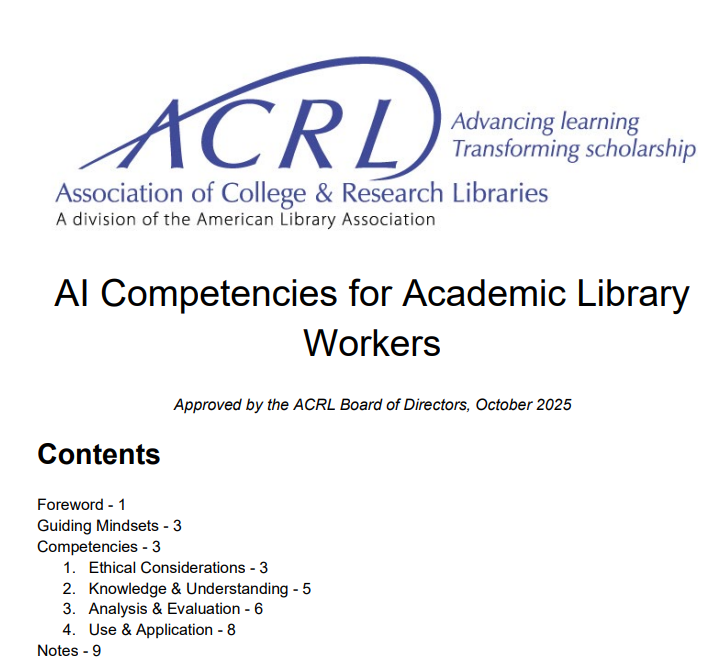 ethical dilemmas: balancing open access ideals against licensing realities, navigating patron privacy in an era of surveillance capitalism, or deciding how to present AI-generated content in instructional settings.
Advocacy is the outward expression of this ethical commitment. Successful university librarians advocate for their institutions, their patrons, and the broader information ecosystem—whether by lobbying for adequate library budgets, championing open-access publishing, or representing the library’s interests on curriculum committees. This requires professional confidence and the ability to articulate the library’s value to stakeholders who may not immediately appreciate it.
Conclusion
Success as a university librarian today demands a blend of technical capability and human skill that would have seemed extraordinary to the profession a generation ago. Digital and AI literacy, instructional expertise, subject knowledge, communication ability, leadership, adaptability, and a strong ethical compass are not optional extras—they are the architecture of the contemporary academic library career. As the IFLA and ACRL have both signaled, the profession’s future belongs to those who treat learning as a lifelong commitment and who understand that a library, at its best, is not a place where information is stored, but one where it is made meaningful.
Sources
[1] Gardella, G. (2025, December 19). Top 15 must-have skills for today’s librarian. LibLime. https://liblime.com/2025/12/19/top-15-must-have-skills-for-todays-librarian/
[2] Proquest/Clarivate. (2025, July 18). Bridging the AI skills gap: A new literacy program for academic libraries. https://about.proquest.com/en/blog/2025/bridging-the-ai-skills-gap-a-new-literacy-program-for-academic-libraries/
[3] Association of College and Research Libraries. (2025). AI competencies for academic library workers. American Library Association. https://www.ala.org/acrl/standards/ai
[4] Ali, M. Y., & Richardson, J. (2025). AI literacy guidelines and policies for academic libraries: A scoping review. Library & Information Science Research. https://journals.sagepub.com/doi/abs/10.1177/03400352251321192
[5] LaFlamme, K. A. (2025). Scaffolding AI literacy: An instructional model for academic librarianship. Journal of Academic Librarianship. https://www.sciencedirect.com/science/article/abs/pii/S0099133325000370
[6] Weldon, M., & Hayes, M. (2024, January 9). Librarian futures part III: The librarian skills landscape. Against the Grain / Charleston Hub. https://www.charleston-hub.com/2024/01/librarian-futures-part-iii-the-librarian-skills-landscape/
[7] MastersinLibraryScience.net. (2022). Librarian skills & core competencies: Qualities of a good librarian. https://www.mastersinlibraryscience.net/core-competencies-of-librarianship/
[8] Syracuse University iSchool. (2026). How to become a librarian: Steps, skills & career tips. https://ischool.syracuse.edu/how-to-become-a-librarian/