
Faltering Foundations: Feds Find Libraries Falling Apart
A landmark federal investigation has exposed a national crisis in public library infrastructure, revealing that nearly 40 percent of America’s libraries are operating with building systems in disrepair. The findings, released this month by the U.S. Government Accountability Office, paint a troubling picture of the civic institutions that serve as cornerstones of millions of communities nationwide.

https://files.gao.gov/reports/GAO-26-107262/index.html
The GAO report, commissioned by Congress, represents the first comprehensive national assessment of library facility conditions in decades. Surveying approximately 16,400 public libraries across all 50 states, the District of Columbia, and four territories, investigators found that an estimated 6,000 libraries have at least one critical building system—such as heating, ventilation, or air conditioning—in poor condition (1). More concerning still, roughly 61 percent of libraries, or approximately 9,800 facilities, have at least one building system or feature that poses a potential health or safety concern (2).
The implications for communities are profound. Libraries have evolved far beyond their traditional role as repositories for books, now serving as emergency shelters, voting sites, and vital access points for technology and internet connectivity. In times of crisis, entire communities rely on libraries for disaster relief resources and essential services (3). Yet many of these facilities are struggling to meet these expanded responsibilities amid deteriorating infrastructure.
The financial burden is staggering. An estimated 70 percent of libraries carry a backlog of deferred maintenance and repair work, with nearly 40 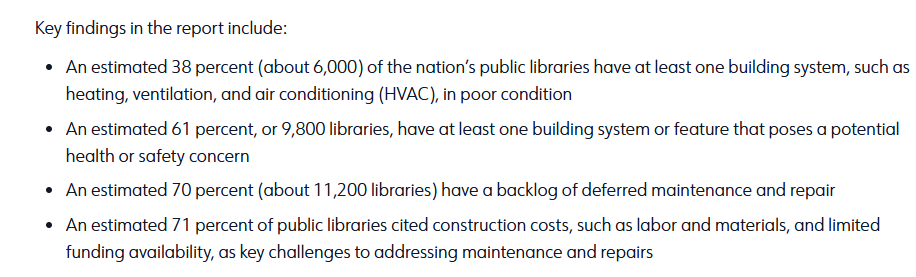 percent facing costs exceeding $100,000 each (1). Individual repair needs range from $60,000 for HVAC replacement to over $225,000 for comprehensive projects, including asbestos removal (4). Perhaps most troubling, survey data indicate that 70 percent of libraries expect their deferred maintenance backlogs to persist or increase over the next three years (5).
The crisis disproportionately affects specific communities. Small rural libraries and those in high-poverty areas face distinct challenges, deprived by limited local tax bases and fewer resources to seek grants or fundraising initiatives (1). These facilities often operate in older structures—with 31 percent of libraries housed in buildings constructed before 1964 and 16 percent in structures over a century old (4). The aging infrastructure creates additional vulnerabilities to natural disasters and extreme weather events.
American Library Association President Sam Helmick emphasized the disconnect between libraries’ critical community role and their physical conditions. Libraries serve as places where Americans “find a job, learn to parent, finish homework, start a business,” yet many buildings fall short of community needs (2). The ALA advocated for the congressional study and welcomed the comprehensive data as validation of concerns library professionals have voiced for years.
Federal funding structures compound the problem. While the Institute of Museum and Library Services provides support for library programs and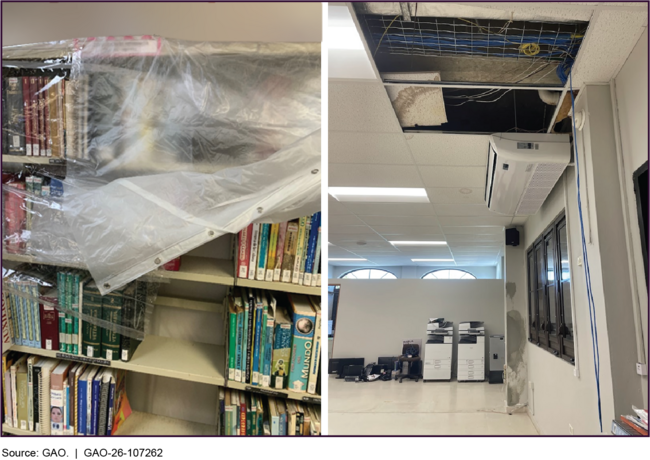 services, these funds cannot be used for building construction or repairs (1). This restriction leaves libraries dependent on local funding streams, which 90 percent already rely upon for maintenance and repairs (4). Construction costs, including rising labor and materials expenses, were cited by 71 percent of libraries as key challenges to addressing their facility needs (5).
As library buildings continue to age and deteriorate, the investigation raises urgent questions about how communities will preserve these essential civic institutions for future generations. Without significant intervention, the deferred maintenance crisis threatens not only the buildings themselves but the vital services they provide to more than 800 million visitors annually across the nation’s 17,000 public library locations (3).
Sources:
- U.S. Government Accountability Office. (2025). Public Libraries: Many Buildings Are Reported to Be in Poor Condition, with Increasing Deferred Maintenance (GAO-26-107262). https://www.gao.gov/products/gao-26-107262
- American Library Association. (2025, December 18). ALA welcomes pathbreaking study on the state of the nation’s library facilities. https://www.ala.org/news/2025/12/ala-welcomes-pathbreaking-study-state-nations-library-facilities
- Jensen, K. (2025, December 19). U.S. Public Library Buildings Are In Poor Condition, Per a New Government Report. Book Riot. https://bookriot.com/gao-report-on-public-library-buildings
- U.S. Government Accountability Office. (2025). PUBLIC LIBRARIES: Many Buildings Are Reported to Be in Poor Condition, with Increasing Deferred Maintenance (Full Report). https://files.gao.gov/reports/GAO-26-107262/index.html
- Washington Stand. (2025, December 18). More Than Two-Thirds of Public Libraries Face Major Maintenance Challenges. https://washingtonstand.com/article/more-than-twothirds-of-public-libraries-face-major-maintenance-challenges