
Automated Material Handling Systems (AMHS) in Large Libraries: Efficiency, Cost-Effectiveness, and User Perception of Robotic Book Retrieval
Libraries have long served as cultural and educational cornerstones, and as their collections grow in scale and complexity, the challenge of efficient material management has intensified. Automated Material Handling Systems (AMHS)—encompassing technologies such as Automated Storage and Retrieval Systems (AS/RS), Autonomous Mobile Robots (AMRs), and Radio-Frequency Identification (RFID)-based sorting systems—are reshaping how large libraries store and retrieve physical items. These solutions were once the exclusive domain of industrial warehousing, but they have migrated into academic and public library environments with considerable promise. This article evaluates the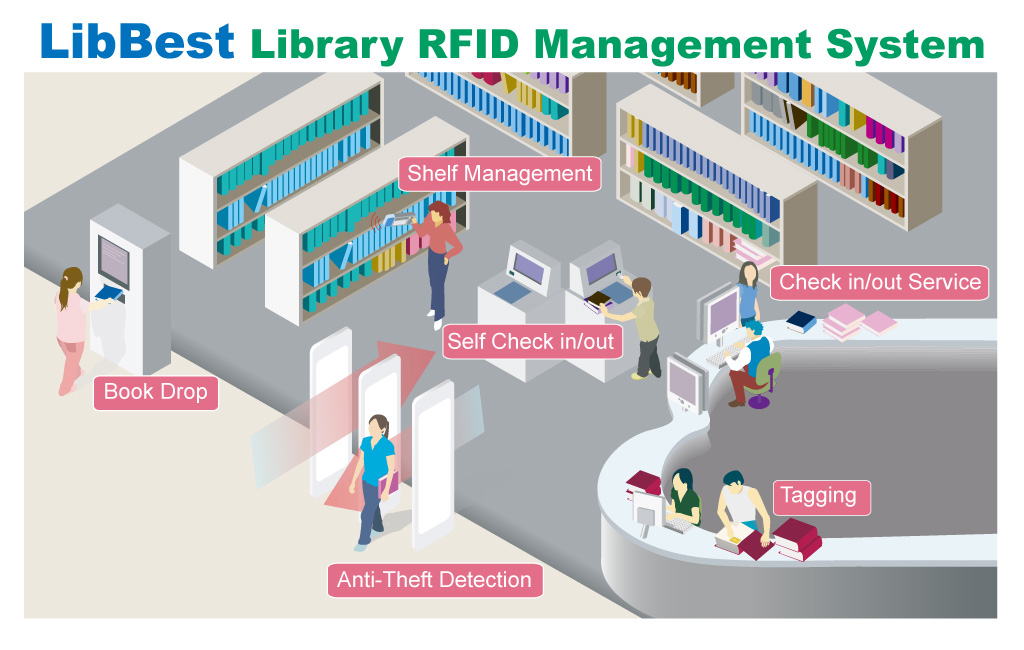 efficiency gains, cost implications, and user perceptions associated with robotic book retrieval systems in larger library settings, drawing on recent research and real-world case studies.
Operational Efficiency: Speed, Accuracy, and Space
The most frequently cited advantage of library AMHS is the dramatic improvement in retrieval speed and accuracy. Modern robotic retrieval systems can locate and deliver items with remarkable speed—typically in under five minutes—and virtually eliminate the retrieval errors that are endemic to manual workflows.1
The University of Technology Sydney (UTS) offers one of the most studied examples. The institution installed a Library Retrieval System (LRS) comprising six large robotic cranes that tend to thousands of closely packed bins of books stored beneath the library floor. When a patron requests a stored item from the online catalogue, the LRS is automatically triggered, a crane retrieves the appropriate bin, and a staff member delivers the book to the hold shelf. This complete process generally takes around fifteen minutes.2
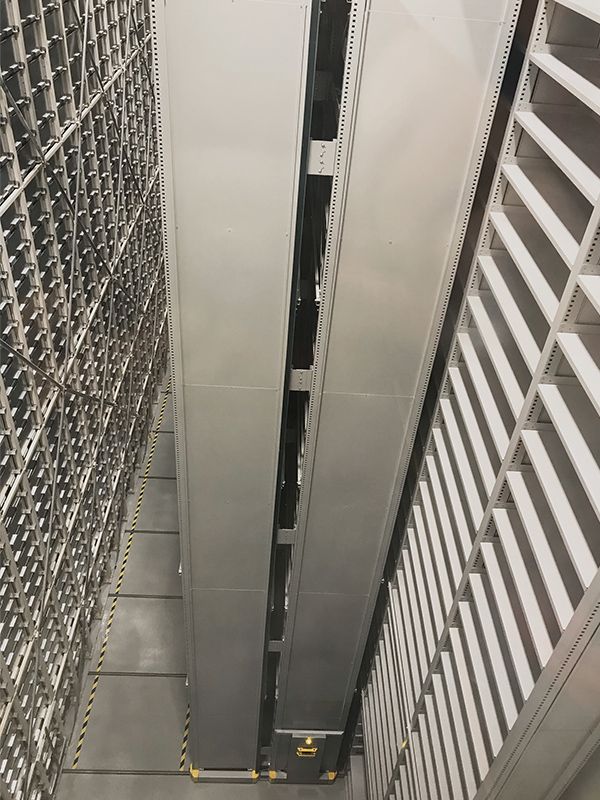
Beyond speed, AMHS delivers substantial space savings. Robotic systems can utilize vertical storage configurations at densities that would be unsafe or inaccessible for human workers, often increasing storage capacity by 50–80% compared to traditional open shelving.1 At UTS, the LRS freed up significant floor space in the main building, which was repurposed into student-centered services, including collaborative study areas, maker spaces, and multimedia editing stations.2
A 2024 simulation study conducted at the Trondheim Public Library in Norway, published in the IFIP Advances in Information and Communication Technology series, modeled  the integration of autonomous mobile robots into library material-handling workflows. The study confirmed that autonomous robot solutions address persistent operational inefficiencies and can materially improve throughput for libraries managing large, high-traffic collections.3
RFID integration has further elevated precision. A 2025 study in the Journal of Propulsion Technology demonstrated that the convergence of autonomous mobile robotics, RFID-based identification, and robotic arm manipulators enables a fully automated framework for book retrieval and reshelving, effectively eliminating manual dependence and markedly enhancing operational efficiency and scalability.4
Sorting robots have also proven transformative for returned materials. Using conveyor systems integrated with RFID readers and automated gates, these systems can process hundreds of items per hour and dramatically reduce staff time spent on repetitive sorting tasks.1
Cost-Effectiveness: Investment, ROI, and Long-Term Viability
The capital investment required for library AMHS is substantial, and it represents one of the most significant barriers to adoption. A standalone automated storage module may begin around $70,000, while a fully integrated, large-scale AS/RS system managing tens of thousands of items can exceed $3 million.5
The world’s first library AS/RS, installed at the Oviatt Library at California State University, Northridge (CSUN) in 1991, cost over $2 million at inception.6 Despite this, the system has survived a 6.8-magnitude earthquake, protected its housed collection, and remained in continuous operation, demonstrating that a well-maintained AMHS can deliver decades of service value.6
The broader automated material handling industry reports compelling returns. According to the 2022 Automation Trends Report, organizations deploying AMRs have seen a 31% increase in both productivity and efficiency.7 A case study from the retail sector documented by Bluepath Robotics found that AS/RS integration produced a 50% increase in operational efficiency and a 30% reduction in labor costs—metrics that translate meaningfully to resource-constrained library settings.8
 The AMHS market itself is on a steep growth trajectory, with industry projections estimating its value will reach $70 billion by 2032.9 For libraries, return on investment is typically realized through reduced labor expenditure, recaptured floor space, and avoided off-site storage costs. Dynamic AS/RS solutions commonly deliver an ROI within eighteen months, driven by space, labor, and picking efficiencies.10
However, long-term cost management poses real challenges. One case study by Spacesaver documented a university library that installed a robotic retrieval system only to discover the software became obsolete shortly after installation. Repeated, expensive software upgrades were needed, and eventually the hardware vendor discontinued support entirely, leaving the institution with a stranded asset.11 This case underscores the importance of evaluating vendor longevity, software update pathways, and total lifecycle costs—not just initial capital outlay—before committing to a system.
User Perception: Patrons, Staff, and the Human Question
Research on the human dimension of library AMHS reveals a nuanced picture. A 2024 systematic literature review published in the Journal of Librarianship and Information Science by Shahzad, Khan, and Iqbal found that robots had a significant positive impact on academic libraries by addressing space issues, performing a variety of service roles, and providing a degree of novelty that entertained library patrons.12
A qualitative study published in the International Journal of Advanced Research in Science and Technology (October 2024), drawing on case studies from institutions including California State University, Northridge, and the University of Chicago, reported a marked improvement in the efficiency of routine library tasks, enhanced user satisfaction due to quicker services, and increased staff productivity as a result of automation.13
Patron perceptions of AMHS are, in general, particularly when the systems perform reliably. The key patron concern is retrieval wait time: a system that delivers items in under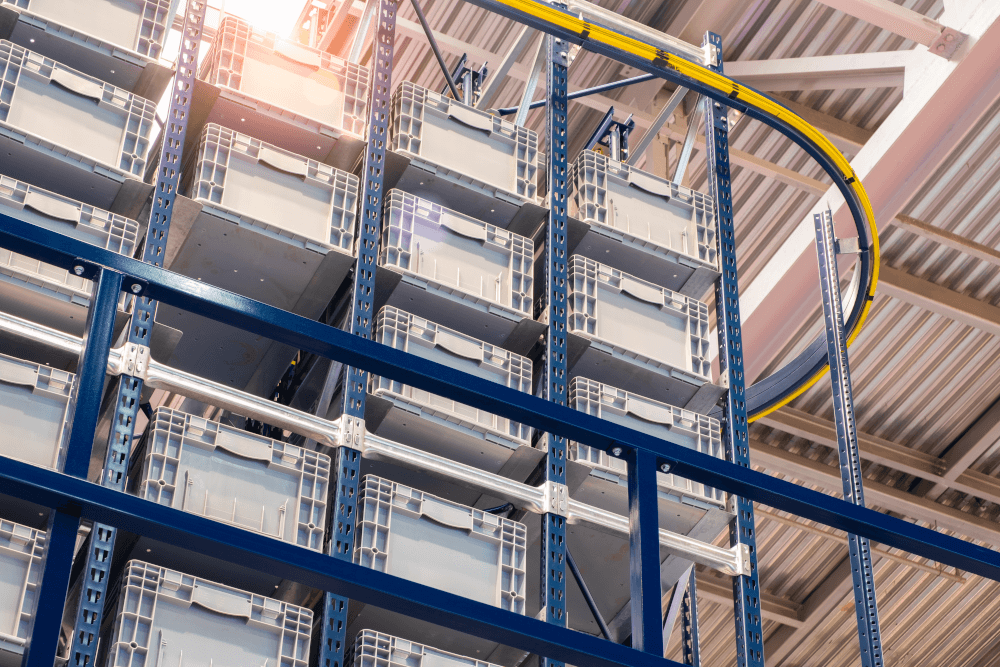 fifteen minutes typically meets or exceeds expectations shaped by traditional manual retrieval, which can take considerably longer.1 Yet a persistent concern is the loss of serendipitous discovery—the experience of browsing open shelves and encountering unexpected titles. When items are stored in bins organized by size rather than subject classification, traditional browsing becomes impossible.2
Staff perceptions are more complex. While automation reduces the physical demands of library work—including heavy lifting, reaching high shelves, and walking miles through stacks daily 1—concerns about deskilling and job displacement remain prevalent. The 2024 review by Shahzad et al. identified fear of job loss, shortage of skilled manpower to maintain robotic systems, and lack of organizational planning as significant barriers to adoption.12
By 2023, an estimated 30% of libraries worldwide were using interactive robots to some extent. The Library Management Systems Market was projected to reach USD 3.75 billion by 2024.14 The consensus in the literature is that robots are not replacing librarians but rather redirecting their expertise—freeing staff from repetitive physical tasks so they can focus on reference services, community programming, and knowledge guidance.2
Automated Material Handling Systems offer compelling efficiency gains and long-term cost benefits for large libraries willing to invest in implementation and ongoing maintenance. Evidence from institutions such as UTS, CSUN, and the University of Chicago demonstrates measurable improvements in retrieval speed, storage density, staff productivity, and patron satisfaction. Yet the technology carries real risks: high upfront costs, software obsolescence, reduced browsability, and the need for specialized technical staff. Libraries evaluating AMHS should conduct rigorous lifecycle cost analyses, prioritize vendors with robust long-term support commitments, and develop strategies—such as curated browsing collections or enhanced digital discovery tools. When implemented thoughtfully, AMHS does not diminish the library’s core mission; it expands the capacity to fulfill it.
References
- Robophil Robotics Consultancy. (2025). Library robots – automating book retrieval and sorting. https://robophil.com/insights/library-robots-automating-book-retrieval-and-sorting/
- Harriet R Cameron, Gisela Reyes-Cruz, Anna-Maria Piskopani, Pepita Barnard, Andriana Boudouraki, Praminda Caleb-Solly, Simon D Castle-Green, Joel E Fischer, Richard Hyde, Ayse Kucukyilmaz, and Horia A. Maior. 2025. Acceptability, Acceptance and Adoption of Telepresence Robots in Museums: The Museum Professionals’ Perspectives. In Proceedings of the 2025 CHI Conference on Human Factors in Computing Systems (CHI ’25). Association for Computing Machinery, New York, NY, USA, Article 431, 1–18. https://doi.org/10.1145/3706598.3713533
- Jefroy, N., Lepre, C., Sgarbossa, F., & Murino, T. (2024). A simulation study for integrating library material handling with autonomous mobile robots. In M. Thürer et al. (Eds.), Advances in Production Management Systems (IFIP AICT, vol. 732). Springer. https://doi.org/10.1007/978-3-031-71637-9_30
- G, N. (2025, April 8). A review on autonomous RFID-Based mobile robot for book retrieval and shelving in library management. https://propulsiontechjournal.com/index.php/journal/article/view/9553
- Kardex. (2025). The cost of automated storage & retrieval systems: ASRS prices & contributing factors. https://www.kardex.com/en-us/blog/asrs-cost-factors
- Heinrich, M., & Willis, D. (2014). Automated storage and retrieval system: A time-tested innovation. [Review of the CSUN Oviatt Library ASRS.] ResearchGate. https://www.researchgate.net/publication/265857621
- Cyngn. (2025). Automated material handling systems in 2024. https://www.cyngn.com/blog/automated-material-handling-systems-in-2024
- Bluepath Robotics. (2025). The future of automated material handling with Bluepath Robotics. https://bluepathrobotics.com/the-future-of-automated-material-handling-with-bluepath-robotics/
- Vecna Robotics. (2024). Automated material handling equipment: How to deploy ASAP. https://www.vecnarobotics.com/resources/automated-material-handling-equipment/
- B2E Automation. (n.d.). ASRS systems overview: Types, costs, and best practices. https://www.b2eautomation.com/insights/asrs-systems-overview-types-costs-and-best-practices
- Spacesaver. (n.d.). Library robotic retrieval system vs. Spacesaver high-bay shelving [Case study]. https://www.spacesaver.com/case-study/library-robotic-retrieval-system
- Shahzad, K., Khan, S. A., & Iqbal, A. (2024). Factors influencing the adoption of robotic technologies in academic libraries: A systematic literature review. Journal of Librarianship and Information Science. https://doi.org/10.1177/09610006241231012
- International Journal of Advanced Research in Science and Technology (IJARST). (2024). Robots in academic libraries: Benefits, challenges, and recommendations. IJARST, 14(10). https://ijarst.in/public/uploads/paper/934711740466030.pdf
- 3Laws Robotics. (2024). Robotic automation and the future of libraries and archives. https://3laws.io/pages/Robotic_Automation_and_the_Future_of_Libraries_and_Archives.html