
Evolving Collection Development Policies in the Digital Age: How Library Policies Must Adapt to Balance Their Collections
Libraries have always been institutions of adaptation — from clay tablets to codices, from card catalogs to online databases. Yet the pace of transformation in the digital age has outpaced policy development, placing tremendous pressure on the collection development frameworks that guide what libraries buy, retain, and discard. Today’s library professionals must navigate an increasingly complex ecosystem of print materials, licensed digital resources, open-access content, and user-generated demand signals. Collection development policies, once largely static documents reviewed every few years, must now function as living frameworks responsive to rapid technological change, shifting user behavior, and constrained budgets.

https://www.ala.org/sites/default/files/2024-10/2023%20State%20of%20Academic%20Libraries%20Report.pdf
This article examines the forces reshaping library collection development policies, explores the tension between print and digital formats, and considers how patron-driven and demand-driven acquisition models are democratizing the selection process in ways that challenge traditional librarian-as-selector orthodoxy.
The Shifting Terrain of Library Collections
The statistical evidence for digital’s growing dominance in academic libraries is unambiguous. According to the Association of College and Research Libraries (ACRL) 2023 Annual Survey, which gathered data from 1,414 responding institutions, digital materials now comprise 47% of reported library collection holdings [1]. Perhaps more striking is what happens at the circulation level: only 1.6% of total reported circulation in academic libraries is physical items, with digital usage having grown 153% relative to 2019 [1]. Meanwhile, average physical circulation has decreased by 51% since 2019, a transformation driven not merely by the COVID-19 pandemic but by deep, durable shifts in how researchers and students prefer to access information [1].
Public libraries tell a similar, if more nuanced, story. Library Journal’s 2025 Budgets and Funding Survey, which received responses from 292 U.S. public libraries, found that public libraries now allocate an average of 28% of their materials spending to digital materials, a slight increase from 27.2% in 2023 [2]. Nearly half of responding libraries (46%) reported an increase in that digital allocation [2]. Libraries in urban and suburban areas lead the charge, with 39% and 36% of their materials budgets, respectively, devoted to digital content [2]. One Miami-Dade County Public Library administrator captured a sentiment echoed across the profession: “it remains difficult to purchase enough [digital content] to meet demand fully” [2].
Yet print has not surrendered. In school libraries, the pendulum has swung notably back. School Library Journal’s 2024 Budget Survey found that print now makes up 93% of book spending in school libraries, up sharply from 74% in 2020–21, while ebook spending dropped from 26% to just 7% over the same period [3]. The pandemic-era e-book  boom has not been sustained, at least not in K–12 settings, pointing to how context, user demographics, and institutional culture shape format preferences in ways that resist universal policy prescriptions.
Policy Frameworks Under Pressure
A Collection Development Policy (CDP) is, at its core, a formal document that provides libraries with a framework for systematic collection building. As described in the foundational literature on library science, a CDP serves multiple functions: informing users, building institutional reputations, justifying budget allocations to funders, and guiding staff judgment in selection decisions [4]. Without such a policy, libraries risk making ad hoc purchasing decisions that fail to reflect institutional mission, community demographics, or long-term collection strategy.
The digital age has not rendered CDPs obsolete — if anything, it has made them more essential and more difficult to write. Contemporary policies must address a dizzying array of new considerations: licensing terms and vendor privacy practices, consortial agreements that expand access beyond local budgets, the distinction between ownership and access in digital formats, and the evolving role of open-access resources. The Boston Public Library’s collection development policy, for instance, explicitly addresses the challenge posed by third-party digital vendors, noting that vendor privacy policies may not align with institutional values and that failure to handle patron data appropriately may result in the cancellation of vendor contracts [5]. This signals a significant expansion of what collection policy must govern — not merely what libraries acquire, but under what ethical conditions they provide access.
Montclair State University’s 2024 Collection Development Policy illustrates another contemporary adaptation: the integration of Demand-Driven-Preferred Approval Plans (DDPAP). This hybrid model makes new titles available to patrons but triggers permanent purchase only when usage reaches a significant threshold [6]. This approach reflects the profession’s growing understanding that acquisition and access need not be synonymous, and that just-in-time provision can complement traditional just-in-case collection building. The University of Connecticut Library, which holds 3.9 million print volumes and over 110,000 electronic and print journals, explicitly addresses this “access versus ownership” tension as a central organizing principle of its collection development program [7].
The Rise of Demand-Driven and Patron-Driven Acquisition
Perhaps no development has more fundamentally challenged traditional collection philosophy than the rise of Demand-Driven Acquisition (DDA) and Patron-Driven Acquisition (PDA) models. Under these approaches, libraries expose large pools of digital content to users — titles appear in the catalog as if owned — and actual purchase (or short-term loan) is triggered only when a patron accesses the content. The model inverts the traditional collector-as-curator paradigm, placing selection power, at least partially, with the people libraries are meant to serve.
A comprehensive 2024 scoping review published in the Journal of Academic Librarianship examined DDA programs across academic libraries, confirming that these programs have become “a well-established approach toward integrating user involvement in the process of building academic library collections” [8]. Drake University’s Cowles Library articulates the appeal clearly: PDA “allows the library to spend money on materials that Drake faculty/students want at their point of need, which ensures that materials we purchase are actually used,” enabling “potentially greater depth and breadth of resource acquisitions” within the same budget envelope [9].
The evidence base for DDA’s efficacy is growing, though not without complications. A 2024 longitudinal study in the Journal of Academic Librarianship examined the circulation performance of patron-driven acquisition books over time, finding that PDA titles maintained a circulation advantage over librarian-selected titles in the long term [10]. However, research at San Francisco State University found that e-book usage for high-use titles fluctuated sufficiently year-to-year that usage in one period was not a reliable predictor of future use, complicating evidence-based acquisition strategies [10].
For public librarians, DDA manifests differently — often through patron purchase requests and community input channels. A survey of public library workers found that patron needs and desires are “always on my mind when purchasing,” but that the appropriate balance between patron requests and professional selection expertise remains a live tension [11]. Celebrity book clubs, social media trends, and community events all shape demand in ways that can either enrich or distort a collection’s intellectual diversity.
Budget Realities and the Economics of Digital Transition
Collection development policy cannot be separated from the economic realities that constrain it. In academic libraries, approximately 80% of materials budgets at doctoral-granting institutions are consumed by ongoing subscription commitments — databases, journals, e-book packages, and streaming media — leaving only about 18% for one-time purchases such as individual books and monographs [12]. This structural dependency on subscriptions means that libraries are increasingly “renting” access rather than building permanent collections, with profound implications for long-term preservation and institutional autonomy.
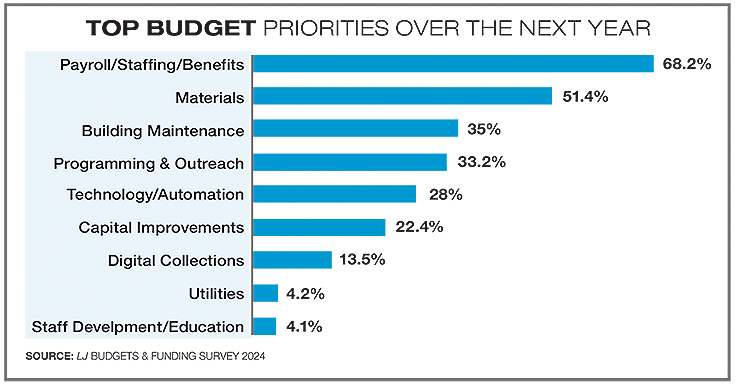 The 2024 Library Journal Budgets and Funding Survey found that U.S. public library total operating budgets rose 7.9% in 2023, the largest increase in a decade, while materials budgets grew a more modest 3.5% [13]. These headline figures mask significant variation: urban libraries command far larger technology and digital budgets, while rural and small-town libraries often lack the scale to negotiate favorable consortium terms. The digital divide is not merely about patron access to technology — it is also about institutional access to the financial and consortial resources needed to sustain robust digital collections.
For-profit scholarly publishing compounds the challenge. Publishers can raise subscription prices with relatively little constraint because demand for core research literature is inelastic — institutions cannot simply opt out of major journal databases without compromising their research missions [12]. This dynamic has pushed many libraries toward open-access advocacy and investment in institutional repositories, both of which are now recognized as legitimate components of a comprehensive collection development strategy.
Toward Adaptive, Living Policies
The lesson of the digital age is that collection development policy must become adaptive by design. Several principles are emerging across institutional contexts. First, policies must explicitly address the access/ownership distinction and articulate under what conditions licensed, transient access is sufficient versus when permanent ownership is required — particularly for materials central to an institution’s core mission. Second, policies must incorporate criteria for evaluating vendor ethics, including data privacy practices and licensing restrictions, as conditions of doing business. Third, user input mechanisms must be formally incorporated—not as ad hoc accommodations but as structured components of the acquisition workflow.
Wittenberg University’s Thomas Library exemplifies the practical integration of these principles. Its 2024 revised policy establishes that, where feasible, electronic access is preferred, while specifying that electronic resource decisions require review by both liaison librarians and technical services leadership [14]. This dual-review structure preserves professional judgment while enabling the institution to capitalize on digital opportunities. The policy also addresses consortial resources separately, acknowledging that OhioLINK and OPAL agreements significantly expand the available resource base beyond what local budgets alone could support [14].
The digital age has not eliminated the need for Collection Development Policies — it has made them more consequential. Libraries that fail to articulate clear principles for navigating the print-digital balance, managing vendor relationships, and incorporating user demand risk make inconsistent decisions that underserve their communities and strain already-tight budgets. Those that invest in adaptive, regularly reviewed policies grounded in usage data, community demographics, and sound professional ethics will be better positioned to fulfill the enduring library mission: connecting the right resources with the right people at the right time.
Sources
[1] Association of College and Research Libraries. (2024). The State of U.S. Academic Libraries: Findings from the ACRL 2023 Annual Survey. American Library Association. https://www.ala.org/sites/default/files/2024-10/2023%20State%20of%20Academic%20Libraries%20Report.pdf
[2] Peet, L. (2025, March 3). What’s Up, What’s Down: Budgets and Funding 2025. Library Journal. https://www.libraryjournal.com/story/whats-up-whats-down-budgets-and-funding-2025
[3] Krasner-Khait, B. (2024, April 4). Spend It If You Can: SLJ 2024 School Library Budget Survey. School Library Journal. https://www.slj.com/story/spend-it-if-you-can-SLJ-2024-school-library-budget-survey
[4] Shaw, W. (2012). Collection development policies for the digital age. In A. Marshall & M. Fieldhouse (Eds.), Collection Development in the Digital Age. Facet Publishing. https://www.cambridge.org/core/books/abs/collection-development-in-the-digital-age/collection-development-policies-for-the-digital-age/6287ED4960C49ABFC1946DE75C4116D0
[5] Boston Public Library. (n.d.). Collection Development Policy. https://www.bpl.org/about-the-bpl/official-policies/collection-development-policy/
[6] Montclair State University Library. (2024). Collection Development Policy 2024. Collection Resources Management Team. https://www.montclair.edu/library/wp-content/uploads/sites/213/2024/09/Collection-Development-Policy-2024.pdf
[7] UConn Library. (2023, May 9). Collection Development Program, Policies, and Guidelines. University of Connecticut. https://library.uconn.edu/about/policies-2/collection-development-program-policies-and-guidelines/
[8] Monroe-Gulick, A., Back, A., Wolfe, G. G., & Morris, S. E. (2024). Demand-driven acquisitions in academic libraries: A scoping review. The Journal of Academic Librarianship, 50(3). https://doi.org/10.1016/j.acalib.2024.102862
[9] Cowles Library, Drake University. (n.d.). Patron Driven Acquisitions. https://library.drake.edu/about/policies/collection-development-policies/pda
[10] Tyler, D. C., & Boudreau, S. O. (2024). Will you still need me, will you still read me…? Patron-driven acquisition books’ circulation advantage long-term and post-pilot. The Journal of Academic Librarianship, 50(5). https://doi.org/10.1016/j.acalib.2024.102940
[11] Schneider, K. G. (2022, October 11). The Complex Role of Demand-Driven Acquisition in Public Libraries: A Survey. Information Today NewsBreaks. https://newsbreaks.infotoday.com/NewsBreaks/The-Complex-Role-of-DemandDriven-Acquisition-in-Public-Libraries-A-Survey-155329.asp
[12] Dowd, S. (2023, January 31). 3 Questions on Academic Library Budgets for an Assessment and Planning Librarian. Inside Higher Ed. https://www.insidehighered.com/opinion/columns/learning-innovation/2023/01/31/3-questions-academic-library-budgets-assessment-and
[13] Peet, L. (2024, February 12). A Complex Landscape: Budgets and Funding 2024. Library Journal. https://www.libraryjournal.com/story/a-complex-landscape-budgets-and-funding-2024
[14] Thomas Library, Wittenberg University. (2024, April). Collection Development Policy. https://wittenberg.libguides.com/policies/collection-development