
How Library-Specific AI Tools Are Transforming Library Workflows
The use of AI in libraries has sometimes outpaced documented evidence of its impact. That gap is now closing. A body of research, vendor studies, and professional surveys from 2025–2026 shows that library-specific AI tools are producing measurable, practical gains across cataloging, metadata management, course resource preparation, reference services, and collection development — though adoption remains uneven and the stakes for professional oversight remain high.
Efficiency Gains in Technical Services: Cataloging and Metadata
Perhaps nowhere has AI had a more immediate and provable impact than in technical services. A May 2026 study conducted by Emerging Strategy on behalf of Clarivate — the Academic AI Impact Study — drew on interviews with eleven library professionals across eight institutions in North America, Latin America, and the Middle East. It found that time spent on manual, repetitive tasks fell by 30-60%, and that course reading list creation, which previously took 15–45 minutes per list, was reduced to just 2–5 minutes using the Leganto Syllabus Assistant. At the University of Windsor, a 20-item list that formerly took 20 minutes to create was completed in just 3 minutes. [1] libraryjournal
Beyond speed, the study found qualitative improvements in output. Between 70 and 90% of AI-generated metadata was accepted with only minor edits, with librarians reviewing every record — the AI produced a first draft, and librarians made the final call. [1] This “human-in-the-loop” model has emerged as the prevailing framework for responsible AI deployment in library technical services. libraryjournal
 OCLC moved in the same direction in December 2025, announcing new AI features across its cataloging products. OCLC added AI tools to its WorldShare Record Manager and Connexion cataloging applications that automatically suggest Dewey Decimal Classification numbers, Library of Congress Classification numbers, and Library of Congress Subject Headings as catalogers create or edit records, drawing on WorldCat data built from millions of library records. [2] Pilot testing showed time savings: catalogers saved up to approximately 20 minutes per title, with AI finding missed details and learning over time as user choices help refine future suggestions. [2] OCLC
Clearing the Backlog: AI in Legacy and Special Collections
One of the most compelling use cases for AI in library workflows is tackling backlogs of uncataloged or poorly described materials — a perennial pain point that has grown as collections expand faster than staffing can keep up with. Libraries face constant challenges in managing metadata, including backlogs of uncataloged resources, inconsistent legacy metadata, and difficulties processing resources in languages and scripts for which staff lack expertise. These issues limit discovery and strain staff capacity. [3] OCLC Research
The Clarivate study offered a striking example of AI addressing this directly: Universidad Tecnológica de Bolívar was able to begin processing a cataloging backlog previously considered unmanageable, and the library’s director reported recovering up to 80% of operational time by eliminating the bottleneck of manual transcription. [1] libraryjournal
For archives and special collections, AI capabilities such as automatic speech recognition and natural language processing have proven particularly well-suited. The most compelling applications in special collections involve transcribing documents and recordings, where AI’s NLP capabilities make it a strong fit for such tasks — helping surface unique resources that present ongoing challenges due to inconsistent or incomplete metadata. [4] OCLC Research
Governance and Quality Standards for AI-Generated Metadata
The rapid integration of AI into cataloging has also accelerated conversations about professional standards and data provenance. From April to June 2025, OCLC’s Research Library Partnership convened a dedicated working group to explore these questions. OCLC has responded to community questions about data provenance for AI-generated metadata by updating WorldCat documentation and providing guidance through programs like AskQC Office Hours. OCLC’s Bibliographic Formats and Standards now includes instructions for recording AI-generated metadata in bibliographic records. [3] A core question emerging from these discussions is lifecycle: when does AI-generated content become simply “cataloger-reviewed content,” much like copy cataloging? How libraries answer that question will shape both transparency standards and workflow design for years to come. OCLC Research
Reference Services: AI Chatbots and 24/7 Patron Support
Beyond the back end, AI is also reshaping how libraries interact with patrons. A January 2026 study published in The Journal of Academic Librarianship by Guoying Liu and Shu Liu conducted a comprehensive environmental scan of 31 library chatbots deployed across institutions worldwide. The study found that as academic libraries adapt to evolving user expectations and digital service models, chatbots have emerged as a promising tool for enhancing reference support, with both rule-based and AI-powered systems now deployed across diverse service models and varying levels of technological maturity. [5] ScienceDirect
The advantages of chatbots in reference are practical and patron-facing. AI chatbots are available 24/7, providing instant assistance that is particularly valuable in academic 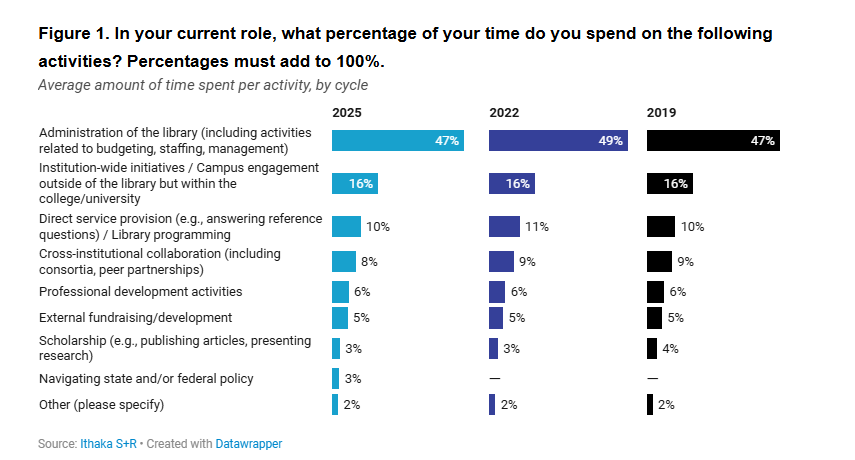 libraries where students and researchers may need help outside regular working hours. They can also support multilingual communication, making them accessible to diverse patron populations. [6] The University of Queensland and UC Berkeley are among institutions that have deployed round-the-clock chatbots to field queries on finding books, navigating databases, and citation guidance. Lisedunetwork
At the same time, the literature consistently emphasizes what AI chatbots cannot replace. Integrating AI chatbots into library services can streamline routine, time-intensive tasks — such as answering queries about opening hours or directing users to relevant databases — freeing human staff to focus on nuanced, higher-level responsibilities that call for emotional intelligence and subject-matter expertise. [7] Chatgptlibrarian
Discovery and Collection Development
AI is also reshaping the front end of library services through discovery and collection development tools. Collection decisions that once relied primarily on professional experience and limited usage reports now draw on large-scale data analysis and trend modeling across much broader datasets. AI-enhanced discovery systems, including advanced natural language processing and generative models, interpret semantic intent and surface related materials without exact keyword matches. [8] Bibliotheca
BiblioCommons made significant enhancements to its BiblioCore discovery interface in 2025, including AI-powered search and review summaries, while OCLC employed AI to enhance the quality of WorldCat records and add new features to resource-sharing and analytics tools. [9] American Libraries Magazine
For collection development specifically, AI offers the potential to identify gaps and forecast needs, though with caveats. A 2025 study from Chapman University and Oregon Health & Science University evaluated four generative AI models — ChatGPT 4.0, Google Gemini, Perplexity, and Microsoft Copilot — for use in health sciences collection development. The findings suggested that large language models are not yet reliable as primary tools for collection development due to inaccuracies and hallucinations. Still, they can serve as supplementary tools for analyzing subject coverage and identifying gaps in collections. [10] nih
The Bigger Picture: Uneven Adoption and Persistent Pressures
Despite these gains, the overall landscape remains uneven. The Ithaka S+R US Library Survey 2025, published in May 2026, captured this tension directly. While library leaders anticipate increased demand for AI literacy instruction, staff reskilling, and research integrity safeguards, many libraries have not yet integrated AI into their internal operations, citing limited staff capacity or expertise, ethical concerns, and competing priorities. [11] Ithaka S+R
The Ithaka survey also situated AI adoption within a broader institutional squeeze: libraries are feeling the same pressures as higher education broadly — budget constraints, 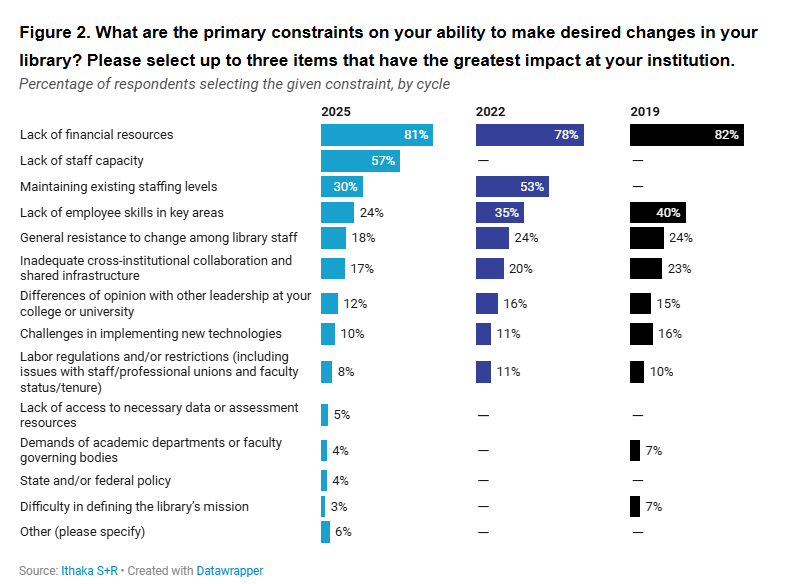 staffing constraints, and an onslaught of new AI-driven initiatives — creating a moment in which libraries are grappling with many of their traditional functions and with what the future looks like. [12] Library Journal
The Clarivate study articulated what may be the most honest framing for where libraries now stand: AI is not producing benefits automatically, and it does not look the same everywhere. Libraries that realized value fastest focused on high-friction workflows where repetitive entry or transcription consumed disproportionate time, rather than attempting broad deployment. Treating AI outputs as drafts, with librarians owning standards and the final record, preserves quality and professional trust. [1] libraryjournal
Sources
- Clarivate | Ex Libris. (2026, May 1). New study: Libraries cut manual workflow time by 30-60% with Academic AI. Library Journal. https://www.libraryjournal.com/story/new-study-libraries-cut-manual-workflow-time-by-30-to-60-with-academic-ai-lj260501
- OCLC. (2025, December 8). OCLC introduces new AI tools to make cataloging faster and smarter. https://www.oclc.org/en/news/releases/2025/20251208-ai-recordmanager-connexion.html
- OCLC Research Library Partnership. (2025, December 9). Striking the right balance: Opportunities and challenges of AI in metadata workflows. Hanging Together. https://hangingtogether.org/striking-the-right-balance-opportunities-and-challenges-of-ai-in-metadata-workflows/
- OCLC Research Library Partnership. (2025, October 14). Exploring AI uses in archives and special collections: Integration, entities, and addressing need. Hanging Together. https://hangingtogether.org/exploring-ai-uses-in-archives-and-special-collections-integration-entities-and-addressing-need/
- Liu, G., & Liu, S. (2026). Chatbots for reference services in academic libraries: Applications and trends. The Journal of Academic Librarianship, 52(1), 103197. https://doi.org/10.1016/j.acalib.2025.103197
- Library & Information Science Education Network. (2025, June 27). Artificial intelligence (AI) chatbots for library reference services. https://www.lisedunetwork.com/artificial-intelligence-ai-chatbots-for-library-reference-services/
- ChatGPTLibrarian. (2025, February). The future of AI chatbots in libraries: Balancing innovation with human expertise. https://www.chatgptlibrarian.com/2025/02/the-future-of-ai-chat-bots-in-libraries.html
- Bibliotheca. (2026, March 23). AI in libraries: What’s changed, what’s at stake. https://www.bibliotheca.com/ai-in-libraries/
- American Libraries Magazine. (2026, May 5). 2026 library systems briefing. https://americanlibrariesmagazine.org/2026/05/05/2026-library-systems-briefing/
- Portillo, I., & Carson, D. (2025). Making the most of artificial intelligence and large language models to support collection development in health sciences libraries. Journal of the Medical Library Association. https://doi.org/10.5195/jmla.2025.2079
- Carroll, E., Bergstrom, T., & Hulbert, I. G. (2026, May 14). US library survey 2025: Under pressure. Ithaka S+R. https://sr.ithaka.org/publications/ithaka-sr-us-library-survey-2025/
- Peet, L. (2026, May). Ithaka S+R survey shows academic library leaders challenged but confident in their mission. Library Journal. https://www.libraryjournal.com/story/ithaka-sr-survey-shows-academic-library-leaders-challenged-but-confident-in-their-mission