
The Hidden Cost of Service: Library Students’ Crushing Debt
Aspiring librarians face a painful paradox: they must take on substantial debt to enter a profession dedicated to public service, only to earn salaries that make repaying that debt nearly impossible. For
students pursuing a Master of Library Science (MLS) or Master of Library and Information Science (MLIS), the financial burden has reached crisis levels, with many graduates questioning whether the degree’s cost justifies its career outcomes.
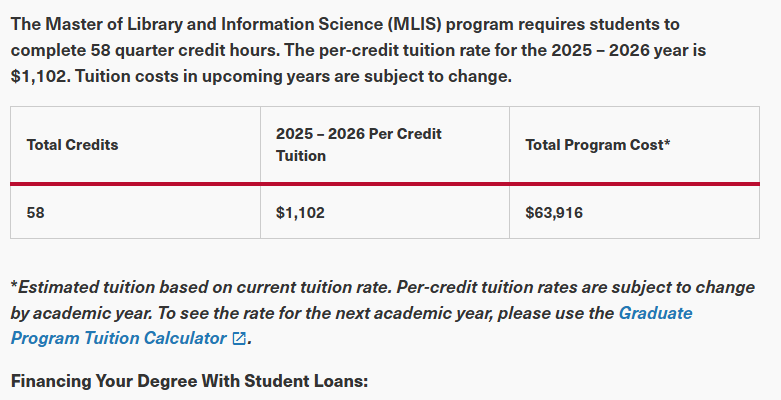
The price tag for an MLIS degree varies dramatically, but costs remain consistently steep. While the most affordable programs charge approximately $11,700 to $14,900 for in-state students [1], many institutions charge significantly higher tuition. Louisiana State University charges $19,980 for its 36-credit program, while the University of Denver requires approximately $63,916 [1][7]. Programs at New York universities can range from $20,000 to $80,000 for the complete course of study [6]. These figures exclude additional expenses such as technology fees, application costs, and textbooks, which can add $500 to $1,500 annually [9].
According to the Education Data Initiative, the average cost of a master’s degree was $59,684 in 2023 [1]. Combined with undergraduate debt averaging $37,850,  library science students often graduate owing over $60,000 [1]. Research published in “Advances in Librarianship” reported debt levels as high as $80,000, with one respondent lamenting that they had “not made a dent” in their loans while working as an adjunct librarian [2].
The crisis intensifies when compared to librarian salaries. The U.S. Bureau of Labor Statistics reports the median annual wage for librarians was $64,320 in May 2024 [8]. Entry-level librarians earn far less, with those with less than 1 year of experience averaging $45,161 [4]. Early-career librarians with one to four years of experience fare only slightly better at $52,309 annually [4]. Library technicians and assistants earn even less at $37,757 in 2025 [5].
This salary-to-debt ratio creates impossible financial situations. Surveys of library students found nearly no respondents believed they would pay off loans within five years, with many laughing derisively at the question [2]. One participant captured the widespread frustration: “The price is simply too high for the degree based on what librarians eventually earn” [2]. Data suggests New York MLIS graduates typically need five to seven years to recoup tuition expenses, though timelines extend significantly for higher debt loads [6].
Employment prospects offer little relief. The
Bureau of Labor Statistics projects only 2 percent growth in librarian positions from 2024 to 2034—slower than the average growth rate for all occupations [8]. With approximately 13,500 openings projected annually, most opportunities come from replacing retiring workers rather than expansion [8]. Despite declining traditional library use, institutions still require librarians to manage technology and host community programs. Yet graduates face fierce competition for positions that barely cover living expenses, much less aggressive loan repayment.
The debt crisis raises fundamental questions about equity in the field. The current degree structure shuts out students who cannot commit significant funds, creating barriers for diverse candidates who might bring crucial perspectives to librarianship [2]. As libraries serve as vital community resources, particularly for populations without home internet access, the profession desperately needs graduates from varied backgrounds. Yet the financial burden discourages many potential students.
While scholarships are available through organizations such as the American Library Association, offering awards ranging from $3,000 to $8,000, these barely dent overall costs [3]. Until institutions address the gap between degree costs and career earnings, aspiring librarians face an untenable choice: abandon their calling or accept decades of financial hardship in service of the public good.
Sources
[1] “Most Affordable Library Science Programs,” HowToBecomeALibrarian.com, October 25, 2024, https://howtobecomealibrarian.com/most-affordable-library-science-programs/
[2] Jennie Rose Halperin, “A Contract You Have to Take: Debt, Sacrifice, and the Library Degree,” Medium, November 13, 2017, https://little-wow.medium.com/a-contract-you-have-to-take-debt-sacrifice-and-the-library-degree-5dbdfe1f6661
[3] “Library Science Scholarships,” Scholarships.com, https://www.scholarships.com/financial-aid/college-scholarships/scholarships-by-major/library-science-scholarships
[4] “Librarian Salary in 2025,” PayScale, https://www.payscale.com/research/US/Job=Librarian/Salary
[5] “Library Science Salary Outlook: What Master’s Graduates Can Expect in 2025?” Research.com, September 17, 2025, https://research.com/careers/library-science-salary-outlook-what-masters-graduates-can-expect
[6] “2024 Most Affordable Library Science Degree Programs Ranking in New York,” Research.com, September 30, 2025, https://research.com/rankings/library-science/most-affordable-library-science-ny
[7] “Tuition and Financial Aid,” University of Denver, August 10, 2020, https://morgridgeonline.du.edu/online-mlis-program/tuition-financial-aid/
[8] “Librarians and Library Media Specialists: Occupational Outlook Handbook,” U.S. Bureau of Labor Statistics, https://www.bls.gov/ooh/education-training-and-library/librarians.htm
[9] “Affordable Master’s in Library Science Degree | Cheap MLIS Programs,” MastersInLibraryScience.org, January 18, 2025, https://www.mastersinlibraryscience.org/resources/cheapest/