
Libraries and Seasonal Affective Disorder Awareness Month
December is Seasonal Affective Disorder (SAD) Awareness Month — a timely reminder that libraries, as trusted community hubs, can play a meaningful role in supporting people who struggle with seasonal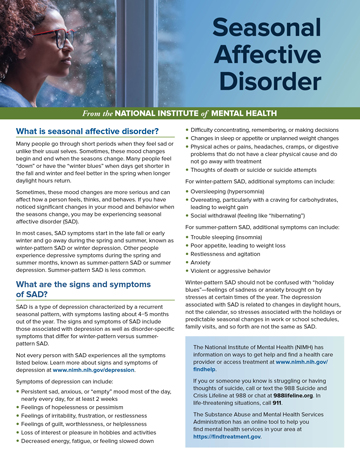 depression. SAD is a recurrent, seasonal form of major depression that most commonly begins in the fall or winter when daylight shrinks; symptoms include low mood, fatigue, oversleeping or appetite changes, and social withdrawal. Clinical guidance and reviews identify bright light (phototherapy), psychotherapy, and, when appropriate, medication as effective treatments. [1] National Institute of Mental Health+1
Libraries are uniquely positioned to help in practical, low-barrier ways. First, several libraries have begun lending or providing supervised access to light therapy lamps — the non-drug intervention with strong evidence for SAD. A 2024 network meta-analysis found phototherapy to be a promising first-line nonpharmacological treatment, and many library programs now mirror campus and community loan programs that provide lamps to patrons who can’t afford them or prefer a nonprescription option. Making lamps  available for short-term checkout or in-library use reduces cost and stigma while linking patrons to further resources. [2] PubMed+1
Second, libraries can design built environments and programming that buffer low-light months. Simple steps — such as creating “bright corners” with high-lux task lamps, reservable well-lit study rooms, and extended daylight-mimicking lighting during peak SAD months — make the physical space more welcoming for patrons struggling with low energy. Programming can include morning “light & read” sessions, guided walking groups that encourage daylight exposure, and daylight-timed social meetups for people who may otherwise isolate. These are low-cost, evidence-based interventions that promote exposure to sunlight and
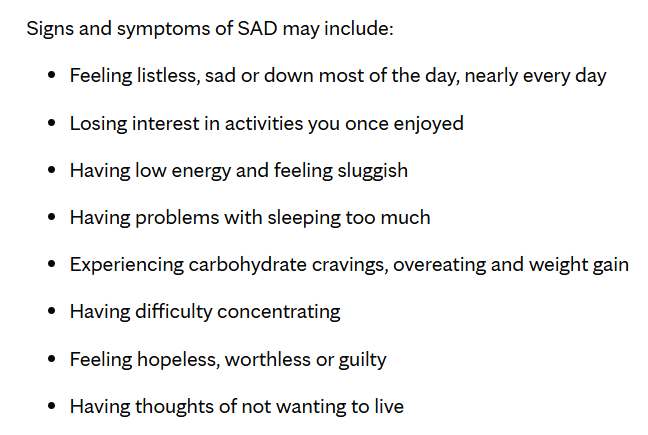
https://www.mayoclinic.org/diseases-conditions/seasonal-affective-disorder/symptoms-causes/syc-20364651#symptoms
social connection, both of which benefit mood. [3] Mayo Clinic+1
Third, curated collections and easily accessible mental health information help patrons navigate symptoms and treatment options. Libraries can assemble reading lists, online resource guides, and displays that distinguish “holiday blues” from more persistent symptoms of SAD, and provide up-to-date handouts that link patrons to local mental health services and crisis lines. Professional library guidance encourages developing collections and  signage that raise awareness and reduce stigma, while making it simple for patrons to find trustworthy clinical information. [4] American Library Association+1
Fourth, partnering with local health organizations multiplies impact. Libraries can host clinicians for informational talks on SAD, run workshops on the use and safety of light therapy, or organize screening and referral events with community health partners. Toolkits developed for “libraries for health” programs recommend such partnerships as an efficient way to bring mental health access to familiar community spaces. Through partnerships, libraries can also provide referral pathways for patrons who need clinical
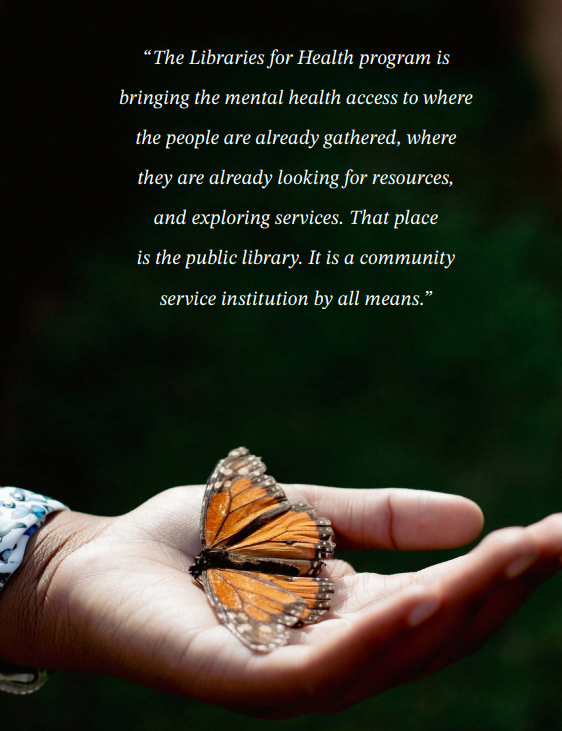
https://stdavidsfoundation.org/wp-content/uploads/2025/07/Libraries-for-Health-Tookit.pdf
assessment, ensuring programs remain within the staff’s scope and connect them to appropriate care. [5] St David’s Foundation+1
Finally, staff training and trauma-informed, compassionate service matter. Frontline staff benefit from basic mental health awareness training so they can recognize when a patron needs a referral rather than counseling, handle behavioral situations safely, and avoid inadvertently using stigmatizing language. Clear signage about available supports and a discreet desk-level “how to get help” handout can make it easier for patrons to take the next step. [6] American Library Association+1
As SAD Awareness Month focuses attention on a condition that can recur annually and significantly impair functioning, libraries can act now: highlight resources, pilot lamp lending, brighten shared spaces, form health partnerships, and equip staff with basic mental health literacy. These moves are practical, low-cost, and evidence-based — and they make libraries safer, more accessible places for people whose winters are darker inside than out.
Sources
- National Institute of Mental Health. Seasonal Affective Disorder. U.S. Department of Health and Human Services. Retrieved from NIMH publications. National Institute of Mental Health+1
- Chen, Z.-W., Zhang, X.-F., & Tu, Z.-M. (2024). Treatment measures for seasonal affective disorder: A network meta-analysis. Journal of Affective Disorders, 350, 531–536. PubMed+1
- Mayo Clinic. (2021). Seasonal affective disorder (SAD): Symptoms & causes. Mayo Foundation for Medical Education and Research. Mayo Clinic
- American Library Association. Mental Health Resources in Libraries. ALA Support pages. American Library Association+1
- Shearer, A. (2025). Libraries for Health: Supporting Community Mental Health in Libraries (Toolkit). St. David’s Foundation / Libraries for Health. St David’s Foundation
- Summit County Libraries. (n.d.). Light therapy lamps at Summit County Library! (example of library lamp-loan program). summitcountylibraries.org+1