
The Great Accelerator: How the Pandemic Reshaped AI in Information Services
The COVID-19 pandemic served as a crucible for digital transformation, forcing industries worldwide to compress years of technological evolution into mere months. No sector felt this pressure and responded with such rapid technological integration as the information services industry. Spanning everything from cloud infrastructure and IT consulting to scholarly publishing and legal research, this sector’s core mission is to manage, process, and deliver knowledge. When the global workforce shifted to remote work and data streams increased, traditional, human-centric processes proved inadequate. Artificial intelligence (AI), which had previously been a strategic asset, instantly became an operational necessity, permanently accelerating its adoption and sophistication across the knowledge economy.
This article explores how the unprecedented demands of the pandemic crisis spurred the use of AI in information services, detailing its application across key sub-sectors, providing empirical evidence of this acceleration, and discussing the ethical considerations raised by this rapid technological pivot.
The Immediate Catalyst: Crisis-Driven Digital Necessities
The early months of 2020 presented an existential challenge to information service providers. Demand for digital access soared—propelled by remote work, virtual education,

https://www.worldbank.org/en/publication/digital-progress-and-trends-report
and a global demand for real-time epidemiological and economic data—while the physical infrastructure and human resources required to meet this demand were severely constrained.
This sudden stress test drove a massive reallocation of resources toward automation and AI. A World Bank study highlighted this trend, noting that the Information Technology (IT) services sector grew nearly twice as fast as the global economy from 2000 to 2022. Still, the jump in digitalization during the pandemic was particularly stark: the share of firms in East Asia investing in digital solutions quadrupled between 2020 and 2022, indicating a global commitment to digital tools [14].
For organizations such as RELX, a major provider of information-based analytics, the decision was simple: automate or fail to meet demand. The use of AI technologies in the US reached 81% in 2020, representing a significant jump from 2018 figures [10]. A key finding of a corresponding study was that 68% of executives increased their investment in AI technologies specifically during the pandemic, underscoring the shift from AI being a long-term research project to an immediate business continuity solution [10].
Streamlining Core Services: Data Analytics and Customer Experience
In the high-volume environment of the pandemic, AI’s ability to ingest, process, and act upon massive, unstructured data streams became the industry’s most critical asset.
1. Real-Time Decision Intelligence
The core product of information services is intelligence. With historical models failing to predict the future, information providers turned to AI and machine learning (ML) for real-time predictive analytics. In logistics and supply chain services—a major client base for IT providers—AI-driven solutions became non-negotiable. For example, companies such as Domina, a Colombian logistics firm, utilized AI to predict package returns and automate delivery validation, resulting in an 80% improvement in real-time data access and a 15% increase in delivery effectiveness [5]. This capability, powered by AI models that rapidly analyze millions of data points, enabled businesses to maintain operations despite global bottlenecks.
2. Scaling Customer Support
As physical call centers shut down, the capacity to handle customer inquiries collapsed just as demand for technical support and service information peaked. AI-powered conversational bots and virtual agents filled this critical void. These were not simply automated phone trees; they were sophisticated Natural Language Processing (NLP) models capable of handling complex, nuanced user requests, from resetting passwords for remote workers to providing detailed service status updates.
This automation was not simply about cost-cutting; it was about maintaining service quality as human capital was distributed and strained. The deployment of AI for tasks such as fraud detection, risk assessment, and service personalization has driven significant efficiency gains, reducing manual errors and saving considerable full-time equivalent (FTE) hours, as evidenced by case studies in financial services [3].
Transformation in Specialist Information Sectors
The impact of AI was particularly transformative in specialist, high-value information sectors like legal research and academic publishing.
A. Legal Information Services (Legal Tech)
The legal industry, traditionally slow to adopt technology, was compelled to undergo rapid digitalization. Court closures and the need for remote collaboration made paper-based workflows obsolete. Information services companies such as Thomson Reuters (a leader in legal information) and other legal technology providers have accelerated the

https://www.escienceediting.org/journal/view.php?number=346
deployment of AI to manage the deluge of documentation.
- Document Review and E-Discovery: AI, particularly NLP, has become essential for expediting these processes. Before the pandemic, a team of lawyers might spend weeks sorting through documents; during the pandemic, AI tools were adopted that could analyze and summarize vast amounts of text in minutes [2].
- Case Analytics and Prediction: AI-powered legal research tools enable professionals to analyze large corpora of case law, statutes, and regulatory documents. Tools leveraging machine learning were deployed to identify relevant precedents and predict litigation outcomes more accurately, saving lawyers an estimated 240 hours per year on routine tasks [13].
- Shift in Perception: The pandemic cemented the idea that AI complements and enhances human legal work rather than replacing it. A 2020 survey found that 56% of law firms were interested in exploring legal AI over the next five years, a trend clearly driven by the need for remote work [2].
B. Academic and Scientific Publishing
The race for a COVID-19 vaccine and treatments generated an unprecedented flood of scientific literature. This urgent need for real-time knowledge sharing has overwhelmed the traditional peer-review and publication system. AI stepped in to manage the sheer volume:
- Manuscript Screening and Quality Control: AI models were rapidly implemented to screen incoming manuscript submissions for quality assurance, compliance, plagiarism, and data integrity [12]. This automation enabled journals to maintain rigorous standards while significantly reducing time-to-publication for critical research.
- Metadata Generation and Discoverability: AI-generated metadata, keyword tagging, and automated summarization systems enhanced the discoverability and accessibility of scientific content. This was vital for researchers needing to cut through the noise and immediately find relevant studies [12]. The growth rate of AI-related publications itself surged sharply after 2020, reflecting the scientific community’s growing reliance on the technology [11].
The Security Imperative and the Ethical Quandary
The acceleration of AI deployment was not without risks and subsequent responses, particularly in cybersecurity and ethics.
Cybersecurity: The New Digital Immune System
The decentralized nature of remote work exposed the information services industry to a broader attack surface. With sensitive data being accessed globally, security can no
longer rely on physical perimeters. AI-driven cybersecurity became the new standard. Machine learning models were deployed to:
- Anomaly Detection: Establish baselines for regular network traffic and user behavior, flagging subtle deviations indicative of a cyber threat or a data breach [1].
- Predictive Risk: Use advanced analytics to identify vulnerabilities and predict potential attack vectors before they are exploited.
https://www.ibm.com/thought-leadership/institute-business-value/en-us/report/covid-19-future-business
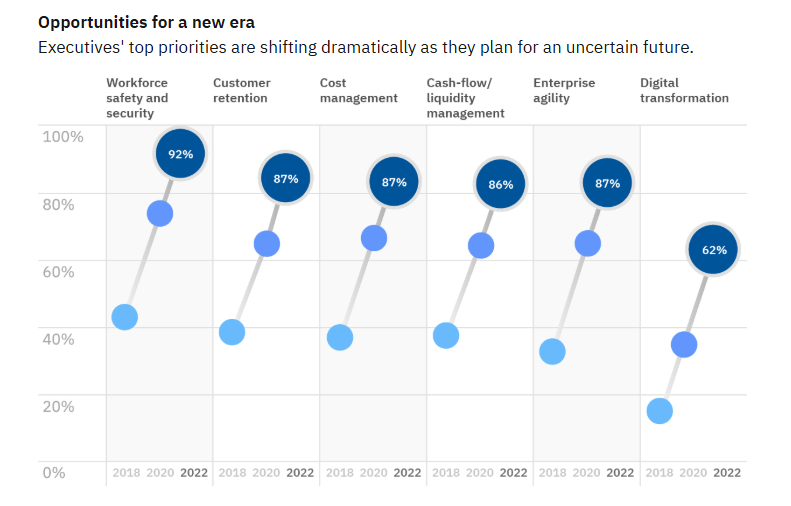
Data supported this strategic deployment: IBM reported that nearly half of executives planned to
use AI to enhance cybersecurity in the immediate post-pandemic period [6].
Ethical Challenges of Speed
The rush to deploy AI during the crisis, particularly in public health and essential services, introduced significant ethical challenges, often related to the quality of the data underpinning the new systems [4]. These moral issues fall squarely on the information service providers who build, train, and maintain these models:
- Algorithmic Bias: If an AI model used for resource allocation (e.g., triaging a surge of customer requests or distributing medical information) were trained on biased historical data, it could perpetuate or exacerbate existing inequalities, resulting in disparate service quality for underrepresented groups [7].
- Transparency and Explainability: Many complex AI models operate as “black boxes.” In critical information services, such as financial risk modeling or legal discovery, a lack of transparency (explainability) makes it difficult for users to trust the output or to ensure accountability when errors occur [4].
- Data Privacy: The pandemic saw an increased willingness to share personal data for the public good [9], but this did not erase privacy concerns. Information service providers had to rapidly integrate privacy-preserving AI techniques (e.g., federated learning) to use sensitive data while maintaining user confidentiality, particularly in highly regulated sectors such as healthcare and finance [8].
https://www.mckinsey.com/capabilities/strategy-and-corporate-finance/our-insights/how-covid-19-has-pushed-companies-over-the-technology-tipping-point-and-transformed-business-forever
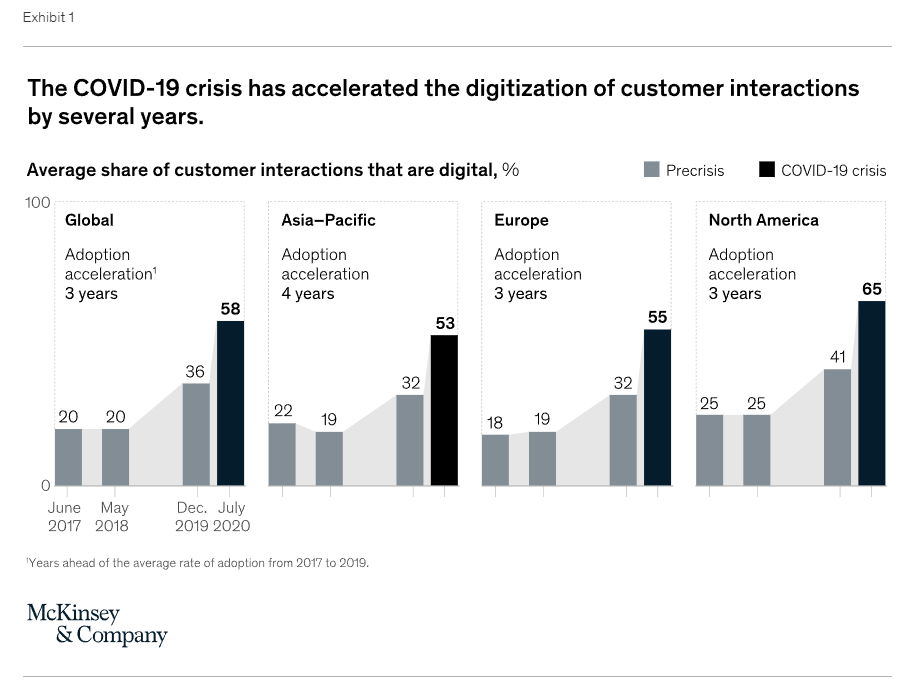
The COVID-19 pandemic served as a significant accelerator for AI in the information services industry. It was a non-negotiable impetus that forced a sector defined by the flow of knowledge to embrace intelligent automation at scale. The transition was not gradual; it was a rapid, often chaotic sprint toward a digital-first operating model.
The strategic investments in computational intelligence, sophisticated NLP, and automated security frameworks made between 2020 and 2022 have established a permanent technological baseline. AI is no longer a future-facing luxury but the very fabric of how information services are delivered—driving efficiency, enabling resilience, and profoundly redefining the relationship between data, technology, and human knowledge work. The lasting legacy of the pandemic is an information services industry that is more capable, more autonomous, and more reliant on artificial intelligence than ever before.
References
- AIMultiple. (2025). 100+ AI Use Cases with Real Life Examples. AIMultiple. https://research.aimultiple.com/ai-usecases/
- Bar Council. (2020). Q&A: How the pandemic has made law tech a priority. Bar Council. https://www.barcouncil.org.uk/resource/q-a-how-the-pandemic-has-made-law-tech-a-priority.html
- CMS Conferences. (2023). Process Improvement With AI in the Service Industry: Case Studies. https://openaccess-api.cms-conferences.org/articles/download/978-1-964867-28-1_8
- Ethox Centre. (2025). Ethical Challenges in the Use of AI for Infectious Disease Epidemiology: A Double-Edged Sword. University of Oxford. https://www.ethox.ox.ac.uk/blog/ethical-challenges-in-the-use-of-ai-for-infectious-disease-epidemiology-a-double-edged-sword
- Google Cloud Blog. (2025). Real-world applications of gen AI from the world’s leading organizations. Google. https://cloud.google.com/transform/101-real-world-generative-ai-use-cases-from-industry-leaders
- IBM Institute for Business Value. (2020). COVID-19 and the future of business. IBM. https://www.ibm.com/thought-leadership/institute-business-value/en-us/report/covid-19-future-business
- Journal of Population Therapeutics and Clinical Pharmacology. (2021). Ethical implications of AI in predicting and preventing pandemics. https://jptcp.com/index.php/jptcp/article/download/8983/8389/18906
- Journal of Reviews in Medical Sciences. (2023). Balancing Innovation and Privacy: Ethical Challenges in AI-Driven Healthcare. https://www.jrevmeds.com/article_211430_5bacafdc31021049a76d382bbcc9cbb8.pdf
- McKinsey & Company. (2020). How COVID-19 has pushed companies over the technology tipping point—and transformed business forever. McKinsey & Company. https://www.mckinsey.com/capabilities/strategy-and-corporate-finance/our-insights/how-covid-19-has-pushed-companies-over-the-technology-tipping-point-and-transformed-business-forever
- RELX. (2020). RELX Survey: AI Adoption Accelerates during COVID-19 Pandemic. RELX. https://www.relx.com/media/press-releases/year-2020/ai-survey-2020
- Science Editing. (2024). Publications on COVID-19 and artificial intelligence: trends and lessons. https://www.escienceediting.org/journal/view.php?number=346
- ScienceOpen Blog. (2025). Academic Publishing in the Age of AI. ScienceOpen. https://blog.scienceopen.com/2025/09/academic-publishing-in-the-age-of-ai/
- Thomson Reuters Legal Solutions. (2025). How AI is transforming the legal profession. Thomson Reuters. https://legal.thomsonreuters.com/blog/how-ai-is-transforming-the-legal-profession/
- World Bank. (2024). Digital Progress and Trends Report 2023. World Bank. https://www.worldbank.org/en/publication/digital-progress-and-trends-report