
Opening the Doors: Libraries as Safe Havens & Autism Acceptance Month
Every April, communities across the United States observe Autism Acceptance Month — a time to move beyond mere awareness and toward genuine inclusion and understanding of autistic individuals. This shift in language, from “awareness” to “acceptance,” is significant: it reflects a broader cultural movement that honors neurodiversity rather than treating it as something to be fixed or feared.
The need for this cultural shift is clear. According to the CDC’s Autism and Developmental Disabilities Monitoring (ADDM) Network, approximately 1 in 31 children aged 8 years has been identified with autism spectrum disorder (ASD). CDC ASD is reported to occur across all racial, ethnic, and socioeconomic groups. CDC As diagnoses continue to rise, public institutions — schools, community centers, healthcare facilities — face increasing pressure to become more inclusive. Among these, public libraries have emerged as quiet but powerful champions of accessibility and belonging.
Libraries have long prided themselves on being open to everyone, but serving autistic patrons requires intentional, thoughtful design. For children with sensory or learning differences such as autism, standard library programs can present barriers, including an unwelcoming climate, an inaccessible sensory environment, and an unpredictable sequence of events. WebJunction Standard storytimes, for example, often take place in bright, noisy, and crowded spaces that can be overwhelming for individuals with sensory sensitivities.
In response, libraries across the country have redesigned their programs and spaces from the ground up. Rates of sensory sensitivity are much higher among neurodivergent  youth, including those with autism spectrum disorder, and in recent years, there has been an increased effort to create sensory-friendly environments. Programminglibrarian Funded through initiatives such as the American Library Association’s Libraries Transforming Communities (LTC) grant, small and rural libraries have been among the leaders in this work. At the Beals Memorial Library in Massachusetts, staff members launched a “See Beyond the Spectrum” initiative and have found community members on the autism spectrum whose presence they were previously unaware of — confirming that the ASD community is larger than many institutions assume. Programminglibrarian
Sensory kits have become a cornerstone tool in autism-inclusive library programming. At the Beals Memorial Library, a sensory box containing headphones, chewies, sunglasses, fidgets, and timers is included in every single program. Programminglibrarian: These items allow patrons to self-regulate and participate comfortably. Libraries have also redesigned physical spaces with calming corners and adjusted lighting, and some have overhauled their collections to remove texts that frame autism as something to be “cured,”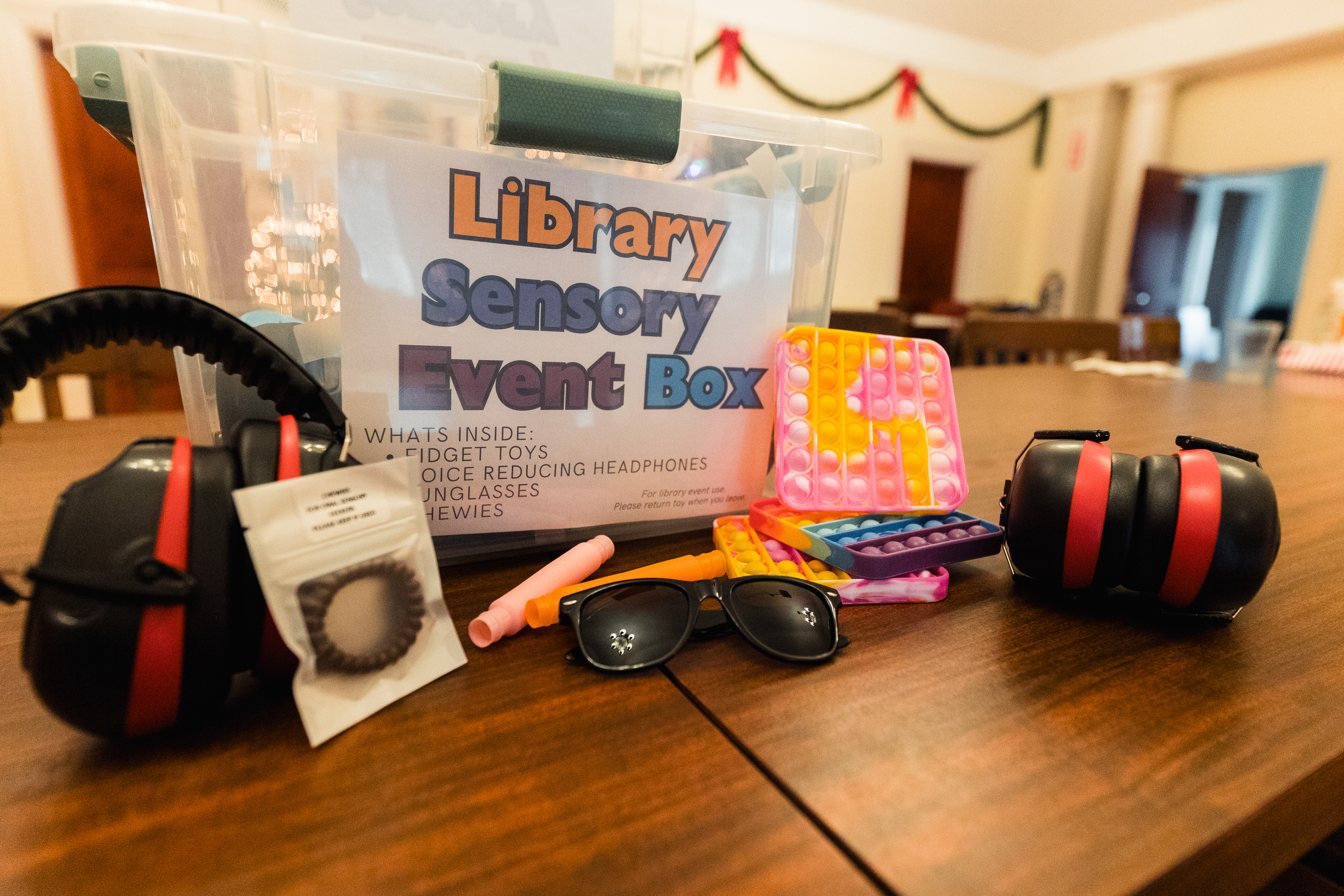 replacing them with affirming works often written by autistic authors themselves.
Some of the most ambitious efforts have happened at the system-wide level. Miami-Dade County passed a resolution to make its library system “autism-friendly and neurodiverse inclusive,” expanding sensory-friendly programming to all 50 of its branches, with staff receiving Autism Spectrum Disorder and Strategies for Inclusivity training provided by the University of Miami and Nova Southeastern University’s Center for Autism and Related Disabilities (CARD). National Association of Counties. The library system also posts “social narratives” on its website — online brochures structured like picture books — to give neurodiverse individuals a detailed, visual preview of what to expect before they arrive at a branch. National Association of Counties This kind of preparation is critical for autistic individuals, for whom the unknown can be a major source of anxiety.
Academic libraries are following suit. NYU’s Bobst Library opened a low-sensory room outfitted with a sensory 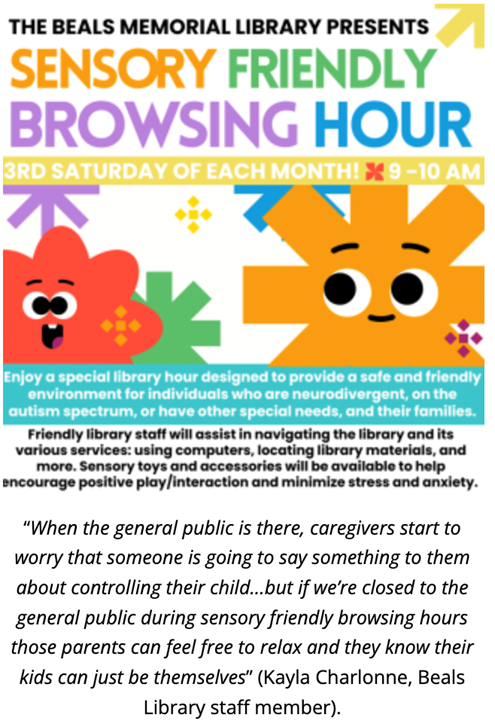 pod, adjustable lighting, noise-canceling wall paneling, and flexible seating — becoming one of only a handful of academic libraries to offer a specially designed space for students with acute sensory needs. Autism Spectrum News
Underlying all of this work is a simple principle articulated by disability advocates: “Nothing About Us Without Us.” By actively involving neurodivergent patrons in the planning process, libraries can ensure their programs effectively meet community needs. Programminglibrarian When autistic individuals help shape the very spaces meant to serve them, those spaces become not just accessible — but truly welcoming.
This April, Autism Acceptance Month invites all of us to ask what genuine inclusion looks like. Libraries offer a compelling answer: a place where everyone, regardless of neurotype, can read, learn, and belong.
Sources
- Centers for Disease Control and Prevention. (2025). Data and statistics on autism spectrum disorder. https://www.cdc.gov/autism/data-research/index.html
- Programming Librarian / American Library Association. (2024). How to add sensory-friendly programs & resources to your library. https://programminglibrarian.org/articles/how-add-sensory-friendly-programs-resources-your-library
- WebJunction. (2024, May 21). Helping libraries to be autism-ready. https://www.webjunction.org/news/webjunction/helping-libraries-be-autism-ready.html
- National Association of Counties. (2024, September 23). Miami-Dade County libraries offer sensory-friendly programs. https://www.naco.org/news/miami-dade-county-libraries-offer-sensory-friendly-programs
- Programming Librarian / American Library Association. (2025, April 9). Sensory-friendly programming: Lessons from small & rural libraries. https://programminglibrarian.org/articles/sensory-friendly-programming-lessons-small-rural-libraries
- Autism Spectrum News. (2024, January). NYU Libraries opens low-sensory room for neurodiverse students. https://autismspectrumnews.org/nyu-libraries-opens-low-sensory-room-for-neurodiverse-students-and-others-who-benefit-from-a-calming-environment/