
Proper Digitization Methods in Modern Information Management
In today’s rapidly evolving digital landscape, organizations across all sectors face mounting pressure to transform physical documents and media into accessible digital formats. From government agencies racing to meet federal mandates to libraries preserving historical collections, the importance of proper digitization methods cannot be overstated. As 80% of surveyed organizations acknowledge that digitalization is critical to their operations (1), the stakes for getting digitization right have never been higher. Poor digitization practices can result in lost data, compromised accessibility, and costly rework—making adherence to established standards and best practices essential for long-term success.
Quality Digitization
Proper digitization extends beyond scanning documents and storing them on a server. It’s a comprehensive approach that includes careful planning, adherence to technical standards, robust quality control, accurate metadata creation, and long-term preservation strategies. Organizations like PTFS have demonstrated that successful digitization requires state-of-the-art equipment, trained staff, and meticulous processes that ensure high-quality digital conversions (2).
The Federal Agencies Digital Guidelines Initiative (FADGI) has established widely recognized benchmarks for digitization quality. The FADGI star rating system evaluates image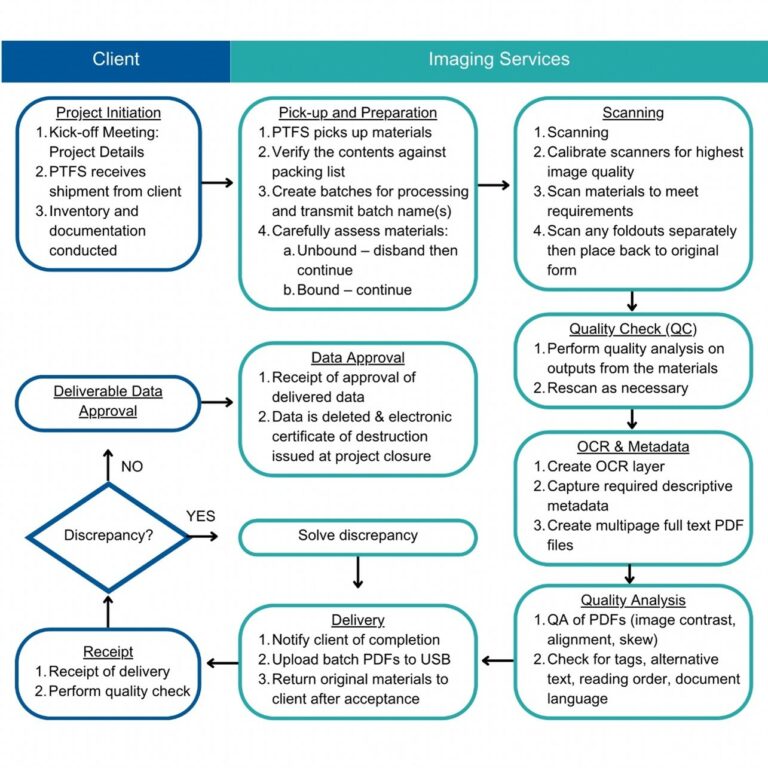 quality based on resolution, color accuracy, and other critical factors, with a 3-star rating indicating high-quality images suitable for long-term preservation (3). As of June 30, 2024, the National Archives and Records Administration (NARA) now requires all permanent records to be submitted in electronic format with a minimum FADGI 3-star rating, underscoring that proper digitization standards are mandatory rather than optional (4).
Technical Standards and Equipment Matter
The technical specifications used during digitization directly impact the quality and usability of digital assets. Key technical attributes include resolution (measured in DPI, or dots per inch), bit depth (which determines color accuracy), and appropriate file formats such as TIFF and PDF/A, for archival-quality images (3). Organizations must use properly calibrated scanners and select settings for resolution, brightness, and contrast based on the specific type of material being digitized (3).
PTFS exemplifies best practices by employing specialized equipment for different material types. Their V-Cradle scanners, which are both Planetary and FADGI compliant, can digitize fragile materials without touching their surfaces. Large format scanners handle engineering media from standard blueprints to Mylar and Sepia, while specialized equipment digitizes video, film, and audio from analog originals (2). This equipment diversity ensures that each material type receives appropriate handling, maximizing both quality and preservation.
The Quality Control Imperative
When digitizing extensive collections, quality control becomes exponentially more critical. In projects involving millions of pages, even a 0.1% error rate translates to 100,000 flawed pages (3). These errors can manifest as missing pages, blurry images, incorrect metadata, skewed orientation, or files that fail to meet accessibility standards. Such issues not only frustrate users but can compromise the integrity of entire collections.
Effective quality control  involves multiple checkpoints throughout the digitization workflow. Before scanning begins, materials must be inspected for damage, organized, and prepared, with fragile items flagged for special handling (3). After scanning, images undergo review for clarity, completeness, and correct orientation. Metadata is verified for accuracy, and files are checked against accessibility standards, such as Section 508 compliance, to ensure users with disabilities can access digital content (3).
Organizations handling massive digitization projects employ both manual review and automated tools. Batch-processing tools can automatically check for common issues, such as blank pages or incorrect file names (3). However, scaling quality control for millions of pages requires intelligent workflows that balance automation with strategic human verification to optimize both accuracy and cost (5).
OCR Challenge
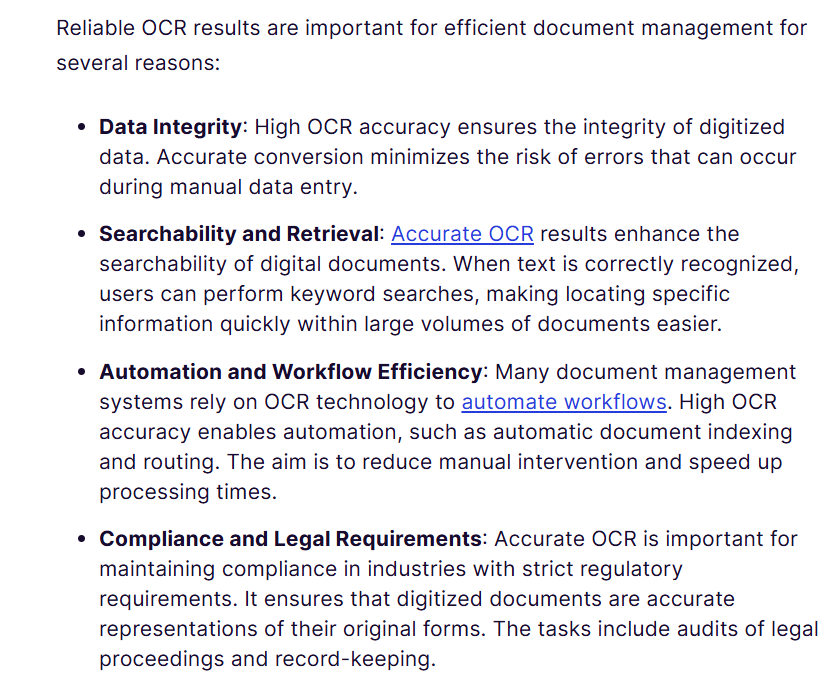
Optical Character Recognition (OCR) represents one of the most challenging yet critical aspects of digitization. While modern OCR systems can achieve accuracy rates exceeding 99% for high-quality printed documents under ideal conditions (6), practical accuracy often falls short of this benchmark. OCR accuracy depends heavily on input quality, with research showing that preprocessing can increase OCR accuracy by 15-30% for challenging documents (5).
Character Error Rate (CER) and Word Error Rate (WER) serve as key metrics for evaluating OCR performance. For printed text, good OCR accuracy is defined as CER of 1-2% (98-99% accurate), while poor accuracy is anything below 90% (7). However, even seemingly small error rates can have significant practical consequences. For example, in a 10,000-character invoice, a 0.1% error rate might produce only 10 errors—but if those errors occur in critical fields such as purchase order numbers or prices, the practical
https://www.docsumo.com/blogs/ocr/accuracy
impact is severe (8).
PTFS has addressed these challenges through advanced OCR engines and best practices that can reduce error rates by up to 80% over conventional OCR processes (2). The company employs techniques including fuzzy search, document intelligence, and pattern recognition to improve text extraction accuracy. Additionally, modern solutions increasingly incorporate Large Language Models (LLMs) with computer vision capabilities, creating multimodal systems that understand semantic context and can correct errors based on meaning rather than processing text in isolation (5).
Metadata: The Key to Discoverability
Accurate and comprehensive metadata is crucial for the successful management and retrieval of digitized records. Without proper metadata, even perfectly scanned documents become challenging to find and use. Metadata falls into three essential categories: descriptive metadata (containing information about content such as title, author, and subject), administrative metadata (including file type, creation date, and technical specifications), and structural metadata (describing how objects are displayed in digital environments) (9).
Federal agencies operating under NARA regulations must capture specific metadata elements at the file or item level, including unique file identifiers, record titles, dates, descriptions, access restrictions, and use restrictions (10). This metadata must be embedded in image files and maintained consistently in recordkeeping systems. Organizations have flexibility in metadata label terminology, but the captured information must align with established standards (10).
Common metadata standards include Dublin Core (the minimum for digital resource description), MARC formats (for bibliographic information), and METS (for encoding  descriptive, administrative, and structural metadata) (11). PTFS’s implementation of these standards enables robust search and discovery capabilities across metadata and full-text documents, making digitized materials genuinely accessible rather than merely stored (12).
Security and Compliance Considerations
Proper digitization methods must address security and compliance requirements, particularly when handling sensitive information. PTFS has maintained facility clearance with cleared staff since the late 1990s for processing classified materials (2). Their advanced technologies include dynamic redaction capabilities that protect sensitive information during the declassification process, addressing a critical need, as manual redaction processes are time-consuming and prone to human error (13).
Organizations must implement appropriate security measures, including encryption, access controls, and regular security audits, to protect digitized documents (2). For federal agencies, compliance with frameworks such as ISO 16363 (for trustworthy digital repositories), FISMA (Federal Information Security Modernization Act), and Executive Order M-23-07 (mandating electronic recordkeeping) is required (14).
Digital Preservation and Long-Term Accessibility
The ultimate goal of digitization extends beyond creating digital copies—it’s about ensuring long-term accessibility and preservation. Digital preservation strategies must include proper storage infrastructure, backup systems, and regular data migration to mitigate risks to digitized records (15). File format selection, file-naming conventions, and adherence to preservation standards all contribute to whether digital materials remain accessible decades into the future.
PTFS’s approach to digital preservation exemplifies best practices. Through their Knowvation Content Services Platform, they provide continuous federated indexing, intelligent search capabilities, and digital object management (16). Their work with organizations like the Defense Technical Information Center demonstrates measurable benefits: consolidating scattered materials into centralized, environmentally controlled storage; establishing digitization-on-demand capabilities; and eventually converting entire collections to digital format, permanently eliminating physical storage costs while expanding information dissemination (12).
As the federal government’s June 30, 2024, deadline for electronic records submission has now passed, and with unstructured datasets comprising 90% of all enterprise-generated data (16), proper digitization methods have become essential infrastructure for modern organizations. The complexity of achieving high-quality digitization—from technical specifications and quality control to OCR accuracy and metadata standards— requires specialized expertise, appropriate equipment, and rigorous processes.
Organizations that invest in effective digitization reap substantial benefits: reduced storage costs, improved efficiency, enhanced accessibility, stronger security, and preservation of institutional knowledge. Conversely, those that cut corners face exponentially accumulating errors, compromised data integrity, accessibility failures, and potential compliance violations. In an era where digital transformation is no longer optional, getting digitization right the first time isn’t just best practice—it’s business critical.
Sources
- AIMultiple. (2025, June 16). 8 Digitization Best Practices in 2025.https://research.aimultiple.com/digitization-best-practices/
- PTFS. (2025, July 25). Document Digitization Services.https://ptfs.com/services/
- PTFS. (2025, October 9). Why Quality Control Matters in Large-Scale Digitization Projects.https://ptfs.com/2025/10/09/why-quality-control-matters-in-large-scale-digitization-projects/
- Interscan. (2025, July 29). FADGI Compliance in 2024.https://www.interscanllc.com/blog/fadgi-compliance-in-2024
- Bora, S. (2025, April 22). The Definitive Guide to OCR Accuracy: Benchmarks and Best Practices for 2025. Medium.https://medium.com/@sanjeeva.bora/
- AIMultiple. State of OCR: Is it dead or a solved problem?https://research.aimultiple.com/ocr-technology/
- Docsumo. (2025, April 8). Analysis and Benchmarking of OCR Accuracy for Data Extraction Models. Models.https://www.docsumo.com/blogs/ocr/accuracy
- Planergy. (2024, November 27). OCR Accuracy In Accounts Payable Invoice Processing.https://planergy.com/blog/ocr-accuracy/
- National Transportation Library. (2024, October 28). Metadata Standards – Digitization.https://transportation.libguides.com/c.php?g=834724&p=5960286
- Records Express. (2023, June 12). Digitizing Records: Understanding Metadata Requirements.https://records-express.blogs.archives.gov/2023/06/12/digitizing-records-understanding-metadata-requirements/
- Atla LibGuides. (2024, July 9). Metadata Schema – Digitizing Collections.https://atla.libguides.com/digitizing-collections/metadata-schema
- PTFS. (2024, May 20). Defense Technical Information Center Case Study.https://ptfs.com/2024/05/20/defense-technical-information-center/
- PTFS. (2025, August 5). Knowvation DX.https://ptfs.com/knowvation-dx/
- PTFS. (2025, July 10). Government Media Conversion Services.https://ptfs.com/government-media-conversion-services/
- AIIM. (2023, November 14). An Overview of NARA’s Newest Guidance on Digitizing Permanent Federal Records.https://info.aiim.org/aiim-blog/an-overview-of-naras-newest-guidance-on-digitizing-permanent-federal-records
- PTFS. (2025, June 25). Knowvation.https://ptfs.com/knowvation/