
How Voting Works in the United States
Voting is a fundamental right and responsibility in the United States democratic system. The process of voting, while seemingly straightforward, involves a complex interplay of federal, state, and local laws and procedures. Let’s review how voting works in the U.S., from voter registration to the Electoral College. All of this information is also available at your local library.
Voter Registration
Before casting a ballot, U.S. citizens must first register to vote. The registration process varies by state, but federal law requires that all states offer voter registration opportunities when citizens apply for or renew their driver’s licenses, a system known as “Motor Voter” [1]. Many states also allow online registration, while others require paper forms to be submitted in person or by mail.
The deadline for voter registration also differs by state. Some states allow same-day registration, while others require registration weeks before an election. As of 2024, 22 states and the District of Columbia have implemented automatic voter registration, where eligible citizens are automatically registered to vote when they interact with government agencies unless they opt out [2].
Types of Elections
The U.S. holds various types of elections:
- Primary Elections: These determine party nominees for general elections.
- General Elections: These include presidential elections every four years, congressional elections every two years, and various state and local elections.
- Special Elections: These are held to fill vacancies in office between general elections.
Voting Methods
While the traditional voting method involves paper ballots marked by hand, many jurisdictions now use electronic voting machines. As of 2024, five voting methods are primarily used across the United States [3]:
- Hand-counted paper ballots
- Optical scan paper ballot systems
- Direct Recording Electronic (DRE) systems
- Ballot Marking Devices (BMDs)
- Internet voting (limited use, primarily for overseas and military voters)
Early Voting and Absentee Voting
Many states offer early voting options, allowing voters to cast their ballots before Election Day. As of 2024, 46 states permit some form of early voting [4]. Absentee voting, also known as mail-in voting, allows voters to cast their ballots by mail. While some states require a valid excuse for absentee voting, 35 states and the District of Columbia offer “no-excuse” absentee voting [5].
Election Day Procedures
Registered voters can cast their ballots on Election Day at designated polling places. Voters typically check in with poll workers, who verify their registration status. In some states, voters may be required to show identification. The type of ID needed varies by state, with some having strict photo ID requirements and others accepting non-photo IDs or even signed affidavits [6].
After verification, voters receive their ballots or access voting machines to select. Once completed, ballots are submitted for counting.
Vote Counting and Reporting
The vote-counting process begins after polls close. For in-person voting, many jurisdictions use electronic tabulators to count votes quickly. Mail-in and absentee ballots may require more time to process and count. Preliminary results are often reported on election night, but official results may take days or weeks to certify, especially in close races [7].
The Electoral College
In presidential elections, the popular vote does not directly determine the winner. Instead, the U.S. uses the Electoral College system. Each state is allocated several electors equal to its total number of Senators and Representatives in Congress. In most states, the candidate who wins the popular vote receives all of that state’s electoral votes (Maine and Nebraska use a district system) [8].
To win the presidency, a candidate must receive the most electoral votes (at least 270 out of 538). This system has occasionally resulted in presidents failing to win the national popular vote, most recently in 2016 [9].
Challenges and Reforms
The U.S. voting system faces ongoing challenges and calls for reform. Issues include:
- Voter suppression concerns
-
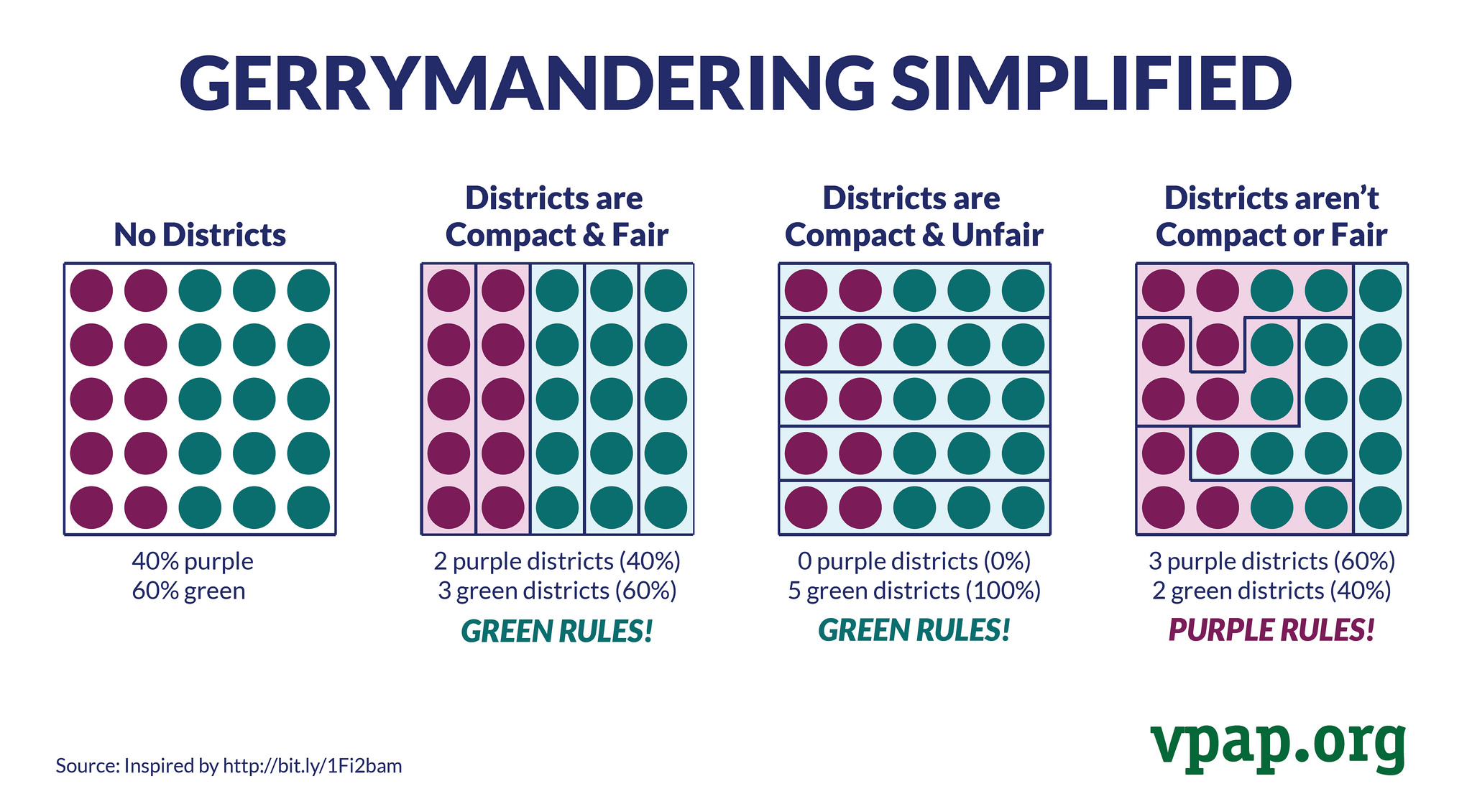 Gerrymandering of electoral districts
 - Campaign finance regulations
- Cybersecurity threats to election infrastructure
- Debates over the Electoral College system
Various federal, state, and local reform efforts are underway to address these challenges and modernize the voting process [10].
Voting in the United States is a complex process that reflects the country’s federal system of government. While the essential act of casting a ballot may seem simple, its mechanisms involve intricate laws, procedures, and technologies that continue to evolve as the nation strives to maintain a fair and accessible democratic process.
Sources:
[1] U.S. Department of Justice. “The National Voter Registration Act of 1993 (NVRA).” Justice.gov, 2021. https://www.justice.gov/crt/national-voter-registration-act-1993-nvra
[2] National Conference of State Legislatures. “Automatic Voter Registration.” NCSL.org, 2024. https://www.ncsl.org/elections-and-campaigns/automatic-voter-registration
[3] U.S. Election Assistance Commission. “Types of Voting Systems.” EAC.gov, 2023. https://www.eac.gov/election-technology
[4] National Conference of State Legislatures. “State Laws Governing Early Voting.” NCSL.org, 2024. https://www.ncsl.org/elections-and-campaigns/early-in-person-voting
[5] Knowing the Difference: Voting Absentee vs. By Mail | League of Women Voters. (2020, September 10). https://www.lwv.org/blog/knowing-difference-voting-absentee-vs-mail
[6] National Conference of State Legislatures. “Voter ID Requirements.” NCSL.org, 2024. https://www.ncsl.org/elections-and-campaigns/voter-id
[7] MIT Election Data and Science Lab. “Voting Technology.” ElectionLab.mit.edu, 2023. https://electionlab.mit.edu/research/voting-technology
[8] National Archives and Records Administration. “What is the Electoral College?” Archives.gov, 2024. https://www.archives.gov/electoral-college/about
[9] Federal Election Commission. “Federal Elections 2016: Election Results for the U.S. President, the U.S. Senate and the U.S. House of Representatives.” FEC.gov, 2017. https://www.fec.gov/introduction-campaign-finance/election-results-and-voting-information/federal-elections-2016/
[10] Bipartisan Policy Center. “The State of American Elections.” BipartisanPolicy.org, 2024. https://bipartisanpolicy.org/report/the-state-of-state-election-policy-in-2024/