
Selling AI to Libraries: Information Vendors Chase a Budget-Strapped, Already-Wired Market
Information service providers like Clarivate, EBSCO, and Elsevier are racing to embed artificial intelligence into the tools they sell to libraries — but they face a complicated market. Their institutional customers are operating under mounting financial pressure, and their end users have largely moved on to free AI tools without waiting for anyone’s permission.
The commercial push is unmistakable. Clarivate announced the expansion of its Academic AI Platform in April 2025, promising to introduce AI agents to support key academic workflows, including literature review, researcher matchmaking, and funding opportunity discovery — all built atop its Web of Science database and already adopted by over 3,000 institutions. Q4web. The company frames these tools as purpose-built alternatives to general-purpose AI, arguing that curated, peer-reviewed content reduces the risk of hallucination that plagues open models. Clarivate describes its AI strategy as “Intelligence Amplified,” positioning its proprietary data as the foundation that makes its tools produce measurably better outcomes than general-purpose alternatives. Clarivate
EBSCO has moved along a parallel track. The company developed AI Insights, a feature that generates short lists of key points from full-text articles, alongside Natural Language Search, which translates conversational queries into
Table 1. Socio-demographic and geographic characteristics of the survey participants. https://doi.org/10.1371/journal.pone.0315011.t001
Boolean logic — with additional programs for AI Reference Assistance and AI Literature Review announced for beta testing. Library Journal A pilot across roughly 50 libraries found that 85% of users said AI Insights would significantly improve their workflows, though about 20% of experienced researchers remained neutral — a reminder that power users are not automatically won over by convenience features.
Yet the institutions these companies are selling to are not flush with cash. Budget constraints remain a key challenge for libraries globally, with half of U.S. and North American respondents in Clarivate’s 2025 Pulse of the Library survey expecting cuts to collections due to geopolitical and funding pressures. Clarivate Budget pressures ranked as the top challenge for libraries overall, selected by nearly half of all survey respondents. Clarivate: Asking these institutions to layer new AI subscriptions onto already-strained budgets is not a trivial ask. The vendors know it, and most are initially bundling AI features into existing subscriptions rather than selling them as standalone products — a foot-in-the-door strategy that may deepen dependency even as it lowers short-term sticker shock.
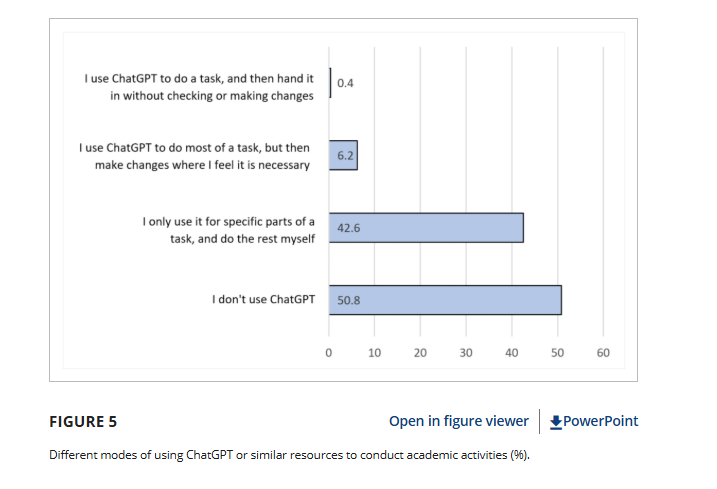
Meanwhile, the users’ libraries have been making their own arrangements. A 2025 study of university students found that over two-thirds use ChatGPT for personal purposes, with more than 40% employing it for academic tasks, including summarization,

https://onlinelibrary.wiley.com/doi/10.1111/ejed.70094
content clarification, and generation. Wiley Online Library A large-scale global study of 23,218 students across 109 countries found that students primarily turned to ChatGPT for brainstorming, summarizing texts, and finding research articles, though they found it less reliable for delivering accurate information than for simplifying complex content. PubMed Central. In other words, students are already using AI to do roughly what the vendors are now charging for — just without the vetted datasets and institutional guardrails.
This creates the central tension in the market. Clarivate’s own survey data found that gaps in confidence and knowledge persist across the library community, and many librarians still have
https://onlinelibrary.wiley.com/doi/10.1111/ejed.70094
concerns about output quality and academic integrity Clarivate — the same concerns that make vendor-built, source-transparent AI tools theoretically attractive. But translating institutional concern into institutional purchasing requires budget authority that many libraries don’t have.
Clarivate’s data also reveals a significant divide among library types: 53% of public library respondents said their institution was not pursuing AI or had no specific plans, with only 4% describing moderate deployment and 1% active implementation. Library Journal: Academic libraries are further along, but even there, adoption is uneven. The pace of AI adoption also varies regionally, with Asia and Europe advancing more quickly and the U.S. expressing the lowest optimism about AI’s potential benefits — only 7% of U.S. respondents rated themselves highly optimistic, compared with 27–31% in Asia and other regions. PR Newswire
The vendors are betting that institutional credibility, data provenance, and academic integrity concerns will eventually drive libraries toward their products rather than toward open-web AI. That may be true. But with budgets being cut, users already outside the system, and a skeptical American library market, the sell is harder than the product launches suggest.
Sources
- Clarivate. (2025, October 30). Pulse of the Library report reveals link between AI literacy, AI implementation and confidence. PR Newswire. https://www.prnewswire.com/news-releases/clarivate-pulse-of-the-library-report-reveals-link-between-ai-literacy-ai-implementation-and-confidence-302598196.html
- Clarivate. (2025). Pulse of the Library: Reflecting the voices of librarians worldwide. https://clarivate.com/academia-government/blog/pulse-of-the-library-reflecting-the-voices-of-librarians-worldwide/
- Clarivate. (2025, April 9). Clarivate expands its Academic AI Platform, introducing agentic AI for research and learning. https://clarivate2023indexrb.q4web.com/news-events/press-releases/news-details/2025/Clarivate-Expands-its-Academic-AI-Platform-Introducing-Agentic-AI-for-Research-and-Learning/default.aspx
- Clarivate. (n.d.). Artificial intelligence. https://clarivate.com/ai/
- Enis, M. (2024, August 5). AI on the horizon. Library Journal. https://www.libraryjournal.com/story/ai-on-the-horizon
- Enis, M. (2025, October 30). Clarivate survey indicates steady increase in library AI adoption worldwide, skepticism in the U.S. Library Journal. https://www.libraryjournal.com/story/clarivate-survey-indicates-steady-increase-in-library-ai-adoption-worldwide-skepticism-in-u-s
- Farinosi, M., & Melchior, C. (2025). ‘I Use ChatGPT, but Should I?’ A multi-method analysis of students’ practices and attitudes towards AI in higher education. European Journal of Education, 60, e70094. https://doi.org/10.1111/ejed.70094
- Ravšelj, D., et al. (2025). Higher education students’ perceptions of ChatGPT: A global study of early reactions. PLOS ONE, 20(2), e0315011. https://doi.org/10.1371/journal.pone.0315011