
Connecting the Stacks: AI Integration in Rural Libraries
Rural libraries have long punched above their weight. With smaller budgets, skeleton staffs, and patrons who may live dozens of miles from the nearest branch, they have consistently served as anchor institutions in communities that lack many of the services taken for granted in cities. Now, artificial intelligence is arriving at their doors — and the conversation is complicated. For some rural systems, AI represents a once-in-a-generation opportunity to do more with less. For others, it raises fears about privacy, bias,  and the erosion of the irreplaceable human relationship at the heart of librarianship.
The Promise of AI in Underserved Stacks
The case for AI in rural libraries begins with a stubborn staffing reality. According to SLAAIT (State Libraries and AI Technologies) documentation published by the Collaborative Institute for Rural Communities & Librarianship (CIRCL), approximately 40% of rural libraries lack full-time staff, and most operate without a credentialed Master of Library Science librarian [1]. Against that backdrop, AI tools that can handle routine catalog queries, answer after-hours reference questions, or automate grant-writing assistance are not luxuries — they are lifelines.
The global trend supports enthusiasm. A 2025 Pulse of the Library report by Clarivate, surveying more than 2,000 librarians across 109 countries, found that 67% of libraries were exploring or implementing AI tools, up from 63% the prior year, with one-third actively deploying solutions [2]. Closer to home, a 2024 Association of Research Libraries poll found that more than 60% of respondents held positive or somewhat positive attitudes toward AI adoption, though they flagged staff readiness, policy guidance, and ethical frameworks as the primary hurdles [2].
The applications with the most immediate appeal for rural settings include cataloging automation, 24/7 chatbot reference services, AI-assisted grant writing, and data analysis for collection management. As the Library Progress International journal noted in 2025, AI algorithms can analyze usage patterns to inform collection decisions and automatically generate bibliographic records, reducing workload and improving consistency without requiring specialized technical expertise from staff [3].
A SLAAIT prospectus articulated an even broader civic vision: “Public libraries from large urban centers to the smallest rural communities can help train workers, support small businesses in linking to vital resources, and provide necessary broadband connectivity to remote workers. Public libraries can be central to advocating for ethical AI and sensitize citizens to the dangers of corrosive AI” [4].
Three Rural Libraries Leading the Way
Pottsboro Area Public Library – Pottsboro, Texas
Perhaps no small rural library has attracted more national attention for AI innovation than the Pottsboro Area Public Library, which serves a community of roughly 3,300 residents near the Oklahoma border. The library — a 501(c)(3) nonprofit that relies heavily on grants and partnerships — was named a Library Journal Best Small Library in America and recognized by the Institute of Museum and Library Services (IMLS) as one of the top three libraries in the nation for innovation and digital inclusion [5].
In April 2025, Pottsboro was selected by Dell Technologies as the only library among 13 nonprofits to participate in an intensive AI Readiness for Nonprofits Pro Bono Consulting program. The library’s development team worked with eight Dell employees from around the world to explore using AI for data analysis, community needs assessment, and to discuss future ambitions, including AI-powered chatbots and community hackathons [6]. The library had already been using AI to analyze circulation data and tailor services to local demand — a low-cost, high-impact use case that other rural libraries can replicate. Pottsboro is also a named partner institution of CIRCL and the SLAAIT project, contributing a practitioner’s perspective to state-level AI policy conversations.
Pottsboro Area Public Library also established a telehealth room — funded by a $20,000 National Library of Medicine COVID-19 outreach grant — allowing patrons  to meet remotely with health professionals, a service made possible in part by the library’s investments in connectivity infrastructure [7].
Cresco Public Library – Cresco, Iowa
The Cresco Public Library, a Carnegie Library in Howard County, Iowa, is another rural institution actively engaged in the national AI conversation. As a named partner library in the CIRCL network — listed alongside Pottsboro and Plum Lake on the organization’s partner roster — Cresco has participated in collaborative discussions about how small Midwestern libraries can deploy AI for collection management, patron services, and grant-writing support [1]. Iowa was among the 14 original state library agencies to join the SLAAIT project when it launched in February 2024, meaning Cresco operates within a state policy environment explicitly designed to equip rural institutions for the AI era [4].
The library’s focus has been practical: staff training, digital literacy for patrons, and the exploration of tools that reduce administrative overhead. SLAAIT’s October 2024 guide on grant writing with AI — developed specifically for “small and rural nonprofit and public libraries” — is an example of the resources Cresco-style libraries have drawn upon to begin integrating AI without requiring specialized expertise or large budgets [8].
Plum Lake Public Library – Plum Lake, Wisconsin
Plum Lake Public Library, a tiny institution in Vilas County in northern Wisconsin’s lake country, represents the frontier of rural AI adoption: a library so small that every saved hour of staff time translates directly into community benefit. Plum Lake is also a listed CIRCL partner library, participating in the network’s ongoing research into how libraries serving low-density, often tourism-dependent rural communities can use AI to archive local history collections, improve patron search experiences, and build AI literacy among residents [1].
At the 2024 ALA LibLearnX conference, practitioners from small and rural libraries discussed how AI could be used to “inventory, organize, and maintain archives and special collections” — a use case particularly relevant for libraries like Plum Lake, where local history collections may be extensive but digitization resources scarce [9]. The conference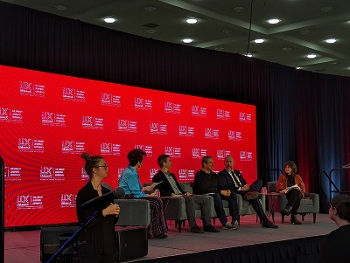 also surfaced the idea of AI-powered mental health chatbots for small communities lacking access to counseling services — a vision consistent with the wraparound community services that rural libraries increasingly provide.
The Misgivings Are Real
Despite these success stories, concerns are widespread and deserve serious consideration. At the start of 2024, more than three-quarters of librarians polled said there was an urgent need to address AI’s ethical and privacy concerns, with data misuse and AI-generated false citations among the top worries [10]. By 2025, budget constraints had become the leading barrier to AI adoption (cited by 62% of libraries), while privacy and security remained the top concern for public libraries specifically, flagged by 65% of respondents [11].
The digital divide cuts in two directions for rural patrons. AI systems that require comfortable internet connectivity to function may simply not work reliably in communities where, according to a 2024 study of rural Alberta, fewer than half of rural households meet basic broadband quality standards [12]. A 2023 ALA study found that 27% of library patrons — disproportionately from rural and lower-income communities — struggle to use AI-powered catalog systems effectively, risking a two-tiered system in which digital literacy determines who benefits [13].
Librarians have also raised concerns about the fundamental character of their profession. A 2025 paper in the International Journal of Library and Information Science Studies noted that many librarians view AI chatbots as a threat to their professional roles, and warned that AI tools may undermine the nuanced, empathetic interactions that distinguish library reference services from simple information retrieval [14]. AI “hallucinations” — confident but factually incorrect outputs — pose a particular risk in a profession built on information accuracy, and the proprietary nature of many library databases limits how effectively AI tools can be grounded in curated, reliable sources [15].
 A December 2024 SLAAIT summative meeting included a presentation titled “Flashing the Hazard Lights,” which addressed AI’s potential for what scholars term “epistemicide” — the erasure of marginalized knowledge systems through algorithmically biased information environments [16]. In rural communities with distinct cultural identities, indigenous histories, or underrepresented regional knowledge, that concern is not abstract.
A Path Forward
The libraries doing this well share a few traits: they start small, leverage grant partnerships, invest in staff training before deploying to patrons, and maintain human oversight of AI-generated outputs. The SLAAIT project’s final report, completed after an eight-month collaborative process running through December 2024, documented these complexities and called for state library agencies to provide both policy guidance and hands-on support for rural institutions navigating AI adoption [17].
Rural libraries may embrace AI proactively or find it arriving through vendor systems and patron expectations. They are already reshaping how communities access information. The question is not whether AI will change rural libraries, but if rural libraries will have a seat at the table when it does.
Sources
[1] CIRCL (Collaborative Institute for Rural Communities & Librarianship). SLAAIT Partner Libraries and Community Overview. circl.community. https://circl.community
[2] Clarivate / ProQuest. Pulse of the Library 2025: Reflecting the Voices of Librarians Worldwide. Cited in: Learn & Work Ecosystem Library. “Research on Artificial Intelligence (AI) Adoption in Libraries (2023–2025).” learnworkecosystemlibrary.com. https://learnworkecosystemlibrary.com/topics/research-on-artificial-intelligence-ai-adoption-in-libraries-2023-2025/
[3] Library Progress International, Vol. 45, No. 1 (2025), pp. 1–11. “The Integration of Artificial Intelligence in Library Systems.” bpasjournals.com. https://bpasjournals.com/library-science/index.php/journal/article/download/379/214/2283
[4] Rich, Hallie. “Rural Library Collaborative and State Libraries Launch AI Project.” Library Journal, February 2, 2024. https://www.libraryjournal.com/story/rural-library-collaborative-and-state-libraries-launch-ai-project
[5] Pottsboro Area Public Library. National Recognition. pottsborolibrary.com. https://pottsborolibrary.com
[6] KXII News. “Pottsboro Library selected in program that is helping provide resources that have been a need.” April 27, 2025. https://www.kxii.com/2025/04/27/pottsboro-library-selected-program-that-is-helping-provide-resources-that-have-been-need/
[7] Simpson, Stephen. “Texas libraries work to bridge state’s mental health services gap.” The Texas Tribune, March 22, 2024. https://www.texastribune.org/2024/03/22/texas-libraries-mental-health/
[8] SLAAIT / CIRCL. Grant Writing with AI: A Guide for Small and Rural Libraries. October 2024. https://circl.community/wp-content/uploads/2024/10/Guide-to-Grant-Writing-with-AI_Oct2024.pdf
[9] “Artificial Intelligence Discussions Take Prominent Role at LibLearnX 2024.” Library Journal, February 2, 2024. https://www.libraryjournal.com/story/artificial-intelligence-discussions-take-prominent-role-at-liblearnx-2024
[10] Marcus, Jon. “New AI guidelines aim to help research librarians.” Inside Higher Ed, May 1, 2024. https://www.insidehighered.com/news/tech-innovation/libraries/2024/05/01/new-ai-guidelines-aim-help-research-librarians
[11] Liblime. “Digital Transformation: How Libraries Are Implementing AI in 2025.” November 13, 2025. https://liblime.com/2025/11/13/digital-transformation-how-libraries-are-implementing-ai-in-2025/
[12] PressReader Blog. “How public libraries are helping bridge the digital divide.” September 30, 2024. https://blog.pressreader.com/libraries-institutions/how-public-libraries-are-helping-bridge-the-digital-divide
[13] Liblime. “Unwelcome AI: Examining the Negative Impacts on Libraries.” October 31, 2024. https://liblime.com/2024/10/31/unwelcome-ai-examining-the-negative-impacts-on-libraries/
[14] Onwubiko, E.C. “Integration of AI Chatbot into Library’s Operations: Opportunities or Threats to Librarians’ Role?” International Journal of Library and Information Science Studies, 11(3), 2025, pp. 47–61. https://eajournals.org/ijliss/wp-content/uploads/sites/68/2025/10/Integration-of-AI-Chatbot.pdf
[15] Ehrenpreis, et al. “Chatbot Assessment: Best Practices for Artificial Intelligence in the Library.” portal: Libraries and the Academy, 25(4), 2025. https://preprint.press.jhu.edu/portal/sites/default/files/06_25.4ehrenpreis.pdf
[16] Library Research Network. “State Libraries and Artificial Intelligence Technology (SLAAIT).” libraryresearchnetwork.org. https://libraryresearchnetwork.org/state-libraries-and-ai-technology/
[17] Library Research Network. “State Libraries and AI Technology: Final Report.” libraryresearchnetwork.org. https://libraryresearchnetwork.org/state-libraries-and-ai-technology/