
Digital Transformation: How Libraries Are Implementing AI in 2025
The library landscape is undergoing a remarkable technological transformation. As artificial intelligence becomes increasingly sophisticated and accessible, libraries worldwide are exploring how these tools can enhance services, streamline operations, and better serve their communities. According to the recently released Clarivate Pulse of the Library 2025 report, which surveyed over 2,000 librarians across 109 countries, 67% of libraries are now exploring or implementing artificial intelligence tools, representing an increase from 63% in 2024. This continuous growth illustrates a shift in how libraries approach their missions in an increasingly digital world.
The Current State of AI Adoption
The Pulse of the Library report reveals patterns in how libraries are approaching the implementation of AI. While the majority remain at the earliest evaluation stages (35%),  librarians who are implementing AI report more optimism, and this increases along with the stage of implementation. This suggests that hands-on experience with AI tools helps overcome initial skepticism and reveals practical benefits.
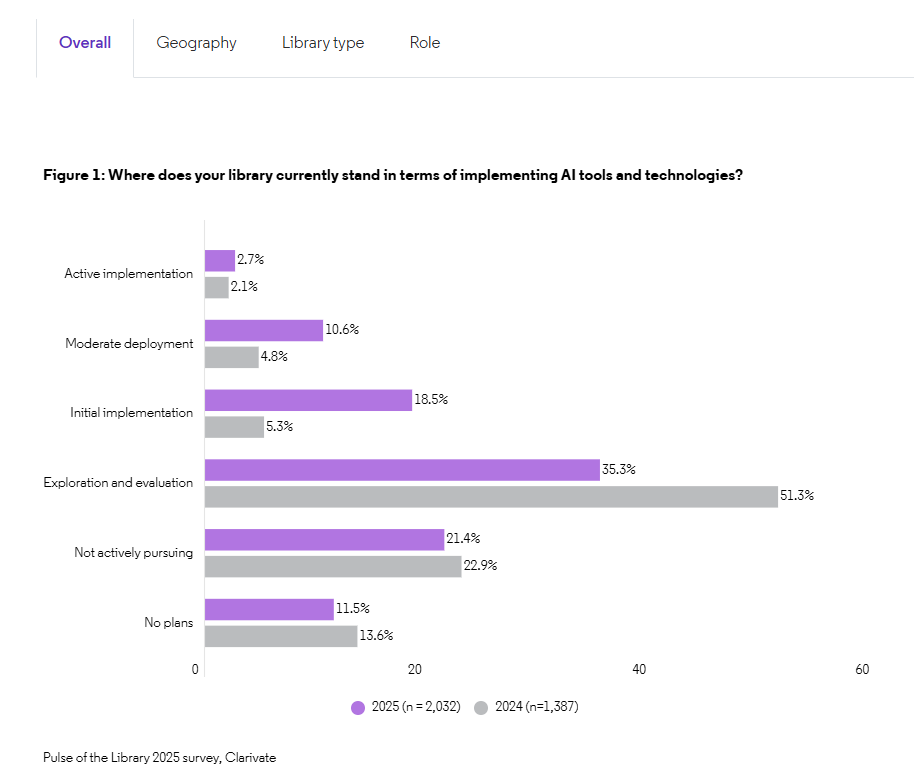
Figure 1: Where does your library currently stand in terms of implementing AI tools and technologies?
Regional differences are a bit striking. Asia and Europe have continued to advance AI adoption, with 37-40% of initial implementations or beyond, compared to 14-16% in 2024. In contrast, the U.S. lags in adoption and confidence, with the lowest optimism about AI’s potential benefits (7% optimistic, compared with 27-31% in Asia, Mainland China, and the Rest of World). These geographic disparities highlight how cultural attitudes, institutional support, and resource availability shape AI adoption rates.
AI-Powered Chatbots: The Front Line of Innovation
One of the most visible AI implementations in libraries involves the use of conversational chatbots. These virtual assistants are transforming how patrons interact with library services by providing instant, round-the-clock access to information. Chatbots can handle frequently asked questions about library hours, locations, policies, and resources, freeing human librarians to focus on complex research inquiries that  require professional expertise (11).
The technology behind these chatbots relies on natural language processing (NLP), which allows users to pose questions in natural language rather than conforming to rigid search structures (14). This conversational interface is particularly valuable for patrons who may be unfamiliar with library terminology or feel intimidated by traditional reference services. Academic institutions, such as San Jose State University, have developed custom AI chatbots for reference services. In contrast, King’s College developed “KingbotGPT” using retrieval augmented generation (RAG) technology to answer questions about library services (12).
These implementations demonstrate a hybrid approach where technology handles routine inquiries while librarians remain available for nuanced guidance. As one librarian from the Berkshire Athenaeum Public Library observed in the Pulse report, libraries must bridge the gap between helping people learn to use AI and helping others learn basic computer skills—illustrating the broad spectrum of digital literacy needs that modern libraries address (1).
Revolutionizing Cataloging and Metadata Creation
Perhaps the most transformative AI application in libraries involves cataloging and metadata generation—traditionally time-intensive work that requires significant expertise. The Library of Congress has been at the forefront of exploring AI’s potential in this domain through its “Exploring Computational Description” experiments. In experiments with approximately 23,000 ebooks, the Library of Congress tested five open-source machine learning models to predict required metadata, including titles, authors, subjects, genres, dates, and identifiers (14).
The results illustrate both the promise and limitations of AI. Transformer-based models have shown particular success in token classification tasks, such as predicting titles and authors. However, none reached the Library’s quality threshold of 95% accuracy except for identifying Library of Congress Control Numbers. Subject classification proved especially challenging, with the Annif model achieving only a 35% accuracy rate in classifying subjects from text (15).
These findings underscore an essential principle: AI will augment rather than replace human catalogers. The Library of Congress developed human-in-the-loop (HITL) workflows where machine learning suggests possible subject headings and author names, which catalogers then review and select. This collaborative approach leverages AI’s processing power while preserving the nuanced decision-making that defines professional cataloging.
Commercial library software vendors are also integrating AI into their platforms. Ex Libris has developed AI-powered metadata generation tools designed to help catalogers handle the growing volume of digital special collections. These tools can assist with tasks like identifying faces in photographs and generating descriptive metadata—capabilities that could significantly reduce the time required to make digital collections discoverable and accessible.
 Academic libraries are also exploring how large language models can assist with multilingual cataloging. By leveraging multilingual embeddings and Retrieval-Augmented Generation (RAG) pipelines, systems can generate recommendations for subject headings in multiple languages, including those in Chinese (16). This addresses critical challenges in staffing and linguistic expertise that many institutions face.
The Critical Role of AI Literacy
A key finding from the Pulse of the Library report is the strong connection between AI literacy and successful implementation. Fifty-six % of librarians recognize that AI will require significant upskilling or reskilling of their teams, with 52% stating that the ethical use of AI is their top priority for AI literacy. More importantly, libraries are more likely to be in the moderate or active implementation phases of AI when AI literacy is part of the formal training or onboarding program (28%), librarians have dedicated time/resources (23.3%), or have managers actively encouraging development (24.2%).
This data reveals that successful AI adoption requires institutional commitment beyond simply purchasing tools. Libraries that invest in training programs see greater confidence among staff and more productive implementation outcomes. As Oren Beit-Arie of Clarivate noted, “Libraries that invest in literacy report greater confidence and will be better positioned to leverage AI for a range of uses, including to increase efficiencies to leave more time for important strategic and creative tasks” (2).
Barriers to Adoption
Despite growing adoption, significant barriers remain. In 2024, lack of expertise was the top concern. In 2025, budget overtook skills as the most critical barrier. Budgets now represent the most significant concern for AI adoption (62%), up from 56% in 2024. For public libraries, privacy and security remain the top concern (65%), consistent with the results from 2024. These concerns reflect the reality that implementing AI requires not just technological infrastructure but also ongoing financial resources for training, maintenance, and software licenses.
Notably, collection librarians face unique challenges. They are least optimistic about the benefits from AI (35%  pessimistic) and show higher concern about the potential impact of AI on job displacement. This anxiety is understandable given that collection management tasks are among those most directly affected by automation technologies.
Looking Forward
The increasing implementation of AI in libraries represents more than technological innovation—it reflects a fundamental reimagining of how libraries fulfill their missions. Rather than replacing librarians, AI tools are enabling them to focus on work that requires distinctly human qualities, such as empathy, cultural sensitivity, ethical judgment, and the ability to understand complex community needs.
In 2025, respondents selected a greater number of objectives for using AI (selecting on average four objectives vs. 3 in 2024). The top objectives for using AI remain unchanged from 2024, with support for student learning and content discovery highest overall. This broadening vision suggests that as libraries gain experience with AI, they recognize its potential across a broader range of applications.
The path forward requires careful navigation. Libraries must strike a balance between innovation and ethical considerations, efficiency with quality, automation, and the human touch that defines excellent library service. As institutions that have always served as bridges between people and knowledge, libraries are uniquely positioned to help their communities navigate the AI era—both by modeling responsible AI use and by ensuring that these powerful tools enhance rather than replace human connection and expertise. The data from 2025 suggests that libraries are rising to meet this challenge, thoughtfully integrating AI while remaining true to their core values of accessibility, equity, and service.
Sources
- Clarivate. (2025). Pulse of the Library. https://clarivate.com/pulse-of-the-library/
- Clarivate. (2025). Clarivate Pulse of the Library Report Reveals Link Between AI Literacy, AI Implementation, and Confidence. https://clarivate.com/news/pulse-of-the-library-report-reveals-link-between-ai-literacy-ai-implementation-and-confidence/
- Clarivate. (2025). Pulse of the Library: Reflecting the voices of librarians worldwide. https://clarivate.com/academia-government/blog/pulse-of-the-library-reflecting-the-voices-of-librarians-worldwide/
- Stock Titan. (2025). Clarivate 2025 Library Pulse: 67% exploring AI, up from 63%. https://www.stocktitan.net/news/CLVT/clarivate-pulse-of-the-library-report-reveals-link-between-ai-yujme4goihe6.html
- PRNewswire. (2025). Clarivate Pulse of the Library Report Reveals Link Between AI Literacy, AI Implementation, and Confidence. https://www.prnewswire.com/news-releases/clarivate-pulse-of-the-library-report-reveals-link-between-ai-literacy-ai-implementation-and-confidence-302598196.html
- ChatGPTLibrarian. (2025). The Future of AI Chatbots in Libraries: Balancing Innovation with Human Expertise. https://www.chatgptlibrarian.com/2025/02/the-future-of-ai-chat-bots-in-libraries.html
- ACRL. (2025). Library-Led AI: Building a Library Chatbot as Service and Strategy. https://www.ala.org/sites/default/files/2025-03/Library-LedAI.pdf
- Christiensen, A. (2013). Chapter 1: Introducing Chatbots in Libraries. Library Technology Reports. https://journals.ala.org/ltr/article/view/4504/5281
- Chow, E. H. C., Deng, S., & Zhu, L. (2025). Exploring the Future of Library Cataloging with AI and Multilingual Embeddings. The Digital Orientalist. https://digitalorientalist.com/2025/05/09/exploring-the-future-of-library-cataloging-with-ai-and-multilingual-embeddings/
- Potter, A., & Saccucci, C. (2024). Could Artificial Intelligence Help Catalog Thousands of Digital Library Books? The Signal, Library of Congress. https://blogs.loc.gov/thesignal/2024/11/could-artificial-intelligence-help-catalog-thousands-of-digital-library-books-an-interview-with-abigail-potter-and-caroline-saccucci/
- Ex Libris Group. (2024). Artificial Intelligence: Metadata Generation for Digital Content. https://exlibrisgroup.com/blog/artificial-intelligence-blog-series-metadata-generation-for-digital-content/
- Ex Libris Group. (2025). Seizing Opportunities: Academic Libraries in the Academic AI Era. https://exlibrisgroup.com/blog/seizing-opportunities-academic-libraries-in-the-academic-ai-era/
- LibLime. (2025). How AI Will Transform Library Cataloging. https://liblime.com/2025/10/11/how-ai-will-transform-library-cataloging/
-
Exploring Computational Description | Experiments | Work | Library of Congress Labs | Library of Congress. (n.d.). The Library of Congress. https://labs.loc.gov/work/experiments/ECD/?loclr=blogsig
-
Vaasan yliopisto. (2022). Novel methods for earth fault passage indication in non-effectively grounded electricity distribution networks. https://www.cenl.org/wp-content/uploads/2025/02/2025-01-30_Intro_to_Annif.pdf
-
Chirkova, N., Rau, D., Déjean, H., Formal, T., Clinchant, S., & Nikoulina, V. (2024, July 1). Retrieval-augmented generation in multilingual settings. arXiv.org. https://arxiv.org/abs/2407.01463